
If you run an independent U.S. dealership, you must register with your state and collect sales tax on taxable retail vehicle sales and related charges. The state treats you as a trustee for every dollar you collect, not the owner of it. Miss that distinction and you’re personally exposed if the money doesn’t get remitted correctly.
Three things need your attention now:
- Confirm you hold a valid seller’s permit or certificate of authority. Louisiana’s Department of Revenue notes that selling without one can trigger penalties and personal liability for dealership leadership.
- Build a collection process that captures the right taxable base on every deal, not just the sticker price.
- Centralize your per-vehicle records now, before an auditor asks for them later.
New York goes further and puts a number on the risk: dealers who collect tax before their Certificate of Authority is issued can face penalties up to $10,000. That’s not a rounding error. It’s the cost of skipping a form.
Key Takeaways
Sales tax compliance for independent dealers comes down to correct registration, an accurate taxable base on every deal, and records organized well enough to survive an audit unannounced.
| Point | Details |
|---|---|
| Register before you collect | Confirm your seller’s permit or certificate of authority is active; New York penalties for collecting without one reach $10,000. |
| Know your taxable base | Vehicle price, retained doc fees, and delivery charges are typically taxable; itemized finance interest usually is not. |
| Rebates and discounts differ | Rebates generally don’t reduce taxable price; dealer discounts do, per California’s guidance. |
| Watch state-specific rules | Single-article caps, SPV, and IMF alternatives change the math in Tennessee, Texas, and South Carolina. |
| Anchor records per vehicle | Tools like Loturn tie taxable charges, recon costs, and exemption documents to one vehicle record for faster audits. |
Table of Contents
- What Is Car Dealer Sales Tax and Who Has to Collect It?
- Step-by-Step Compliance Checklist for This Week and This Quarter
- Which Sales and Fees Are Actually Taxable?
- How Does Sales Tax Differ From State to State?
- Filing, Remittance, and What Triggers an Audit
- Why Per-Car Accounting Cuts Sales-Tax Errors
- Get Sales Tax Compliance Built Into Your Deal Process
- Official State Resources Worth Bookmarking
- Sources
- FAQ
What Is Car Dealer Sales Tax and Who Has to Collect It?
Car dealer sales tax is the tax a dealership collects from a retail buyer at the point of sale and remits to the state, based on the taxable price of the vehicle and any taxable charges bundled into the deal. It’s distinct from use tax, which a private buyer might owe if they purchase out of state and bring the vehicle home, and from registration or title fees, which usually flow through the DMV rather than the state revenue department.
Every state that imposes this tax expects the same basic relationship: the dealer collects, the dealer holds the money in trust, and the dealer remits on schedule. You’re not paying the tax. You’re the collection point for it. That framing matters because it changes how auditors and courts treat shortfalls. A dealer who under-collects or spends trust funds on operating expenses isn’t just behind on a bill. They’ve mishandled money that legally belonged to the state the moment it hit the register.
Registration is the first gate. Nearly every state requires a seller’s permit or certificate of authority before you can legally collect tax at all, and the paperwork varies enough by state that guessing is a bad strategy. Loturn’s collection of dealer forms by state links directly to the official registration pages so you’re not hunting through a state website at 11 p.m. trying to find the right PDF.
Step-by-Step Compliance Checklist for This Week and This Quarter
Getting current doesn’t require an overhaul. It requires sequencing.
- Register or verify your permit. Pull up your state’s dealer license requirements and confirm your seller’s permit or certificate of authority is active and tied to your current business entity.
- Map your taxable base. Sit down with your finance manager and list every line item on a typical deal jacket. Flag which ones get taxed and which don’t.
- Set up your point-of-sale workflow so the taxable base calculates automatically instead of relying on someone doing math by hand at 6 p.m. on a Friday.
- Assign an owner for filing and remittance. One person, one calendar, one set of due dates. Ambiguity here is how deadlines get missed.
- Build your exemption-certificate folder before you need it, not after an auditor asks where it is.
Pro Tip: Keep a single dealer-level folder, physical or digital, for every exemption certificate and out-of-state removal affidavit you collect. Auditors don’t ask for these politely once, they ask for them by transaction number, and scrambling to reconstruct a file six months later is how clean deals turn into audit findings.
Which Sales and Fees Are Actually Taxable?
Retail sales to consumers are taxable. Wholesale sales to another licensed dealer generally aren’t, as long as you collect a valid resale certificate proving the buyer is also a dealer, not just someone claiming to be one. Tennessee’s automotive dealer manual draws this line clearly, and it also spells out that parts sales, service labor, and extended warranties sold at retail are taxable in their own right, separate from the vehicle transaction.
The harder part is figuring out what belongs in the taxable sales price on a given deal. Generally included:
- The negotiated vehicle price
- Document or processing fees, when the dealer keeps them rather than passing them straight through
- Delivery or installation charges
- Any service necessary to put the vehicle in sellable condition
Generally excluded, when handled correctly:
- Finance interest, but only when it’s separately and clearly itemized on the invoice
- Certain GAP waiver charges
- Reimbursement for title or registration fees that get remitted directly to the DMV rather than kept by the dealer
Rebates and discounts get treated differently, and dealers mix this up constantly. Manufacturer rebates typically do not reduce the taxable sales price, even though they reduce what the customer pays out of pocket. Dealer discounts, by contrast, do reduce it, since the discount lowers the actual negotiated price of the vehicle. California’s tax authority confirms this distinction explicitly for motor vehicle dealers.
Trade-ins reduce the taxable base by the net difference between the vehicle sold and the vehicle taken in trade, not by simply subtracting the trade allowance from the price.
Worked example: A dealer sells a used vehicle for $22,000. The buyer trades in a car valued at $6,000. A $400 documentation fee is retained by the dealer, and $150 in delivery prep is billed separately. Finance interest of $1,200 is itemized on its own line and excluded.
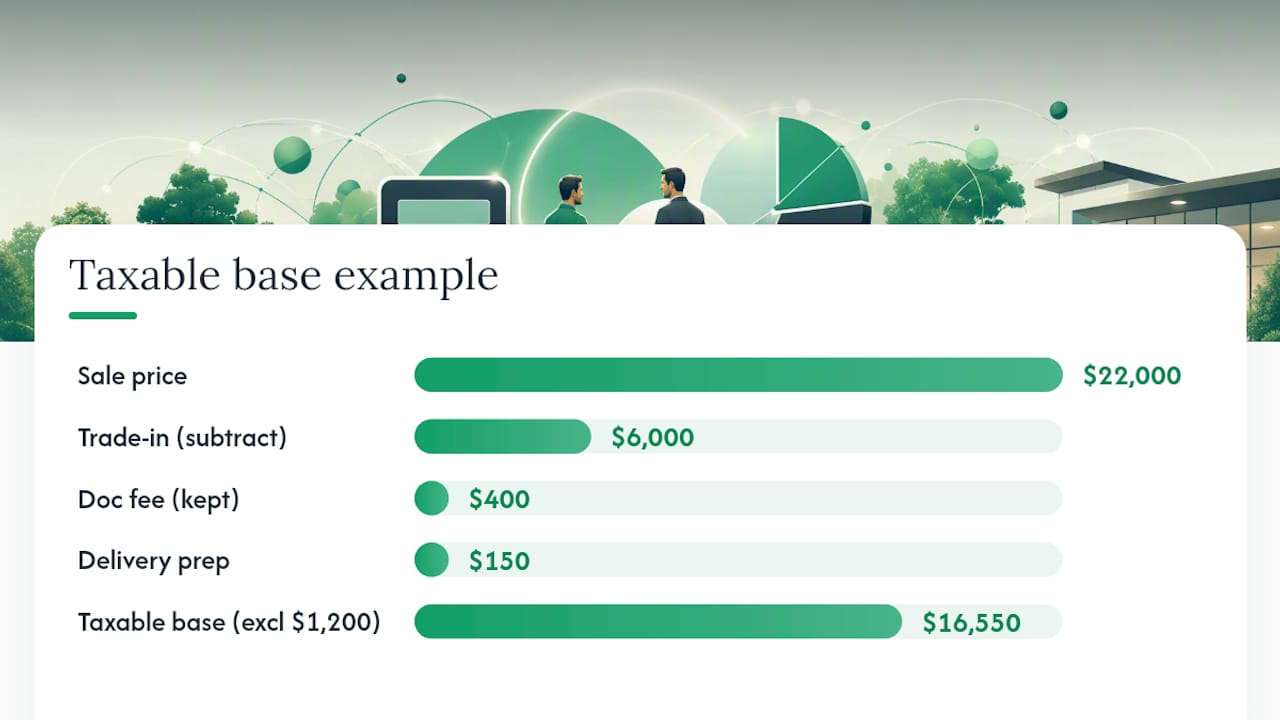
Taxable base = $22,000 (sale price) minus $6,000 (trade-in) plus $400 (doc fee) plus $150 (delivery) = $16,550. At a typical combined rate, the tax owed on the deal is proportional to the taxable base. The finance interest never enters the calculation.
How Does Sales Tax Differ From State to State?
The gap between the friendliest state and the toughest one is bigger than most dealers realize. A handful of states, including Alaska, Delaware, Montana, New Hampshire, and Oregon, charge no statewide sales tax on vehicle purchases at all, according to Car and Driver’s breakdown of state vehicle tax rules. Others lean on registration or privilege fees instead, and local rate caps can swing the effective tax on a single high-ticket vehicle substantially.
A few state-specific quirks come up constantly for dealers:
- Single-article limits. Tennessee caps the local-option tax rate applied to any single item above a certain price threshold, which changes the math on higher-priced vehicles. Tennessee’s dealer manual walks through the calculation directly.
- Standard Presumptive Value. Texas uses SPV to value private-party used vehicle sales when the stated sale price looks artificially low, protecting the tax base from underreported transactions, as detailed by the Texas Comptroller.
- Infrastructure Maintenance Fee. South Carolina applies an IMF instead of standard sales tax on certain vehicle transactions, with its own cap and calculation rules, per the South Carolina Department of Revenue’s dealer guide.
- Three-day removal rules. Some states, Tennessee among them, exempt sales to out-of-state buyers who remove the vehicle within a set window, provided the dealer collects the right affidavit.
Pro Tip: If you sell across state lines with any regularity, bookmark your buyer’s home-state DOR page alongside your own. Nexus rules mean you may owe that state’s tax, not yours, depending on where title work and delivery actually happen.
Filing, Remittance, and What Triggers an Audit
Filing frequency isn’t fixed. Most states set it as monthly, quarterly, or prepay-based depending on sales volume, and some states shift dealers between tiers without much warning. California has moved certain used-vehicle dealers from monthly to quarterly reporting, and in some cases tax gets collected through the DMV registration process rather than through a standalone return, according to the California Department of Tax and Fee Administration.
Know who actually remits the money on each transaction:
- In states where DMV collects tax at registration, the dealer’s job is accurate reporting on the paperwork the buyer submits.
- In states where the dealer files directly, remittance runs through the dealer’s own sales tax return, on the DOR’s schedule, not the DMV’s.
Late payment isn’t cheap. Texas tiers its penalties at 5% for payments one to 30 days late and 10% for anything later than that, based on figures from the Texas Comptroller. That’s real money on a $1,500 tax bill, and it compounds fast across a month of missed deals.
Repossession credits are one of the most commonly mishandled entries on a return. When a dealer repossesses a vehicle sold on credit, they can generally deduct the unpaid balance, minus any statutory threshold the state sets, from taxable sales. Tennessee’s manual walks through the documentation required to support that deduction.
When an auditor shows up, they’ll ask for:
- Sales journals showing every transaction
- Invoices that clearly show the taxable base, not just the total price
- Exemption and resale certificates tied to specific deals
- Bank deposit records that reconcile to reported sales tax
- DMV reporting confirmations where applicable
- Per-vehicle costing records
If any of those categories is thin, that’s where an audit finding starts.
Why Per-Car Accounting Cuts Sales-Tax Errors
Sales tax errors almost always trace back to the same root cause: the taxable base on a deal was never tied cleanly to a single vehicle record. Doc fees get buried in a spreadsheet tab. Recon costs live in a separate system from the sale price. Trade-in values get entered twice with two different numbers. By the time someone reconstructs the deal for a return, or worse, for an auditor, the numbers don’t match.
Per-car accounting fixes this by anchoring every taxable charge, discount, and trade-in adjustment to one vehicle record from acquisition to sale. A few controls make the biggest difference:
- Invoice templates that separate taxable line items from nontaxable ones by default, so nobody has to remember the rule mid-deal
- Required fields for buyer residency and trade-in value, so out-of-state and trade-in math can’t get skipped
- A workflow that attaches exemption certificates directly to the deal file the moment a wholesale or exempt sale happens
- Automatic tax calculation checks that flag a deal where the taxable base looks off before it gets filed
That’s exactly the gap Loturn was built to close for independent dealers. It tracks every cost tied to a vehicle, from purchase through recon and transport, on a dealer-specific chart of accounts, so the taxable base on a sale reflects reality instead of a guess. Bank-level encryption keeps the underlying financial data secure, which matters when that same data is what you’ll hand an auditor if the day ever comes.
The mistakes that actually cause trouble
The dealers who get burned aren’t usually the ones running elaborate tax schemes. They’re the ones who put off registration for a few months while they got the lot open, or who let exemption certificates pile up in a shoebox instead of a system. Fee allocation is the other quiet killer: doc fees, delivery charges, and trade-in math get handled a little differently by whoever’s at the desk that day, and six months later nobody can explain why two similar deals show different taxable bases. The fix isn’t more diligence. It’s fewer places for the number to drift, which is what a per-car ledger and a saved-form library, like the state-specific pages in Loturn’s Dealer Academy, are for.
Get Sales Tax Compliance Built Into Your Deal Process
Loturn is the alternative to juggling spreadsheets, a shoebox of exemption certificates, and a generic bookkeeping app that has no idea what a doc fee or a trade-in adjustment even is. It ties every taxable charge to the vehicle that generated it, so the number on your return is the same number sitting in your deal file, and your finance manager isn’t reconstructing math from memory at filing time.

Here’s what that looks like in practice:
- Faster audit responses, because sales journals and invoices are already organized by vehicle
- Fewer calculation errors, since taxable and nontaxable items are separated automatically at invoice creation
- Centralized compliance records, with exemption certificates and out-of-state affidavits attached directly to the deal instead of scattered across drives and desks
If you want to see how Loturn’s dealer accounting handles per-car tax tracking on your own inventory, start a free trial and import your existing data in one sitting.
Official State Resources Worth Bookmarking
State DOR manuals change more often than dealers expect, and the fastest way to stay current is bookmarking the primary sources instead of relying on secondhand summaries.
- Tennessee’s automotive dealer manual is the strongest reference for single-article local rate limits and repossession-credit documentation.
- California’s CDTFA motor vehicle dealers page covers seller’s permit requirements and the shift toward DMV-collected payment for some used dealers.
- The Texas Comptroller’s motor vehicle sales and use tax page is the go-to for SPV valuation rules and the 5%/10% late-payment penalty tiers.
- New York’s Publication 838 lays out dealer trustee obligations and Certificate of Authority requirements in plain terms.
- South Carolina’s auto and truck dealers guide explains the infrastructure maintenance fee alternative and dealer duties on leases.
Save your state’s DOR contact information alongside your DMV registration contact, since remittance responsibility can split between the two depending on how your state handles vehicle sales tax. For state-specific forms and direct links, Loturn’s dealer forms library covers registration paperwork across most states in one place.
This article is general information, not a substitute for advice from a qualified financial advisor. Consult a qualified financial professional about your own circumstances before acting on anything here.
Sources
- Louisiana Department of Revenue — Dealer registration FAQ
- Tennessee Automotive Dealership Manual (Auto-dealership guide)
- Publication 838: A Guide to Sales Tax for Automobile Dealers (New York State)
- California Department of Tax and Fee Administration — Motor vehicle dealers industry topics
- Texas Comptroller — Motor vehicle sales and use tax
FAQ
Do Independent Dealers Need a Separate Sales Tax Permit?
Yes. Nearly every state requires a seller’s permit or certificate of authority before you can legally collect sales tax, separate from your dealer license itself.
Are Trade-Ins Taxed on a Car Purchase?
No, not directly. Trade-ins reduce the taxable base by the net difference between the vehicle sold and the vehicle taken in trade, lowering the amount subject to tax.
Is a Manufacturer Rebate Taxable?
Generally yes. Most states, including California, do not let a manufacturer rebate reduce the taxable sales price, even though it lowers what the buyer pays out of pocket.
What Happens if a Dealer Files Sales Tax Late?
Penalties are tiered in most states.
How Can Dealers Reduce Sales Tax Calculation Errors?
Tying every taxable charge to a single vehicle record, rather than tracking fees in separate spreadsheets, is the most reliable fix. Platforms like Loturn build this per-car structure in automatically.