
Curtailment accounting captures the financial effect when a company significantly reduces the expected future service of plan participants or eliminates benefit accruals for a substantial group of employees. The net curtailment gain or loss has two components: (1) the accelerated recognition of unamortized prior service cost (PSC) and any remaining transition obligation, and (2) the change in the projected benefit obligation (PBO), which may be offset by unrecognized actuarial gains or losses sitting in accumulated other comprehensive income (AOCI). The single most important distinction between frameworks is timing. Under IFRS (IAS 19), both gains and losses are recognized when the curtailment event occurs. Under US GAAP (ASC 715), losses are recognized when probable and reasonably estimable, but gains are deferred until realized, typically at amendment adoption or when employee terminations actually occur. That asymmetry creates real reporting differences and is the source of most cross-framework errors, as PwC’s IFRS and US GAAP comparison and Deloitte’s employee benefits roadmap both flag as the most common preparer mistake.
Immediate action checklist:
- Remeasure the PBO immediately using current discount rates and pre-curtailment demographics.
- Check AOCI balances for unamortized PSC and actuarial gains/losses before computing the net effect.
- Decide recognition timing based on your reporting framework, not the other one.
Pro Tip: Document the event date, the board or management approval date, and the effective date separately. Under US GAAP, those three dates can each trigger different recognition points for gains versus losses.
Key Takeaways
Curtailment accounting requires two separate calculations, a clear timeline of event dates, and framework-specific recognition rules that must not be mixed across IFRS and US GAAP.
| Point | Details |
|---|---|
| Two-component measurement | Compute PSC acceleration and PBO change separately before netting against AOCI balances. |
| Recognition timing asymmetry | US GAAP defers gains until realized; IFRS recognizes both gains and losses at the event date. |
| Significance threshold | Reductions below ~5% are generally not significant; above 10% commonly are; 5–10% requires judgment. |
| Sequencing with settlements | Apply curtailment accounting before settlement accounting when both occur in the same period. |
| Loturn for reconciliations | Loturn’s dealer accounting platform centralizes double-entry entries and supports the reconciliation workflows that curtailment events generate. |
Table of Contents
- What qualifies as a curtailment under US GAAP and IFRS?
- How to measure the two components of a curtailment gain or loss
- How to calculate the change in PBO for a curtailment
- When to recognize curtailment gains and losses, and how to present them
- Worked numeric example with journal entries
- How to tell a curtailment from a plan amendment, settlement, or freeze
- Required disclosures and a practical reporting checklist
- Common mistakes and audit red flags in curtailment accounting
- An editorial perspective on applying curtailment guidance in practice
- Loturn keeps your accounting clean when events get complex
- Sources
- FAQ
What qualifies as a curtailment under US GAAP and IFRS?
Under ASC 715, a curtailment is an event that either significantly reduces the expected years of future service of present employees or eliminates the accrual of defined benefits for future service for a significant number of employees. PwC’s guidance on significant pension plan events identifies plant closings, partial shutdowns, and large-scale layoffs as the most common triggers. IAS 19 uses similar language but places heavier emphasis on the timing of recognition: the event itself is the trigger, not a probability assessment.
Common curtailment triggers:
- Plant or facility closures affecting a defined group of participants.
- Mass layoffs or workforce reductions tied to restructuring.
- Permanent pension freezes that stop future benefit accruals.
- Disposal of a business unit where the employees transfer out of the plan.
- Phased terminations across multiple periods as part of a multi-year restructuring.
The word “significant” requires judgment. The plan itself is the unit of account for this test, not individual business units.
Temporary layoffs deserve special attention. A temporary layoff becomes a curtailment only if it is no longer probable that the affected employees will be rehired. Duration, replacement hiring patterns, and management intent all factor into that conclusion. If rehiring remains probable, no curtailment exists yet, even if the layoff is extended.
Pro Tip: When assessing a phased reduction, apply the significance test to the total expected reduction across all phases, not just the first tranche. Segmenting phases to stay below the threshold is an audit red flag.
How to measure the two components of a curtailment gain or loss
The net curtailment gain or loss is the sum of two distinct elements, as detailed in PwC’s curtailment accounting guidance. Getting each element right before netting them is the only way to produce a defensible number.
Element 1: Accelerated prior service cost
Unamortized PSC (and any remaining transition obligation) is accelerated in proportion to the reduction in expected future service years. If the curtailment reduces expected future service years substantially, for example by more than half, a corresponding proportion of the remaining unamortized PSC balance is recognized immediately. The proportion is calculated at the plan level, using the same participant population the actuary used to amortize PSC originally.
Element 2: Change in the PBO
The PBO is remeasured as of the curtailment date using current discount rates and pre-curtailment plan terms. The difference between the pre-curtailment PBO and the post-curtailment PBO is the second element. A reduction in the PBO produces a gain; an increase produces a loss.
AOCI offset mechanics:
The two elements interact with AOCI balances in four scenarios:
- PBO decreases (gain) and AOCI holds a net actuarial loss: the gain is reduced by the actuarial loss balance before any net gain is recognized.
- PBO decreases (gain) and AOCI holds a net actuarial gain: the two gains combine, but the net amount is still subject to the US GAAP deferral rules for gains.
- PBO increases (loss) and AOCI holds a net actuarial gain: the actuarial gain offsets the loss; only the excess loss is recognized.
- PBO increases (loss) and AOCI holds a net actuarial loss: both losses stack, producing a larger recognized loss.
Net curtailment gain/loss formula:
Net curtailment effect = Accelerated PSC ± Change in PBO ± AOCI actuarial offset
Sequencing matters. Compute the PSC acceleration first, then the PBO change, then apply the AOCI offset. Never net the AOCI balance against PSC before computing the PBO delta.
How to calculate the change in PBO for a curtailment
Producing a defensible PBO delta requires a structured remeasurement process. The steps below apply under both frameworks, though the timing of when you use the result differs.
- Remeasure PBO and plan assets as of the curtailment date. Use the current discount rate as of that date, not the rate from the most recent annual measurement. This remeasurement also updates AOCI balances and becomes the baseline for the curtailment calculation.
- Apply pre-curtailment plan terms and demographics. The baseline PBO uses the plan terms and participant population before the curtailment event. Do not strip out the affected employees yet.
- Apply the curtailment event. Remove the future service assumptions for terminated employees or freeze accruals as applicable. Rerun the actuarial calculation.
- Calculate the delta. Post-curtailment PBO minus pre-curtailment PBO equals the change in PBO for the event.
Discount rate selection is the single largest driver of the PBO delta. A 50-basis-point move in the discount rate can shift the PBO materially for a large plan. Coordinate with your actuary on the exact rate as of the curtailment date, not a rate interpolated from year-end.
Staged terminations create multiple measurement dates. Each tranche requires its own remeasurement, its own PSC acceleration calculation, and its own AOCI offset analysis. Do not aggregate tranches across periods and apply a single blended rate.
Pro Tip: For IFRS reporters, check the asset ceiling under IAS 19 before finalizing the curtailment gain. A plan surplus can limit the recognizable gain, and the asset ceiling calculation must be updated as part of the remeasurement.
Two special cases warrant extra care. First, partial plan curtailments, where only a subset of the plan’s participants are affected, require the actuary to isolate the PBO attributable to that subset. Second, when a disposal of a business unit triggers the curtailment, the accounting follows the curtailment rules but the disclosure must also address the disposal context.
When to recognize curtailment gains and losses, and how to present them
Recognition timing is where IFRS and US GAAP diverge most sharply, and where cross-framework errors are most costly.
IFRS (IAS 19): Recognize both gains and losses when the curtailment event occurs. There is no probability gate for losses and no deferral for gains. The event date controls recognition.
US GAAP (ASC 715): Losses are recognized when the curtailment is probable and the effect is reasonably estimable. Gains are deferred until realized, which under ASC guidance means either the date a plan amendment is adopted or the date employee terminations actually occur. If PBGC or another oversight body must approve the action, do not recognize a gain until that approval is obtained.
When the curtailment follows a plan amendment, recognition typically occurs at the amendment adoption date, which may precede the amendment’s effective date. When it follows employee terminations, the timing depends on whether the result is a gain or a loss, applying the asymmetric rules above.
| Dimension | US GAAP (ASC 715) | IFRS (IAS 19) |
|---|---|---|
| Definition/trigger | Significant reduction in expected future service or elimination of accruals for a significant number of employees | Significant reduction in the number of employees covered or amendment that eliminates future benefit accruals |
| Measurement components | Accelerated PSC + change in PBO, offset by AOCI actuarial balances | Accelerated past service cost + change in obligation, recognized in P&L |
| Recognition timing (losses) | When probable and reasonably estimable | When the curtailment event occurs |
| Recognition timing (gains) | When realized (amendment adopted or terminations occur) | When the curtailment event occurs |
| Presentation | Pension expense line; AOCI reclassification to income | Recognized in profit or loss; no OCI deferral for curtailment effects |
| Required disclosures | Nature of event, amounts recognized, effect on future expense, actuarial assumptions | Description of event, amounts recognized, effect on future benefit cost |
For multi-period restructurings, interim reporting requires judgment. If a restructuring spans two fiscal quarters, each tranche is assessed separately for probability and estimability. Disclosures in interim filings should describe the overall plan and the amounts recognized to date.
Worked numeric example with journal entries
Facts:
- Pre-curtailment PBO: $10 million
- Post-curtailment PBO decreased significantly following the elimination of accruals for a noticeable portion of employees due to plant closure.
- There was a substantial unamortized PSC balance in AOCI, representing a cost.
- A significant unamortized actuarial loss resided in AOCI.
- The curtailment caused a sizeable reduction in expected future service years, affecting a notable fraction of employees.
Step 1: Remeasure PBO
Pre-curtailment PBO remeasured at current discount rate: $10 million. Post-curtailment PBO: $8.5 million. PBO delta: $1.5 million decrease, which is a preliminary gain.
Step 2: Compute accelerated PSC
A proportional share of the unamortized PSC balance was recognized immediately as a gain, based on the reduction in expected future service years.
Step 3: Apply AOCI offset
The preliminary PBO gain was offset by the unamortized net actuarial loss in AOCI, resulting in a net PBO-related gain after offset.
The net curtailment result reflected a gain after combining the net PBO-related gain and the PSC acceleration loss.
| Input / Calculation | Amount |
|---|---|
| Pre-curtailment PBO | $10 million |
| Post-curtailment PBO | $8.5 million |
| PBO decrease (preliminary gain) | $1.5 million |
| Unamortized net actuarial loss (AOCI offset) | ($400,000) |
| Net PBO-related gain | $1.1 million |
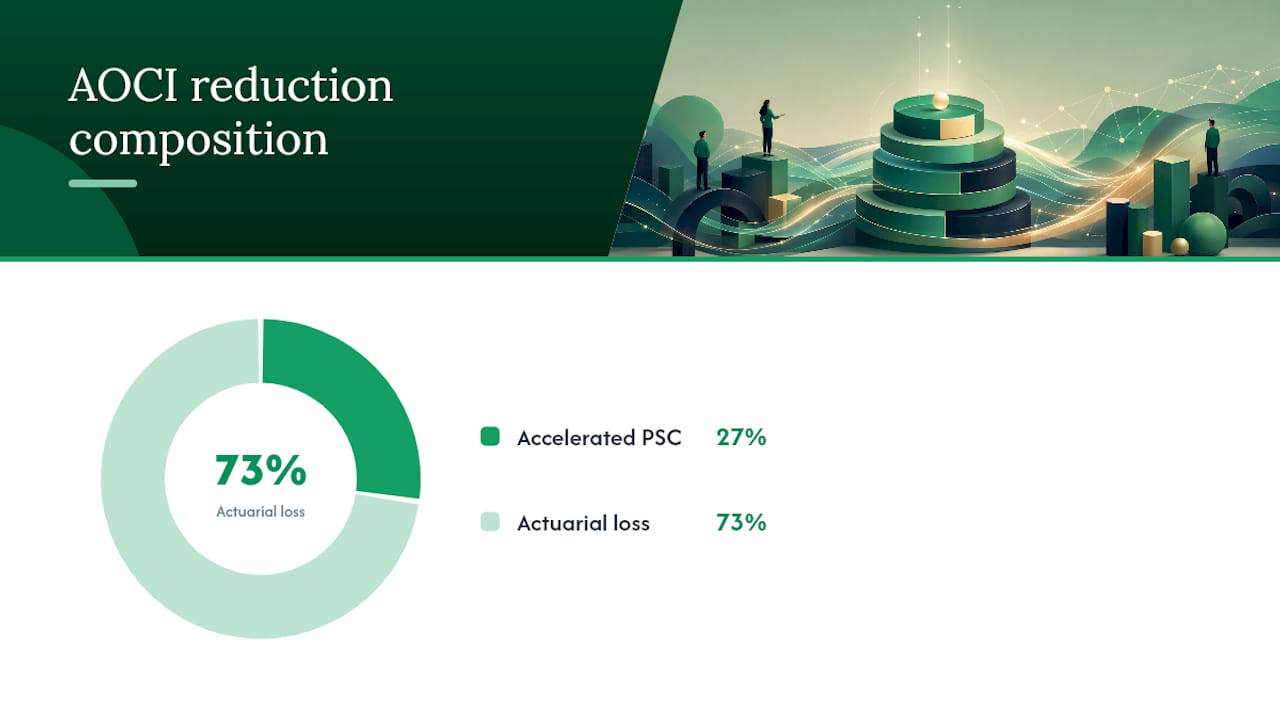
| Accelerated PSC (25% × $600,000) | ($150,000) |
| Net curtailment gain | $950,000 |
Journal entries:
(a) Recognize accelerated PSC (immediate, both frameworks):
Dr. Pension Expense                $150,000
   Cr. AOCI — Prior Service Cost              $150,000
(b) Recognize curtailment gain when realized (US GAAP) or at event date (IFRS):
Dr. Pension Liability (PBO)      $1.5 million
   Cr. AOCI — Net Actuarial Loss               $400,000
   Cr. Curtailment Gain (P&L)                  $1.1 million
© Net entry after both components:
The income statement reflects a net curtailment gain of $950,000 ($1.1 million gain less $150,000 PSC loss). AOCI is reduced by $550,000 in total ($150,000 PSC reclassification plus $400,000 actuarial loss reclassification).
If a settlement also occurs in the same period, apply curtailment accounting first, then settlement accounting. Disclosing the amounts attributable to each event separately is required, as Milliman’s settlement accounting guidance emphasizes.
How to tell a curtailment from a plan amendment, settlement, or freeze
These four events often occur together, and misclassifying one as another produces the wrong accounting treatment.
Curtailment: Reduces the expected future service of participants or eliminates accruals for a significant group. The focus is on future service.
Plan amendment: Changes the benefit formula, vesting schedule, or other plan terms without necessarily reducing future service. An amendment can increase or decrease the PBO but does not by itself constitute a curtailment unless it also eliminates future accruals for a significant group.
Settlement: Transfers the obligation to a third party, typically through an annuity purchase or lump-sum payment. A settlement eliminates risk; a curtailment reduces future service. Both can occur simultaneously.
Freeze: A freeze stops future benefit accruals but may still count future service toward vesting. A freeze is a curtailment only if it eliminates accruals for a significant number of employees. A freeze that preserves vesting credit but stops benefit accruals still meets the curtailment definition under ASC 715 if the accrual elimination is significant. Verify the vesting and accrual mechanics before applying curtailment rules.
Decision checklist for initial event assessment:
- Does the event reduce expected future service years or eliminate accruals for a significant group? If yes, apply curtailment rules.
- Does the event transfer the obligation to a third party? If yes, apply settlement rules (and check for concurrent curtailment).
- Does the event change the benefit formula without reducing future service? If yes, apply plan amendment rules only.
- Is the reduction temporary with probable rehiring? If yes, no curtailment yet.
- Does the plan freeze still count future service toward vesting? Confirm whether accrual elimination is significant before concluding curtailment.
Pro Tip: A plant closure combined with a lump-sum buyout offer triggers both curtailment and settlement accounting. Apply curtailment first, remeasure, then apply settlement to the remaining obligation. Reversing the order produces a materially different result.
Required disclosures and a practical reporting checklist
ASC 715 requires disclosure of the nature of the curtailment event, the amounts recognized in the period, the effect on future pension expense, and the actuarial assumptions used in the remeasurement. IAS 19 requires similar disclosures: a description of the event, amounts recognized in profit or loss, and the effect on future benefit cost. Both frameworks require disclosure of the measurement date used for the remeasurement.
Required disclosures under ASC 715:
- Description of the curtailment event and the affected employee population.
- Amounts recognized in the current period (PSC acceleration, PBO change, net gain/loss).
- Actuarial assumptions used in the remeasurement (discount rate, salary scale, mortality table).
- Effect of the curtailment on future net periodic pension cost.
- AOCI reclassification amounts and the remaining AOCI balance after the event.
Practical reporting checklist for U.S. preparers:
- Confirm the event meets the curtailment threshold (significance test, unit of account).
- Request an interim remeasurement from your actuary as of the curtailment date.
- Obtain the post-curtailment PBO and updated AOCI balances from the actuary.
- Compute the PSC acceleration using the percentage reduction in expected future service years.
- Apply the AOCI offset and compute the net curtailment gain or loss.
- Determine recognition timing: loss (probable and estimable) or gain (realized).
- Prepare and post journal entries; reconcile AOCI balances.
- Draft footnote disclosures covering all required elements.
- Coordinate with external auditors on the remeasurement assumptions and timing judgments.
- Document board or management approval dates separately from effective dates.
For staged terminations spanning multiple reporting periods, each period’s disclosure should describe the cumulative plan and the amounts recognized in that period. Do not wait until the final tranche to disclose the overall restructuring.
Common mistakes and audit red flags in curtailment accounting
Frequent mistakes:
- Treating a temporary layoff as a curtailment before rehiring becomes improbable. The probability assessment must be documented and updated each period.
- Applying US GAAP timing logic to IFRS reporting. Under IFRS, there is no deferral for gains; recognizing an IFRS curtailment gain only when “realized” is a framework error.
- Computing the PSC acceleration percentage using headcount rather than expected future service years. The correct denominator is service years, not employees.
- Ignoring AOCI offsets and recognizing the full PBO change as a gain or loss without netting actuarial balances.
- Using the year-end discount rate rather than the rate as of the curtailment date for the remeasurement.
- Failing to apply curtailment accounting first when both curtailment and settlement occur in the same period.
Audit red flags:
- Large, unexplained AOCI reclassifications with no supporting actuarial report.
- Curtailment gain recognized before PBGC or other required approvals are documented.
- Inconsistent sequencing when both curtailment and settlement apply in the same period.
- PSC acceleration percentage that does not reconcile to the actuary’s participant data.
- Disclosure that describes the event but omits the effect on future pension expense.
Pro Tip: Retain the actuary’s sign-off on the participant population and the expected future service year calculation used for the PSC acceleration. That document is the first thing auditors request, and gaps in it are the most common cause of extended audit procedures on curtailment entries, as LegalClarity’s curtailment guidance notes.
Internal review checklist before posting entries:
- PSC acceleration percentage ties to actuary’s population data.
- PBO delta uses current discount rate as of the curtailment date.
- AOCI offset applied in the correct sequence.
- Recognition timing documented and approved (gain vs. loss, US GAAP vs. IFRS).
- Journal entries balance; AOCI reconciliation prepared.
- Disclosure draft reviewed by legal, HR, and audit.
An editorial perspective on applying curtailment guidance in practice
The technical rules for curtailment accounting are not especially complex once you separate the two measurement components. What creates real problems in practice is governance: specifically, the gap between when management decides to act and when the accounting event is formally triggered.
The timing asymmetry under US GAAP is not a technicality. It is a genuine judgment call that requires documented evidence. A curtailment loss recognized before the event is probable and estimable is an error. A curtailment gain recognized before the amendment is adopted or the terminations occur is also an error, even if the economic outcome is already clear. Finance teams that treat the accounting date as interchangeable with the business decision date consistently produce restatements.
The practical fix is straightforward: build a parallel timeline that tracks the business decision, the board or management approval, the regulatory approval (if PBGC is involved), and the effective date. Each of those dates has a different accounting consequence, and the actuary needs to know which date to use for the remeasurement. Sending the actuary a single “event date” without that context is how remeasurements get done twice.
Separating measurement steps also matters more than most teams realize. The PSC acceleration and the PBO change are independent calculations that happen to be netted at the end. Teams that compute them together, or that let the actuary produce a single “curtailment adjustment” number without the components broken out, lose the ability to verify the AOCI offset logic and cannot produce the disclosure detail ASC 715 requires.
Loturn keeps your accounting clean when events get complex
Curtailment events generate a concentrated burst of accounting work: interim remeasurements, AOCI reclassifications, new journal entries, and disclosure drafts, all under time pressure from auditors and governance. That workload lands on top of your normal close process.

Loturn’s dealer accounting platform is built around native double-entry accounting with a purpose-built chart of accounts, so complex entries post cleanly without workarounds. Every transaction ties back to a specific cost center, which means AOCI reconciliations and remeasurement adjustments have a clear audit trail from day one. The platform’s real-time reporting lets you see the effect of a new entry immediately, rather than waiting for a manual spreadsheet to update. If you want to see how a purpose-built accounting system handles the reconciliation workflows that events like these create, explore Loturn and start a free trial.
This article is general information, not a substitute for advice from a qualified financial advisor. Consult a qualified financial professional about your own circumstances before acting on anything here.
Sources
The sources below are the primary references for curtailment accounting under US GAAP and IFRS. Use them in the order that fits your framework and question.
Primary technical guidance:
When to use each resource:
FAQ
What is curtailment accounting?
Curtailment accounting records the financial effect when a company significantly reduces the expected future service of defined benefit plan participants or eliminates benefit accruals for a substantial group of employees. The net effect combines accelerated recognition of unamortized prior service cost with the change in the projected benefit obligation.
How does curtailment accounting differ under IFRS and US GAAP?
Under IFRS (IAS 19), both gains and losses are recognized when the curtailment event occurs. Under US GAAP (ASC 715), losses are recognized when probable and reasonably estimable, but gains are deferred until realized, such as when a plan amendment is adopted or employee terminations occur.
Can a retired person lose their pension through a curtailment?
A curtailment affects future benefit accruals and expected future service, not benefits already earned or in payment. Retirees already receiving benefits are generally not affected, though a concurrent settlement (such as a lump-sum buyout offer) could affect the plan’s funded status.
How do you account for a defined contribution plan curtailment?
Defined contribution plans do not carry a projected benefit obligation or prior service cost, so the two-component curtailment calculation does not apply. The accounting impact is limited to any remaining employer contribution obligations for the affected period, which are expensed as incurred.