
Deal paperwork automation ties every title, Buyers Guide, lender stip, and registration form to the vehicle’s per-car ledger so you close, fund, and post accurate profit without guesswork. It replaces manual data entry and paper chasing with OCR-driven extraction, automated stip requests, and a document trail linked to a stock number. The immediate move: spend one hour auditing your last 20 deals, count how many hours went into paperwork versus selling, and pick the single worst offender to automate first.
TL;DR:
- Automation of lender stip collection and Buyers Guide generation can reduce funding times from about a week to 2-3 days, with outstanding stips dropping below 3%.
- Modern OCR tools handle title, registration, and handwritten stip extraction across all 50 states without customizable templates, saving time and reducing errors.
- Connecting documentation directly to each car’s stock number and integrating with existing systems prevents lost titles and delays, ensuring compliance and smooth funding.
- Implementing role-based access, audit logs, and retention schedules significantly lowers the risk of fines for non-compliance with FTC, state, and IRS requirements.
- Starting with a narrow pilot focused on high-impact workflows, then gradually scaling, helps avoid automation sprawl and maintains process stability.
Table of Contents
- What Deal Paperwork Automation Covers for a Used-Car Dealer
- Core Components Every Automated Deal Workflow Needs
- How to Roll Out Paperwork Automation Without Breaking Anything
- Compliance Risk and the Controls That Actually Reduce It
- Tracking ROI: The Numbers That Prove Automation Is Working
- Where Dealers Actually Go Wrong With Automation
- How Loturn Handles Deal Paperwork for Independent Dealers
- Sources
- FAQ
What Deal Paperwork Automation Covers for a Used-Car Dealer
Every deal generates a stack of forms that has nothing to do with selling and everything to do with compliance and cash flow. A single transaction can produce a large volume of pages once you add the buyer’s order, credit application, title work, registration, and F&I paperwork, and Lido’s breakdown of dealer document flow shows why that volume overwhelms manual filing at any real sales pace.
The documents that eat the most staff time include:
- Vehicle titles and lien releases
- FTC Buyers Guides for every retail-ready unit
- Bills of sale and buyer’s orders
- Lender stipulation packages (pay stubs, insurance binders, proof of residence)
- State registration and tax forms
- F&I product paperwork and disclosures
Automation matters here for one reason: each of those documents should map to a stock number, and that stock number should map to a single ledger entry for that car. When paperwork lives outside your inventory system, you lose titles, forget Buyers Guides, and watch lender funding stall for days while someone hunts down a missing pay stub. Tie the paper to the car, and the operational chaos mostly disappears.
Core Components Every Automated Deal Workflow Needs
Not all “automation” is equal. Before you commit to a vendor, check for four capabilities that actually move the needle.
OCR and AI extraction should read titles, registrations, and handwritten stips without you building a template for every state. Modern extraction tools handle format variation across all 50 states out of the box, which matters because state title formats vary wildly and manual template maintenance is a losing game for a small back office.
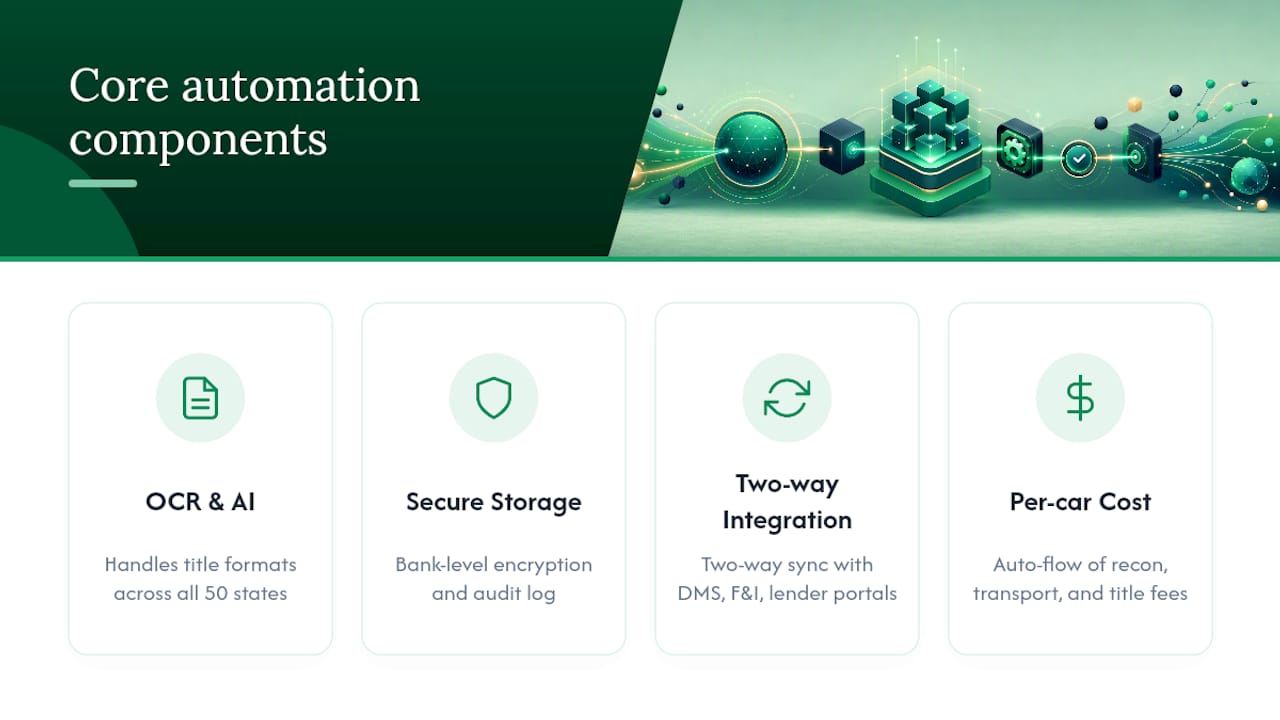
Secure storage with an audit trail comes next. You need bank-level encryption, role-based access, and a log of who touched a document and when, not just a shared drive folder.
Two-way integration with your DMS, F&I platform, and lender portals keeps deal status synced instead of retyped three times.
Per-car cost capture is the piece most systems skip. Recon invoices, transport bills, and title fees need to flow automatically into that vehicle’s cost of goods sold so your front-end gross is real the moment the deal funds.
Pro Tip: Ask any vendor demo to show you one thing: a title document uploaded on Monday appearing as a line item on that car’s ledger by Tuesday. If they can’t show it live, the integration is thinner than the pitch.
How to Roll Out Paperwork Automation Without Breaking Anything
Dealers who try to automate everything at once usually create new failure points instead of removing old ones. The fix is a narrow, sequential rollout.
- Audit your paperwork flow. Pull your last 20 to 30 deals and log hours spent per document type, how many stips came back incomplete, and average days to funding. This tells you where the real bleeding is.
- Pick one pilot workflow. Lender stip collection and Buyers Guide generation are the two highest-value starting points because they touch every deal and carry compliance exposure.
- Connect it to your stock numbers. Every document the pilot touches needs to write back to that car’s ledger entry, not sit in a separate folder.
- Run the pilot for 30 to 60 days. Track funding days, stip completion rate, and exceptions that needed manual override.
- Scale deliberately. Add lender portal integrations, state-specific form generation, and retention rules only after the pilot proves stable.
Dealers who automated stip requests with written, deadline-driven sequences saw average funding time drop from close to a week down to 2 to 3 days, with outstanding-stip rates falling under 3% in higher-volume stores. That’s a realistic target for a first pilot, not an outlier.
Compliance Risk and the Controls That Actually Reduce It
The forms most likely to generate fines or audit trouble aren’t exotic: the FTC Buyers Guide, state title and registration paperwork, and IRS Form 8300 cash-reporting aggregation rules. Missing or incorrect FTC Buyers Guides carry a maximum civil penalty of up to $51,744 per vehicle, a number that turns a “we’ll get to it” filing habit into a real balance-sheet risk once you multiply it across inventory.
Automation reduces that exposure through a few concrete controls:
- Auto-generating a Buyers Guide the moment a car goes retail-ready, with no manual trigger required
- Role-based access and immutable audit logs so every document edit is traceable
- Retention schedules that match state requirements, similar in spirit to how payroll record retention rules work for employment documents
- Exception routing: mismatched pay stubs or expired insurance binders kick back to the customer with a deadline, and an F&I manager signs off before funding proceeds
Tracking ROI: The Numbers That Prove Automation Is Working
Five metrics tell you whether the investment is paying off: days to funding, percentage of deals with outstanding stips, F&I hours per month spent chasing paperwork, title-processing time, and reconciliation error rate against your per-car ledger.
Run the math on your own volume: if you fund 20 deals a month and cut three and a half days off each one, that’s roughly 70 days of floorplan interest and carrying cost recovered monthly. Multiply your average per-day carrying cost by that number and you have your business case in one line, not a slide deck.
Where Dealers Actually Go Wrong With Automation
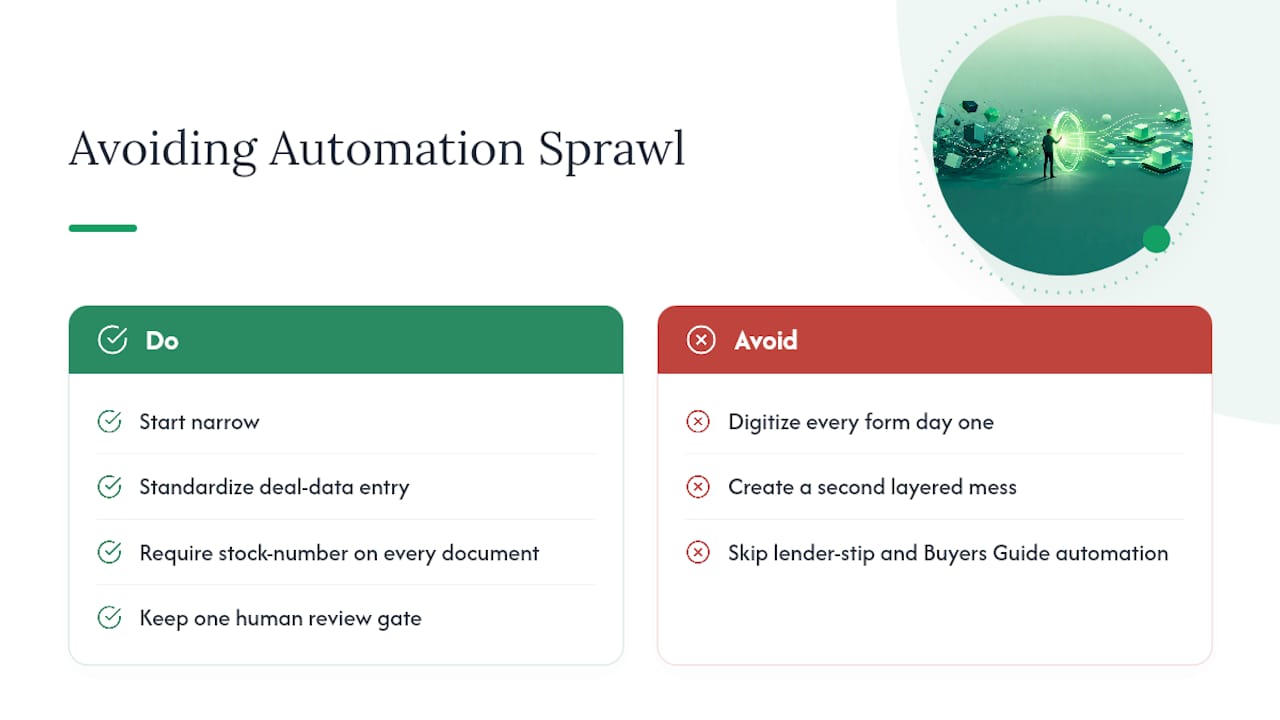
The biggest mistake I see is automation sprawl: dealers try to digitize every form on day one instead of picking the workflow that hurts most. That approach usually creates a second mess layered on top of the first one.
Start narrow. Standardize how deal data enters the system before you automate the paperwork it generates, and require stock-number linkage on every document without exception. Keep one human review gate for exceptions, mismatched income documents, expired insurance, anything unusual. The fastest wins come from lender stip collection and automatic Buyers Guide generation, because both touch every single deal and both carry real financial or compliance downside when handled manually.
— Eric Dosset
How Loturn Handles Deal Paperwork for Independent Dealers
Loturn was built specifically for the workflow described above: every title, bill of sale, and lender stip ties directly to that car’s stock number and flows into a real per-car ledger, not a generic chart of accounts borrowed from retail bookkeeping.
Where most accounting software treats a car sale like any other transaction, Loturn’s dealer accounting uses an automotive chart of accounts built around recon work-in-progress, transport costs, and title fees, so your front-end gross reflects reality the day the deal funds. Data security runs on bank-level encryption, and onboarding includes free data import so you’re not rebuilding your inventory from scratch. If you’re evaluating a switch from a legacy DMS, the Frazer alternative comparison walks through what independents gain by moving to a platform designed around per-car profit instead of dealer-wide averages. Start a trial and import your current inventory to see your true per-car numbers inside a day.
Sources
For state-specific compliance requirements, Loturn’s dealer forms by state collection links directly to official state resources. The FTC’s civil penalty schedule and dealership document management research informed the compliance and ROI sections above.
FAQ
What Documents Should a Dealer Automate First?
Lender stip collection and FTC Buyers Guide generation deliver the fastest returns because they touch every deal and carry direct financial or compliance risk.
How Much Can Automation Reduce Funding Time?
Dealers using automated stip requests with deadlines have seen average funding time drop to 2 to 3 days from roughly a week.
What’s the Real Cost of Skipping a Buyers Guide?
The FTC’s maximum civil penalty for a missing or non-compliant Buyers Guide runs up to $51,744 per vehicle, a risk that scales with your inventory count.
Does Deal Paperwork Automation Replace My DMS?
No. It should integrate with your existing DMS and lender portals while feeding cost and document data into a per-car ledger, which is how Loturn’s per-car profit tracking works.
How Long Should a Pilot Run Before Scaling?
Run a single workflow for 30 to 60 days, track funding days and stip completion rates, then expand to lender integrations and state forms once the pilot is stable.