
Dealership bookkeeping automation is the set of integrated systems and workflows that automatically capture, validate, post, and reconcile dealership transactions. Done right, it cuts month-end close time, gives you real per-car profit visibility, and eliminates the posting errors that come from manual data entry. If you’re starting from scratch, the recommended move is to evaluate a purpose-built dealer accounting platform with native DMS integration and AP automation, rather than trying to force generic small-business software into a dealership’s workflow.
The primary benefits show up fast once the right pieces are in place:
- Faster month-end close, often by days rather than hours
- Real per-car profitability instead of guesswork at sale time
- Fewer manual posting errors in accounts payable and bank reconciliation
- Audit-ready records that hold up when the FTC or your CPA comes calling
Pro Tip: Start automation wherever manual hours and reconciliation risk are highest. For most independent dealers, that’s accounts payable and bank feeds, not payroll or floorplan.
Key Takeaways
Dealership bookkeeping automation works best when AP, bank feeds, and per-car costing are automated first, backed by encryption and MFA required under the FTC Safeguards Rule.
| Point | Details |
|---|---|
| Start with AP and bank feeds | These carry the highest manual hours and reconciliation risk, so automate them before payroll or floorplan. |
| Per-car costing is the differentiator | Automated cost assignment shows true profit before the sale, not a guess after. |
| Security is mandatory, not optional | Encryption at rest and in transit plus MFA are required under the FTC Safeguards Rule for dealers. |
| Discipline upstream, automation downstream | Deal cutoffs and sales manager approvals keep automated books accurate. |
| Loturn fits dealer-specific needs | Purpose-built per-car profit tracking, DMS integration, and bank-level encryption address the gaps generic software leaves open. |
Table of Contents
- What Does Dealership Bookkeeping Automation Actually Do?
- Which Bookkeeping Processes Should You Automate First?
- What Tools and Integrations Actually Matter?
- How Long Does Implementation Take and What Does It Cost?
- Is Dealership Data Encryption Actually Required by Law?
- How Does a Purpose-Built Platform Solve These Problems?
- See Loturn’s Bookkeeping Automation in Action
- Where to Verify Compliance and Close Best Practices
- Sources
- FAQ
What Does Dealership Bookkeeping Automation Actually Do?
Automation in a dealership context handles a specific set of recurring workflows: accounts payable, accounts receivable, payroll accruals, floorplan interest tracking, per-car cost assignment, bank and credit-card feed posting, and general ledger mapping pulled straight from your DMS. That’s a different job than what general small-business accounting software does.
A retail shop reconciles a register tape. A dealership has to reconcile floorplan financing, manufacturer statistical reporting, and inventory that ages and depreciates while sitting on the lot. Every vehicle carries its own cost stack, purchase price, transport, reconditioning, and title work, and each of those needs to land in the right place before you know what you actually made on the sale.
Per-car costing means every dollar spent on a specific vehicle, from acquisition through recon, gets tagged to that unit rather than dumped into a general expense bucket. GL mapping from your DMS means deal data flows into the correct chart-of-accounts line automatically, instead of a controller re-keying numbers by hand.
Two regulatory frameworks matter here even before you pick software: the FTC Safeguards Rule, which treats dealers as financial institutions, and IRS reporting rules for cash transactions.
Which Bookkeeping Processes Should You Automate First?
Not every process deserves equal priority. Ranked by return on effort, here’s where independent dealers typically see the fastest payoff:
- Accounts payable — invoice capture and approval routing eliminates the slowest, most error-prone task in most back offices.
- Bank and credit card feeds with reconciliation — daily automated matching instead of a controller reconstructing transactions at month’s end.
- Per-car expense assignment and inventory costing — every recon bill, transport invoice, and title fee tagged to the correct unit as it happens.
- Month-end close workflows and schedule automation — recurring journal entries and reconciliation schedules that run themselves.
- Payroll accrual and commission verification — catching commission errors before they hit the books, not after.
- Floorplan interest and lender statement reconciliation — matching what the lender bills against what you’ve actually got on the lot.
Dealers who automate AP first typically report the sharpest drop in reconciliation days, since invoice extraction and validation tools let accounting staff shift from data entry to exception review.
Pro Tip: None of this works if your sales floor treats deal cutoffs as optional. Automation depends on upstream discipline, so require sales manager approval on every deal before it reaches accounting.
What Tools and Integrations Actually Matter?
The building blocks fall into five categories: purpose-built dealer accounting platforms, your DMS, AP automation with OCR, bank feed connections, and payroll or document management providers. The integrations between them matter more than any single tool.
Before signing with a vendor, run through this checklist:
- Does it offer two-way DMS integration, not just one-way data export?
- Can it map your chart of accounts automatically, including per-car cost hooks?
- Does the bank feed connection use encryption in transit and at rest?
- Does it match vendor statements automatically, flagging discrepancies rather than burying them?
- Does every transaction leave an audit trail a CPA can follow without asking you to explain it?
Pro Tip: Generic small-business accounting software wasn’t built for floorplan interest or per-car costing. If a platform can’t natively assign recon and transport costs to a specific VIN, you’ll end up rebuilding that logic in spreadsheets anyway, which is exactly what comparing dealer-specific accounting software against QuickBooks tends to reveal once dealers dig into the details.
How Long Does Implementation Take and What Does It Cost?
The rollout sequence is fairly consistent regardless of dealership size: evaluate your needs, select a vendor, map your chart of accounts and data model, connect the DMS and bank feeds, pilot AP automation on a subset of vendors, train staff, then cut over fully while monitoring closely for the first few cycles.
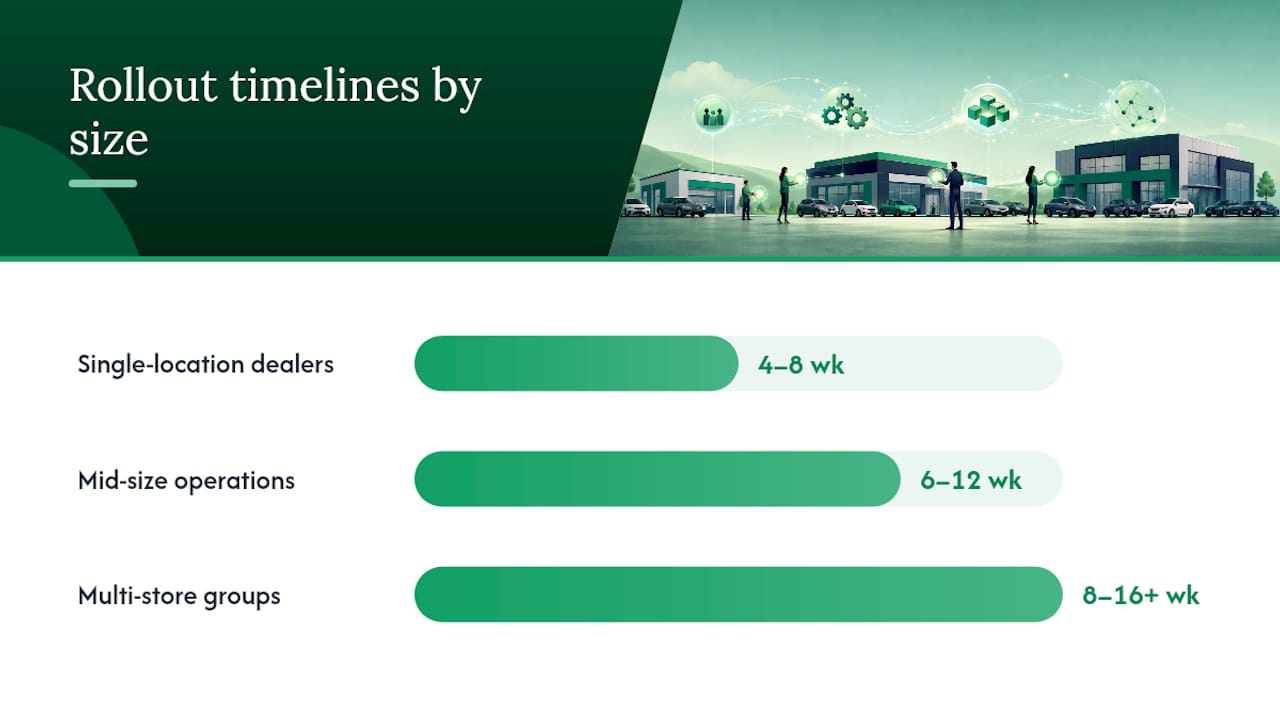
Timelines vary by scale:
- Single-location independent dealers: a 4 to 8 week pilot is typical.
- Mid-size operations with multiple departments: 6 to 12 weeks, mostly driven by chart-of-accounts complexity.
- Multi-store groups: 8 to 16+ weeks, since custom GL mapping across locations takes longer to validate.
Cost drivers to budget for:
- Data migration services and free import assistance where offered
- DMS connector licensing fees
- AP automation pricing, whether per-invoice or flat monthly
- Staff hours spent on mapping and training, which is real cost even when the software itself is affordable
- A third-party security audit if your current vendor management program is thin
Track three metrics during rollout: days to close, AP invoice touch time, and how accurate your per-car gross figures are compared to your old manual method.
Is Dealership Data Encryption Actually Required by Law?
Yes. Automobile dealers acting as financial institutions must implement encryption for customer data both at rest and in transit, along with multifactor authentication for anyone accessing systems holding nonpublic personal information. This isn’t optional guidance. It’s a Safeguards Rule requirement, and it applies whether you run five bookkeeping entries by hand or automate all of them.
Build your security checklist around these items:
- Encryption at rest and in transit across your DMS, CRM, and F&I platforms
- Multifactor authentication for every user touching sensitive systems
- Vendor contracts that explicitly require safeguards compliance, not just a handshake agreement
- A regular penetration testing schedule
- A current data inventory, plus validation that your DMS actually archives required schedules and GL summaries where you can retrieve them later
Cash transaction reporting matters here too. If automation changes how your dealership records cash receipts, review your Form 8300 recordkeeping obligations so nothing falls through the cracks when a payment crosses the $10,000 threshold.
How Does a Purpose-Built Platform Solve These Problems?
Generic accounting software forces you to bolt on spreadsheets for per-car costing and floorplan tracking. Purpose-built dealer platforms remove that manual layer entirely by connecting DMS data directly to double-entry accounting built around an automotive chart of accounts.
Loturn was built specifically for independent used-vehicle dealers around this problem. It tracks every dollar spent on a vehicle, from acquisition through transport and recon, against an automotive-specific chart of accounts, so you see true profit before the sale closes rather than guessing after. Key pieces include:
- Per-car profit tracking tied to real cost data, not estimates
- Native double-entry accounting with automotive-specific account structures
- DMS integration and AP automation to cut manual entry
- Bank-level encryption for data security
- Free data import to speed up setup
Dealers moving off spreadsheet-based tracking typically see faster month-end cycles and fewer reconciliation exceptions, though exact gains depend on how disciplined your current process already is.
Pro Tip: Before comparing platforms, pull your last three months of per-car cost data. If you can’t produce it in under ten minutes, that’s your automation priority. You can explore the dealer accounting feature set directly to see how the pieces fit together.
A Practical Perspective on Making the Switch
Expect a real learning curve, not a plug-and-play afternoon. Staff who’ve kept cost sheets in spreadsheets for years will resist the change, and that’s normal. The quick wins come fast, usually in bank reconciliation, but per-car costing accuracy takes a full sales cycle to trust.

Assign one qualified person to own the transition, enforce deal cutoffs without exception, and schedule weekly reconciliation reviews for the first two months. Automation reduces the workload. It does not replace the need for someone watching whether the numbers are actually right.
See Loturn’s Bookkeeping Automation in Action
If you’re ready to move past spreadsheet cost tracking and manual AP entry, Loturn gives independent dealers a single system built around per-car profit instead of retrofitted general ledger software.
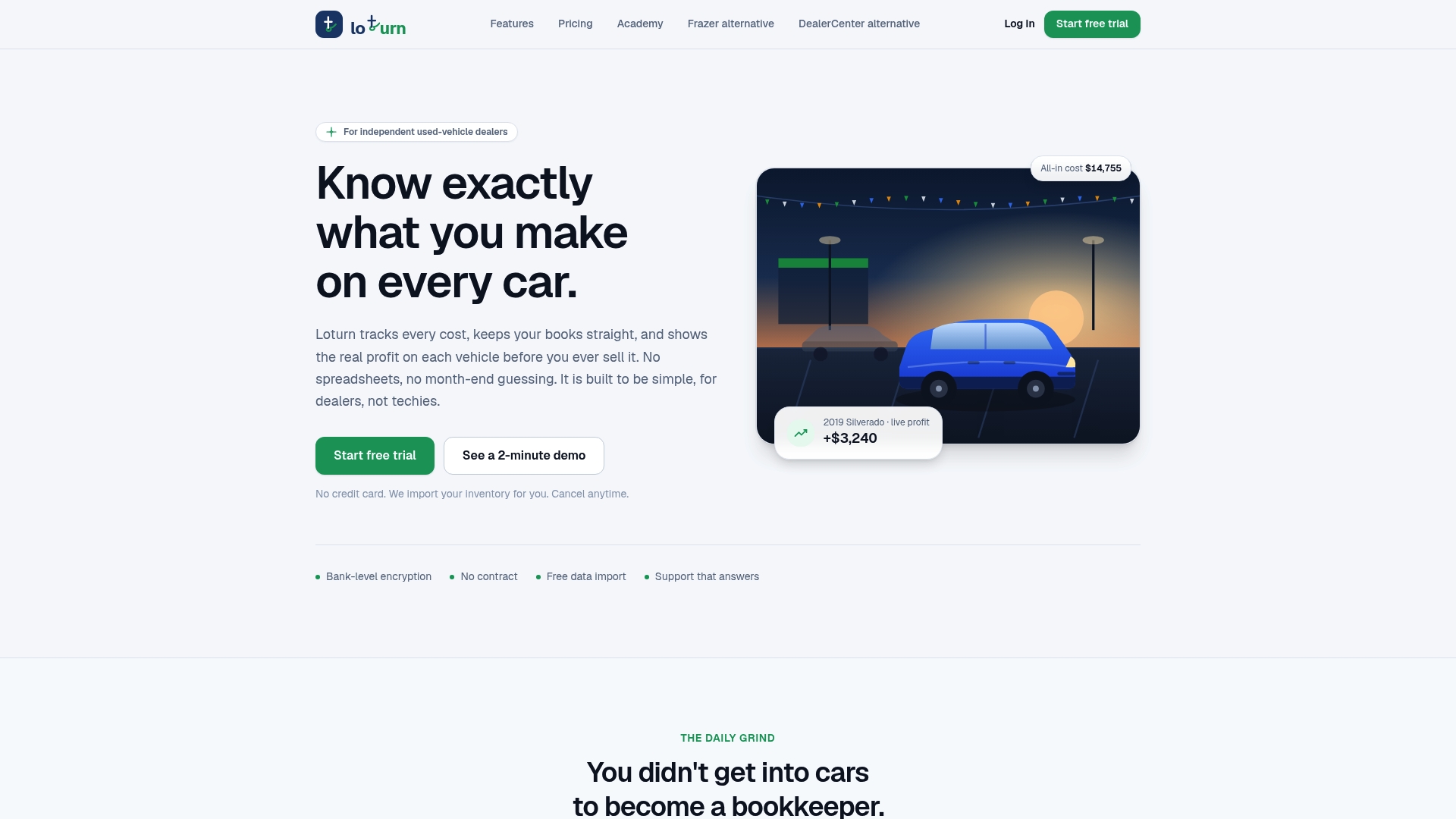
Before booking a demo, pull together one month of DMS exports along with last month’s payables and bank statement. Bringing that data lets Loturn’s team show you exactly how your own numbers would flow through the system, rather than a generic walkthrough. That’s the fastest way to see whether the fit is real. Start by exploring Loturn’s dealer accounting features and scheduling a demo when you’re ready to see your own data in motion.
Where to Verify Compliance and Close Best Practices
Cross-check your setup against primary sources rather than vendor marketing alone:
- The FTC’s Safeguards Rule FAQ for encryption and MFA requirements
- IRS Form 8300 guidance for cash reporting and recordkeeping
- The CNCDA-ComplyAuto compliance manual for vendor oversight standards
- Schneider Downs’ month-end close guidance for cutoff and reconciliation practices
This article is general information, not a substitute for advice from a qualified financial advisor. Consult a qualified financial professional about your own circumstances before acting on anything here.
Sources
- Automobile Dealers and the FTC’s Safeguards Rule Frequently Asked Questions | Federal Trade Commission
- Report of Cash Payments Over $10,000 Received in a Trade or Business (Form 8300) | IRS
- Top Month-End Closing Tips for Dealership Accounting Teams - Schneider Downs
- How AI in car dealerships is reshaping back-office operations
- CNCDA-ComplyAuto Safeguards Rule Compliance Manual
FAQ
What Accounting Software Do Dealerships Use?
Most dealerships use either a generic small-business platform paired with manual spreadsheets, or a purpose-built dealer accounting system like Loturn that connects directly to their DMS and handles per-car costing natively.
Is It Possible to Fully Automate Bookkeeping?
Most of it, yes. AP capture, bank reconciliation, and per-car cost assignment can run largely on their own, but month-end review and exception handling still need a person checking the numbers.
How Much Does a Car Salesman Make Off a $20,000 Car?
Commission structures vary widely by dealership and deal structure, so there’s no single figure that applies across the industry; it depends on gross profit, pack, and the individual pay plan.
Is AI Replacing Bookkeepers?
Not entirely. AI tools now extract and validate invoice data and match purchase orders automatically, shifting bookkeepers from data entry toward reviewing exceptions and approving what the system flags.