
Dealership double entry is double-entry bookkeeping applied to every vehicle and related transaction, so every debit matches a credit and you can track true profit per car instead of guessing at margins. It follows the same balancing rule accountants have used for centuries, but at a dealership it runs through inventory, floorplan payable, recon costs, and cost of goods sold on every single unit. Get it right and three things happen almost immediately:
- Per-car profit becomes visible, not a month-end estimate.
- The books self-check, because debits and credits must match, catching data errors before they compound.
- Reconciliation shrinks, since fewer corrections means faster closes and fewer surprises from your accountant.
What follows covers the actual journal entries for a purchase, a recon job, and a sale, why duplicate data entry keeps creeping back into dealership workflows, and a checklist to kill it for good.
Key Takeaways
Dealership double entry works because every transaction, purchase, recon, sale, and floorplan interest, posts as matched debits and credits tied to a specific vehicle, which is what makes true per-car profit possible.
| Point | Details |
|---|---|
| Double entry defines dealer accounts | Inventory, floorplan payable, COGS, and sales revenue must balance on every transaction. |
| Recon policy changes margin | Capitalizing recon into inventory versus expensing it can shift reported per-car profit noticeably. |
| Duplicate entry starts upstream | Disconnected DMS and bookkeeping systems, not staff error, cause most rekeying problems. |
| Pilot before full rollout | Test GL mapping on 10 to 15 deals and reconcile margins before switching entirely. |
| Loturn automates the posting | Native double-entry accounting with per-car costing removes the second manual bookkeeping step. |
Table of Contents
- What Is Dealership Double Entry in Practice?
- Sample Journal Entries for Common Dealership Transactions
- Why Duplicate Data Entry Keeps Happening at Dealerships
- A Checklist to Stop Duplicate Entry for Good
- How Loturn Handles Dealer Double Entry
- What Actually Matters Once the Books Balance
- Get Per-Car Profit Without the Double Bookkeeping
- Sources
- FAQ
What Is Dealership Double Entry in Practice?
Every dealership transaction touches at least two accounts, and the specific accounts matter more here than in most small businesses because a single vehicle can move through five or six of them before it sells. Modern dealership accounting systems post every transaction as equal debits and credits, which is what keeps your trial balance correct and lets you actually trust the number next to each VIN.
The accounts that matter most for a used-car dealer:
- Inventory (asset). Every vehicle on your lot sits here at cost until it sells.
- Floorplan payable (liability). What you owe your lender for financed inventory.
- Accounts payable. Vendors, transport companies, recon shops.
- Cost of goods sold. The full cost of a specific vehicle, recognized the moment it sells.
- Sales revenue. What the customer actually paid.
- Sales tax payable. Collected from the buyer, owed to the state.
- Recon expense. Either capitalized to inventory or expensed, depending on your policy.
- Accounts receivable / cash. What’s actually landing in the bank.
A vehicle’s life in the books runs in a predictable line: you acquire it and debit inventory, you capitalize reconditioning costs into that same inventory account, then at sale you flip the entire balance from an asset into cost of goods sold while booking the sale price as revenue. That flip is where most dealer books go sideways, because it requires someone (or some system) to know the exact accumulated cost of that specific car on the day it sells, not an average.
Pro Tip: If your trial balance is off by even a few dollars at month-end, check for a partial posting first, a recon invoice that hit expense instead of inventory, or a floorplan payoff that never cleared. Double-entry systems don’t hide errors; they just flag that something’s unbalanced without telling you which line caused it.
Sample Journal Entries for Common Dealership Transactions
Seeing the actual entries makes the theory concrete. Here’s how the four most common dealership events post to the ledger.
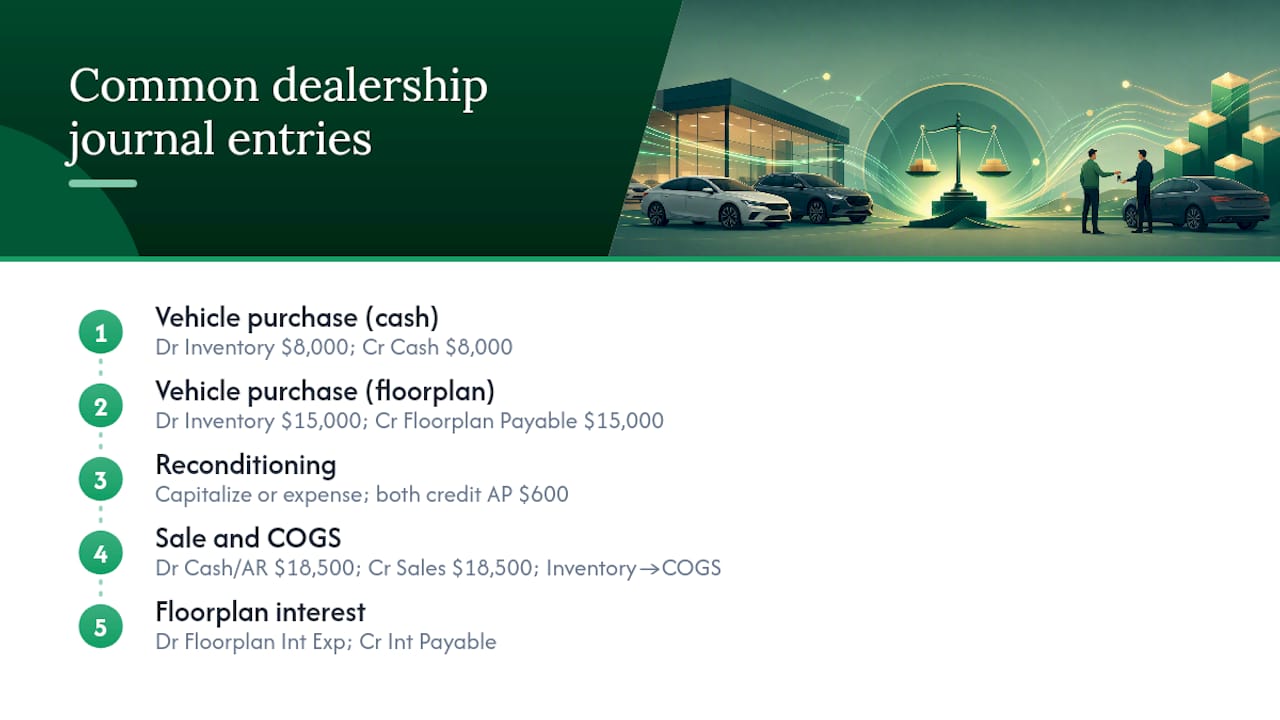
Vehicle purchase, cash. You buy a trade-in or auction unit for $8,000 cash. Debit Inventory $8,000, credit Cash $8,000. Simple, and it’s the entry most owners already understand intuitively.
Vehicle purchase, floorplan financed. You buy a $15,000 unit using your floorplan line. Debit Inventory $15,000, credit Floorplan Payable $15,000. No cash moves yet, but the liability is now sitting on your balance sheet against that specific VIN.
Reconditioning. A $600 recon invoice comes in. If your policy is to capitalize recon into the vehicle’s cost (the more accurate approach for per-car profit), debit Inventory $600, credit Accounts Payable $600. If your policy is to expense recon as incurred, debit Recon Expense $600 instead. Most dealers underestimate how much this single policy choice swings their reported per-car margin, sometimes by hundreds of dollars per unit once transport and detail costs stack up.

Sale and cost of goods sold. The car sells for $18,500. You debit Cash or Accounts Receivable $18,500 and credit Sales Revenue $18,500, then in the same entry debit Cost of Goods Sold and credit Inventory for the vehicle’s full accumulated cost, purchase price plus every capitalized recon and transport dollar.
Floorplan interest. Interest accrues monthly on the outstanding balance. Debit Floorplan Interest Expense, credit Floorplan Interest Payable, then reverse the payable when you actually pay it. Dealer accounting manuals specifically call for departmental sub-accounts here so recon, transport, and interest each carry their own audit trail instead of blending into one vague expense line.
Why Duplicate Data Entry Keeps Happening at Dealerships
Duplicate entry is almost never a training problem. It’s an architecture problem. A deal gets keyed once into the front-end system when the salesperson writes it up, then keyed again into a separate bookkeeping platform because the two systems don’t talk to each other. Add a third touch when someone exports a CSV to reconcile floorplan payoffs, and a fourth when the office manager manually adjusts QuickBooks because the numbers don’t match.
The usual culprits:
- A disconnected DMS and accounting system, where deal data lives in one place and books live in another.
- CSV export and import workflows, which introduce formatting errors and lag between when a deal closes and when it hits the ledger.
- Bookkeeping treated as a separate step rather than a byproduct of the sale, forcing someone to translate every deal after the fact.
- Multiple staff rekeying the same VIN, price, and cost data into different systems, each with its own chance for a typo.
The fix starts with picking one canonical record. The deal front-end, the system where the vehicle, the buyer, and the numbers actually get created, should be the single source of truth, with GL mapping rules that push standardized entries automatically at defined triggers: purchase recorded, recon invoice approved, sale closed. DMS platforms with built-in accounting modules exist specifically to collapse this into one workflow instead of two.
Pro Tip: Ask your current provider one question: does a closed deal post to your GL automatically, or does someone still have to open a second system and type it in? If the answer involves a CSV file, you have a duplicate-entry problem whether or not anyone’s noticed the time cost yet.
The payoff shows up fastest in month-end close. Dealers running integrated posting routinely cut reconciliation time because the numbers already match by the time anyone looks at them, and enterprise dealer platforms built around auto-accounting and drill-down journal entries exist largely to eliminate that manual step entirely.

A Checklist to Stop Duplicate Entry for Good
Fixing this doesn’t require ripping out your systems overnight. It requires a sequence.
- Audit your current touchpoints. Walk one deal from write-up to closed books and count how many times someone types the same VIN, price, or cost figure.
- Define your canonical deal record. Decide which system owns the vehicle data, then map every required field, VIN, lot cost, freight, recon, vendor, department code, to a specific GL account.
- Pilot with a small batch. Run 10 to 15 real deals through the new mapping and reconcile the resulting per-vehicle margins against your old manual numbers before trusting it at scale.
- Roll out and train. Once the pilot matches, turn on full sync, train staff on the new single-entry workflow, and run a monthly verification pass for the first quarter.
| Step | What to check |
|---|---|
| Audit | Count manual re-entry touchpoints per deal |
| Map | Confirm VIN, cost, and vendor fields tie to correct GL accounts |
| Pilot | Reconcile per-car margins against manual records before rollout |
How Loturn Handles Dealer Double Entry
Loturn was built around one idea: a dealer shouldn’t have to be an accountant to know what a specific car actually made. It runs native double-entry accounting on an automotive chart of accounts already structured around inventory, floorplan, and recon, rather than a generic small-business template someone has to customize.
What that means operationally:
- Every cost tied to a VIN, purchase price, transport, recon, detail, gets assigned to that specific car automatically instead of sitting in a general expense bucket.
- The deal record is the single source of truth, so a closed sale posts its own journal entry without a second manual step in a separate bookkeeping tool.
- Data protection runs on bank-level encryption, and switching over doesn’t mean starting from zero: free data import handles the migration.
A dealer who’s been estimating margins from memory or a spreadsheet for years typically finds the biggest surprise isn’t the software itself, it’s discovering which cars they thought were winners actually weren’t once every recon dollar got assigned correctly.
Pilots typically start with a handful of units imported from existing records, reconciled against known numbers, before a full switch.
What Actually Matters Once the Books Balance
Most advice on dealer accounting stops at “get a system that does double entry,” as if the mechanics were the hard part. They aren’t. Any competent bookkeeper can make debits equal credits. The actual failure point is almost always upstream of that: which account a recon invoice hits, whether floorplan interest gets captured against the right unit, whether someone’s still exporting a CSV on the side because two systems don’t trust each other.
The conventional wisdom treats double entry like a compliance checkbox, something you need for the accountant, not something that changes daily decisions. That’s backwards for a used-car dealer. The entire value of getting this right is that per-car profit stops being a month-end guess and becomes something you can check before you even decide what to price a trade-in at. A dealer who capitalizes recon inconsistently, or who lets floorplan interest sit in a vague expense line, will have technically balanced books that still tell them nothing useful about which cars actually make money.
Prioritize the canonical-record problem before the software problem. Fix where data gets typed first, then worry about which platform posts it.
— Eric Dosset
Get Per-Car Profit Without the Double Bookkeeping
Loturn replaces the two-system shuffle, deal front-end plus separate bookkeeping software, with one dealer-built platform that posts double-entry journal entries automatically as deals move from purchase to recon to sale. Instead of exporting CSVs or rekeying VINs into QuickBooks, you get native accounting built for used-vehicle dealers, with per-car cost tracking, floorplan interest handling, and an automotive chart of accounts already set up.
Setup uses free data import, so existing inventory and cost records move over without a manual rebuild, and bank-level encryption protects deal and customer data throughout. If you’re switching from a Frazer-style system or evaluating what a modern cloud DMS actually replaces, the fastest way to see the difference is to import a real batch of your own deals and compare the per-car margins against what you’ve been calculating by hand. Start a trial and bring your last month of deals with you.
Sources
- Car Dealership Accounting Software | Streamline Reporting
- General Motors Dealer Standard Accounting Manual and Handbook
- Automotive DMS Car Dealer Enterprise Accounting Software
FAQ
What is the double-entry for a vehicle sale?
A sale debits Cash or Accounts Receivable and credits Sales Revenue for the sale price, while a second matched entry debits Cost of Goods Sold and credits Inventory for that vehicle’s full accumulated cost.
How do you record a vehicle purchase in accounting?
A cash purchase debits Inventory and credits Cash for the purchase price; a floorplan-financed purchase debits Inventory and credits Floorplan Payable instead, since no cash changes hands yet.
What does double entry mean?
Double entry means every transaction posts as at least one debit and one credit of equal value, which keeps the accounting equation balanced and lets a dealership catch posting errors before they distort per-car profit.
What does “dealer” mean in accounting?
In dealership accounting, “dealer” refers to a business that holds vehicles as inventory for resale, which is why vehicles sit on the balance sheet as an asset until sale rather than being expensed immediately like a typical supply purchase.
How does software like Loturn reduce duplicate data entry?
Platforms like Loturn use the deal record as the single source of truth and post standardized journal entries automatically at each transaction trigger, removing the second manual entry step into a separate bookkeeping system.