
Treat earned dealer reserve as income and any unpaid or held-back portion as a receivable — never book the full calculated amount as cash at funding. That single rule is the foundation of accurate finance reserve accounting. Miss it, and every per-vehicle profit figure you see is wrong.
Three timing events drive every reserve entry:
- At signing/pre-funding: Debit Finance Reserve Receivable, Credit Finance Reserve Income for the earned amount the lender has not yet remitted.
- At funding (lender remittance): Debit Cash, Credit Finance Reserve Receivable for the cash actually received; the receivable clears as money arrives.
- On chargeback or true-up: Debit Finance Reserve Chargeback Expense, Credit Finance Reserve Receivable (or Cash if already paid) for the amount the lender claws back.
| Event | Debit | Credit | Amount |
|---|---|---|---|
| Pre-funding (reserve earned) | Finance Reserve Receivable | Finance Reserve Income | $850 |
| Lender remittance received | Cash | Finance Reserve Receivable | $850 |
| Chargeback (early payoff) | Finance Reserve Chargeback Expense | Cash / Receivable | $340 |
Key Takeaways
Accurate finance reserve accounting requires recording earned reserve as a receivable at signing, reconciling holdbacks to lender statements monthly, and tying every chargeback back to the originating vehicle’s profit line.
| Point | Details |
|---|---|
| Record reserve as a receivable | Debit Finance Reserve Receivable at funding; never book the full calculated amount as cash. |
| Track holdbacks by deal | Each lender holdback needs a deal number so chargebacks can be matched and reversed cleanly. |
| Reconcile monthly | Compare Finance Reserve Receivable aging to lender statements every month-end close. |
| Monitor KPIs weekly | Average reserve per lender and chargeback rate are the two metrics that move per-car profit fastest. |
| Use Loturn for automation | Loturn splits cash and holdbacks automatically, tracks chargebacks by vehicle, and shows true PVR in real time. |
Table of Contents
- Finance reserve accounting: the correct journal entries and timing
- How to calculate per-vehicle profit including finance reserve
- Operational controls and KPIs: daily, weekly, and monthly checks
- Regulatory constraints, fair-lending risk, and documentation
- Chart of accounts mapping and month-end close checklist
- Common problems and fast fixes
- How Loturn handles finance reserve for independent dealers
- Why most independent dealers undercount their own margin
- Loturn gives you true profit on every financed deal
- Sources
- FAQ
Finance reserve accounting: the correct journal entries and timing
Dealer reserve is the spread between the lender’s buy rate and the contract rate you sell to the customer. A 2-point markup on a $25,000, 60-month loan might produce $850 in reserve. The accounting question is when and how to record that $850.
Pre-funding: the receivable entry
When the deal is signed but the lender has not yet funded, record the earned reserve as a receivable, not cash. The income is economically earned at the point of sale, but the cash has not moved.
Debit: Finance Reserve Receivable $850 Credit: Finance Reserve Income $850
At funding: clearing the receivable
When the lender remits, match the cash to the open receivable. If the lender pays the full $850, the receivable closes completely. If the lender holds back a portion — say, $340 — only $510 clears.
Debit: Cash $510 Debit: Finance Reserve Receivable (holdback) $340 (remains open) Credit: Finance Reserve Receivable $850
Some lenders pay only part of reserve upfront to protect themselves against early payoffs, which is exactly why the holdback portion must stay on the balance sheet as a receivable rather than disappear into revenue.
Chargeback or short-pay
When a customer refinances or pays off early within the lender’s chargeback window, the lender claws back a prorated share. Reverse the income and close the receivable:

Debit: Finance Reserve Chargeback Expense $340 Credit: Finance Reserve Receivable (or Cash) $340
Chargeback windows commonly run 90–180 days after funding, which means open receivables from recent deals always carry some chargeback risk. Estimating a chargeback reserve at the time of sale and truing it up monthly against actual lender clawbacks keeps your P&L from lurching.
How to calculate per-vehicle profit including finance reserve
Finance reserve often represents a large share of F&I back-end gross, which means leaving it out of your per-vehicle retail (PVR) calculation understates true profit significantly. Here is a step-by-step worked example.
Deal terms:
- Financed amount: $22,000
- Term: 60 months
- Buy rate (lender): 5.9%
- Sell rate (contract): 7.9%
- Rate spread: 2.0 points
Step 1 — Convert spread to reserve dollars. Using a standard participation schedule, a 2-point markup on a $22,000, 60-month loan produces approximately $800 in reserve. Your lender’s participation table gives the exact figure; the DealerInt guide shows how markup caps commonly fall in the 2.0–2.5 point range and how each point maps to dollars across credit tiers.
Step 2 — Split cash vs. holdback. If your lender pays a majority upfront and holds a smaller portion: some cash arrives at funding, and a holdback portion remains in Finance Reserve Receivable.
Step 3 — Build the per-car profit line.
| Profit component | Amount |
|---|---|
| Front-end gross (sale price minus cost) | $850 |
| Reserve — cash received at funding | $510 |
| Reserve — holdback receivable | $320 |
| F&I product gross | $340 |
| Total PVR (true profit) | $800 |
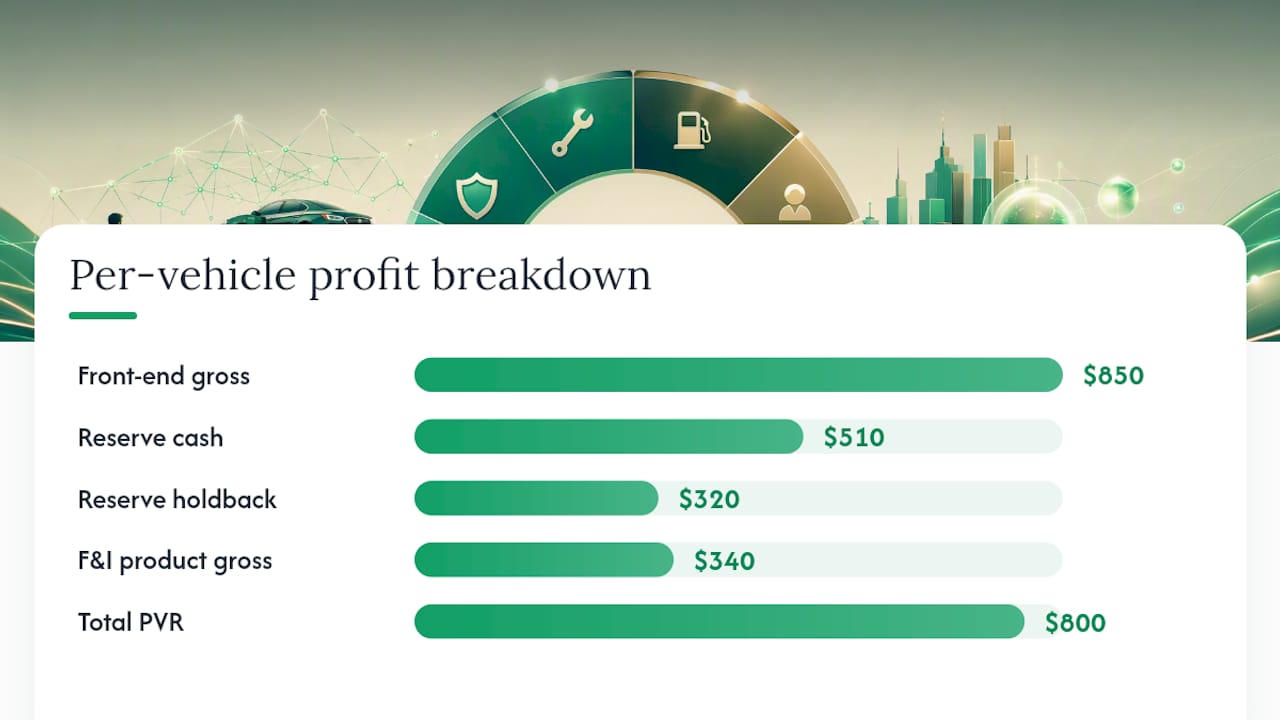
Step 4 — Adjust for chargeback. If the customer refinances at month 3 and the lender claws back $320, reduce the vehicle’s profit record by $320. The per-car profit line drops to $2,480 for that deal.
Pro Tip: Track the holdback receivable against each deal number, not just as a lump balance. When the chargeback hits, you can match it to the exact vehicle and keep PVR accurate without a manual hunt.
Operational controls and KPIs: daily, weekly, and monthly checks
Good controls prevent the two most expensive reserve problems: unrecorded holdbacks and surprise chargebacks that hit the P&L without warning. Lender selection and routing materially affect reserve per deal and chargeback exposure, so tracking by lender is not optional.
Daily:
- Match each funded deal to the lender remittance; post cash receipts against open Finance Reserve Receivable balances same day.
- Flag any deal funded more than 48 hours ago with no remittance posted.
Weekly:
- Run a lender-level summary: funded deals, expected reserve, cash received, and open holdback.
- Pull an early-payoff flag report for deals inside the chargeback window.
- Log exceptions in a manager exception file with deal number, lender, and reason.
Monthly:
- Reconcile Finance Reserve Receivable aging to each lender’s statement.
- True up the chargeback reserve estimate against actual clawbacks.
- Roll results into the month-end P&L and per-car profit reports.
KPI dashboard template:
Pro Tip: Average reserve per financed deal by lender moves per-car profit faster than any other single KPI. A lender with a slightly lower approval rate but $150 more reserve per deal is often more profitable than a high-approval lender with thin participation.
Regulatory constraints, fair-lending risk, and documentation
Markup flexibility creates compliance exposure. The CFPB and ECOA both flag inconsistent markup application as a disparate-impact risk — if protected-class customers consistently receive higher markups than similarly qualified buyers, the dealership faces fair-lending liability regardless of intent.
Practical documentation checklist:
- A written standard markup schedule by credit tier, signed off by management.
- Documented exceptions with a reason code, manager approval, and timestamp for every deal that deviates from the schedule.
- Multi-lender shopping records when you route deals to more than one lender.
- Lender-specific markup cap acknowledgments on file (many lenders cap at 2.0–2.5 points).
Some lenders are moving to flat-fee compensation models to sidestep fair-lending risk entirely. Flat fees simplify compliance but typically reduce average reserve income, so the tradeoff deserves a deliberate policy decision rather than a default.
Structured exception capture — tying each deviation to a reason code, manager, and timestamp — is the single most effective way to reduce audit exposure, as the DealerInt guidance on exception documentation makes clear.
Chart of accounts mapping and month-end close checklist
A clean chart of accounts is what lets reserve flow correctly from the deal worksheet to the general ledger and into per-car profit reports.
Suggested accounts:
- Finance Reserve Receivable (current asset) — holds earned but unpaid reserve and holdbacks.
- Finance Reserve Income (revenue) — recognized when earned at funding.
- Finance Reserve Chargeback Expense (expense or contra-income) — records lender clawbacks.
- Reserve Holdback Liability (current liability) — use only if your lender structure requires you to hold funds on their behalf.
Month-end close checklist:
- Reconcile Finance Reserve Receivable balance to each lender’s remittance statement.
- Roll forward any holdback reserves; document variances with deal-level explanations.
- Post performance-based true-ups and any disputed amounts separately.
- Confirm every funded deal from the month has a corresponding receivable or cash entry — no orphaned deals.
For DMS or accounting software integration, the deal worksheet must push at minimum: deal number, lender name, financed amount, reserve amount, cash received, and holdback amount to the general ledger. Without those fields, per-car profitability reporting breaks. A dealer-specific accounting ledger handles this mapping natively; generic small-business software typically does not.
Common problems and fast fixes
The five most common reserve accounting errors:
- Posting the full calculated reserve as cash at funding when the lender only paid a portion.
- Not recording holdbacks as receivables — they simply disappear until a chargeback arrives.
- Failing to match lender remittance statements to individual deal records.
- Booking chargebacks as miscellaneous expenses rather than reversals of reserve income.
- No documented exception log, making audit responses impossible.
Quick fixes:
- To correct a misposted reserve: reverse the original cash entry, post the correct cash amount, and create the Finance Reserve Receivable for the holdback. Date the correction to the original funding period if the month is still open.
- To build a short-term chargeback reserve: calculate your trailing 90-day chargeback rate, apply it to open receivables, and post a chargeback reserve accrual monthly.
- For lender disputes: pull the original deal worksheet, lender confirmation, and remittance statement together before contacting the lender — most disputes resolve faster with documentation in hand.
Pro Tip: A controller can triage systemic posting errors in under 30 minutes: pull the Finance Reserve Receivable aging report, compare the total to the sum of open holdbacks on funded deal worksheets, and check whether any receivable line has no corresponding deal number. Gaps there almost always mean a mispost.
How Loturn handles finance reserve for independent dealers
Most independent dealers run into the same wall: their accounting software has no concept of a Finance Reserve Receivable, no per-deal holdback field, and no way to tie a chargeback back to a specific vehicle’s profit line. That is the gap Loturn is built to close.
What the platform does for reserve accounting:
- Per-deal reserve fields capture financed amount, buy rate, sell rate, cash received, and holdback at the point of deal entry.
- Automatic posting splits cash and receivable correctly at funding — no manual journal entry required.
- Lender holdback schedules are configurable so the system knows how much each lender holds and when it releases.
- Chargeback workflows reverse income and update the vehicle’s per-car profit record automatically.
- KPI dashboards surface finance penetration, average reserve by lender, and chargeback rates without a spreadsheet.
30-day rollout checklist:
- Import open deals and existing Finance Reserve Receivable balances on day one.
- Train the F&I manager and bookkeeper on deal entry and lender remittance matching (typically one session).
- Run a parallel reconciliation for the first two weeks: compare Loturn’s receivable balance to your prior ledger.
- By day 30, verify that every funded deal has a matching receivable or cash entry and that per-car profit reports include reserve.
Pro Tip: Start the import with the current month’s funded deals only. Trying to backfill six months of history before going live is the most common reason rollouts stall.
The Loturn accounting features page shows the full deal-to-ledger workflow and how reserve integrates with inventory costing and per-car profit reporting.
Why most independent dealers undercount their own margin
Reserve accounting is one of those areas where the gap between what dealers think they earn and what they actually earn is widest — and the gap runs in both directions. Dealers who book reserve as immediate cash overstate profit on paper and then get blindsided by chargebacks. Dealers who never track holdbacks at all leave real money unrecorded and have no idea which lenders are actually performing.
The fix is not complicated. It is a receivable account, a reconciliation habit, and a KPI you check weekly. What makes it hard in practice is that most independent lots are running lean, and the bookkeeping falls to whoever has 20 minutes. That is exactly why the chart of accounts and the month-end checklist in this article need to be written down and handed to a specific person, not left as tribal knowledge.
Consistent posting and simple lender-level tracking usually recover margin that was always there — it was just invisible.
Loturn gives you true profit on every financed deal
Independent dealers who finance cars are leaving money on the table when reserve accounting is manual, inconsistent, or missing entirely. Loturn fixes that at the source: every financed deal flows through a purpose-built ledger that splits cash from holdbacks, tracks chargebacks by vehicle, and surfaces per-car profit in real time — no spreadsheet, no manual journal entries, no month-end scramble.
Setup is fast, and Loturn’s team migrates your existing data so you are not starting from zero. Bank-level encryption keeps your deal and lender data secure. The result is a clean Finance Reserve Receivable balance, accurate PVR on every car, and a KPI dashboard that tells you which lenders are actually making you money.
See how Loturn handles dealer accounting and start a free trial to see true per-car profit on your next funded deal.
Sources
Regulatory and compliance:
- Dealer Reserve & F&I Rate Markup Explained (2026 Guide) | DealerInt
- F&I Per Vehicle Retail (PVR) - Benchmarks, Calculation & Optimization Strategies - 2026 Guide
- Do Car Dealers Make Money on Financing? - NerdWallet
- Car Dealership Accounting: Revenue, Inventory, and Compliance - LegalClarity
Accounting and revenue recognition:
PVR and lender strategy:
Loturn implementation resources:
This article is general information, not a substitute for advice from a qualified financial advisor. Consult a qualified financial professional about your own circumstances before acting on anything here.
FAQ
What is finance reserve in dealer accounting?
Finance reserve is the income a dealer earns from the spread between the lender’s buy rate and the contract rate charged to the customer. It is recorded as a receivable until the lender remits payment.
When should I recognize finance reserve income?
Recognize reserve income when the deal funds and the lender confirms participation — not at contract signing. Holdback portions stay in Finance Reserve Receivable until the lender releases them.
How do chargebacks affect per-vehicle profit?
A chargeback reverses a portion of reserve income and reduces the vehicle’s PVR by the clawed-back amount. Booking it as a chargeback expense tied to the original deal keeps per-car profit accurate.
What accounts do I need for reserve accounting?
At minimum: Finance Reserve Receivable (current asset), Finance Reserve Income (revenue), and Finance Reserve Chargeback Expense (expense or contra-income). Add a Reserve Holdback Liability account if your lender structure requires it.
How does Loturn handle finance reserve automatically?
Loturn captures reserve fields at deal entry, splits cash and holdbacks at funding without a manual journal entry, and updates the vehicle’s per-car profit record when a chargeback is posted — all visible in the per-car profit dashboard.