
Real time gross tracking means seeing what you actually make on every vehicle the moment costs hit that unit, not weeks later when your accountant closes the books. It combines acquisition cost, transport, recon, floorplan interest, and every other dollar tied to a VIN into one live profit number. For an independent dealer, that changes everything about how fast you spot a loser.
The immediate payoff is simple: you stop guessing gross, you catch bleeding inventory before it becomes a write-off, and you make pricing or wholesale calls while there’s still margin to protect. A few things ground this claim:
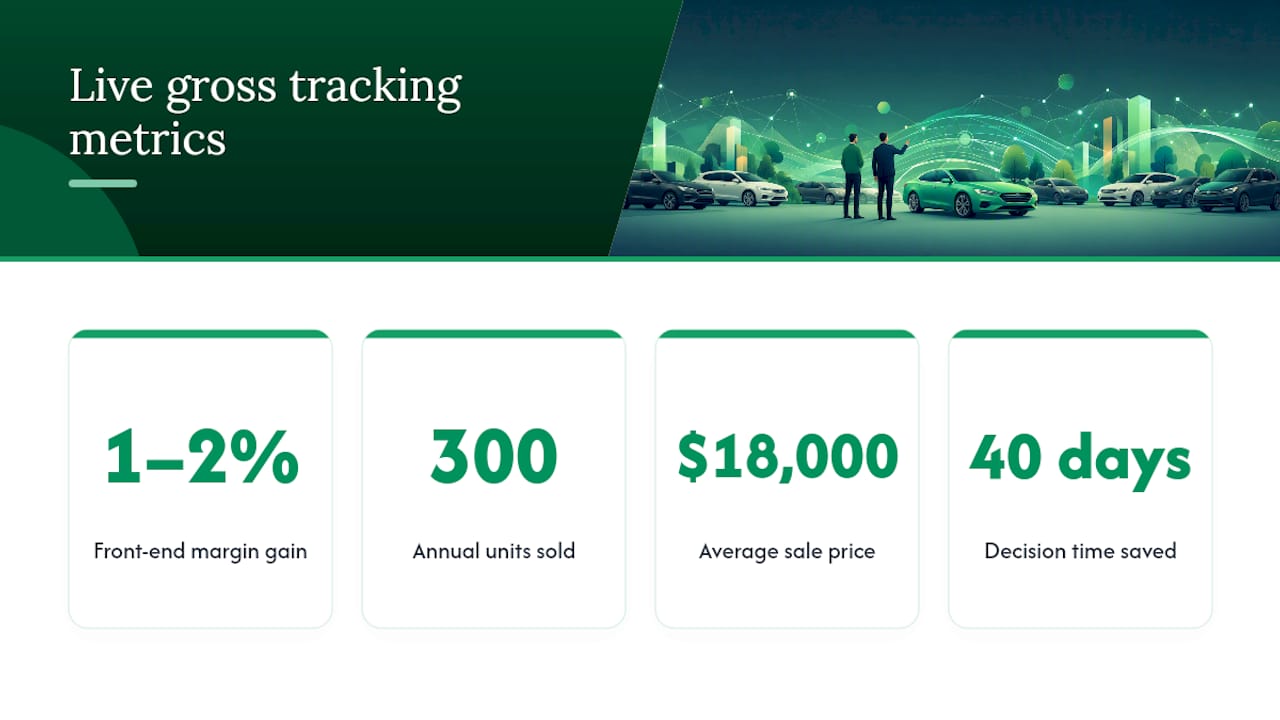
- Dealers running real-time inventory data have cut days on lot by 20 to 50 percent while lifting front-end margins 1 to 2 percent.
- Loturn builds per-car profit tracking specifically so recon, transport, and acquisition costs update automatically instead of sitting in a spreadsheet until month-end.
- Weekly, unit-by-unit reviews are what separate dealers who protect gross from those who discover the damage after the sale.
Key Takeaways
Real time gross tracking works because it forces cost visibility at the moment money moves, not weeks later when a loss is already locked in.
| Point | Details |
|---|---|
| Track five cost layers | Acquisition, transport, recon, floorplan interest, and depreciation all need to attach to the same VIN record. |
| Run a weekly review | A fixed weekly cadence, not ad-hoc checks, is what catches aging units before they lose money. |
| Capitalize recon and transport | These costs belong in inventory, not as period expenses, or your monthly gross numbers will mislead you. |
| Set aging thresholds | Flag units at 30, 60, and 90 days with automatic alerts and firm action rules for each stage. |
| Loturn automates the whole stack | Per-car profit, recon and acquisition tracking, and encrypted data import let dealers run this system without manual spreadsheets. |
Table of Contents
- Why Real-Time Gross Tracking Matters for Your Bottom Line
- What You Actually Have to Track on Every Vehicle
- How to Set Up Real-Time Gross Tracking at Your Dealership
- Running the Weekly Gross Review That Actually Works
- The Capability Checklist for Gross Tracking Tools
- Accounting Mistakes That Hide Your Real Margin
- What Live Gross Tracking Looks Like in Practice
- How Live Gross Data Changes Your Pricing and Negotiation
- Getting Your Team to Actually Use the Data
- Data Accuracy Challenges Worth Watching For
- Privacy and Compliance Considerations for Dealer Data
- Why the Weekly Habit Beats the Occasional Deep Dive
- Put Live Per-Car Gross Tracking on Autopilot
- Sources
- FAQ
Why Real-Time Gross Tracking Matters for Your Bottom Line
Every day a vehicle sits unsold, it costs you money you probably aren’t watching closely. Floorplan interest accrues daily. Insurance, storage, and detailing touch-ups add up. Used-vehicle days’ supply has hovered near 49 days industry-wide, with holding costs estimated around $30 to $35 per vehicle per day.
Run that math on a 40-unit lot and the carrying cost adds up fast, especially on units nobody’s watching closely.
Statistic to note: Dealers using real-time inventory tracking have seen front-end margins improve by 1 to 2 percent, a small-sounding number that compounds hard across a full month of sales.
That’s the ROI case in one sentence: a platform that costs a few hundred dollars a month pays for itself if it saves you from missing the moment a $2,000-gross car quietly becomes a $200-gross car. Haig Partners’ analysis of the used-vehicle market backs this up, recommending a rigid weekly cadence where every unit gets reviewed for aging and margin health, not just the ones that feel stale.
- Small gross erosion is invisible until you tally it across dozens of units.
- Weekly reviews catch problems while you still have pricing leverage.
- Waiting for month-end accounting means the damage is already locked in.
What You Actually Have to Track on Every Vehicle
True per-vehicle gross isn’t just sale price minus purchase price. It’s a stack of costs that has to update as they happen, not get reconciled after the fact. Here’s the full list, in the order they typically hit a unit:
- Acquisition cost and fees. This includes the purchase price plus auction buy fees, title work, and any lien payoff. This data comes straight from your VIN intake record the moment you acquire the vehicle.
- Transport. Every hauler invoice needs to attach to the specific VIN it moved, not sit in a general “shipping” expense bucket.
- Recon. Parts, labor, and outside vendor work all belong to the unit they touched. Dealers who integrate recon tracking with inventory management report time-to-line improvements of roughly 2.8 days, which shortens the entire cost-accrual window.
- Floorplan interest. This one accrues daily and is the cost most dealers underestimate. A $35,000 unit financed at 6.5% floorplan runs roughly $6.23 a day in interest alone.
- Depreciation and market movement. Vehicle values shift with the season and with what’s happening at auction. A live feed on comparable market pricing tells you when a unit’s value is sliding under you.
- Opportunity cost. The capital tied up in an aging unit isn’t buying your next fast-turning car. It’s the hardest cost to quantify, but the easiest to feel once you’re tracking the other five.
Each of these has a natural source system: your VIN intake form, vendor invoices, your floorplan lender’s interest feed, and market pricing data. The trick is getting them to update the same per-car record automatically instead of living in five different places.
How to Set Up Real-Time Gross Tracking at Your Dealership
Standing up a live per-car gross system doesn’t require a rebuild of your entire operation. It requires discipline in a specific order.
- Build one VIN master record. Every cost, every note, every document lives against a single record per vehicle, not scattered across a DMS, a spreadsheet, and a filing cabinet.
- Import your historical recon and transport invoices. Pull the last 60 to 90 days of vendor bills and attach them to the correct units retroactively so your baseline gross numbers are accurate from day one.
- Connect or calculate your floorplan interest. Either pull a live feed from your floorplan lender or set up a daily accrual formula so interest updates automatically instead of getting added once a month.
- Set your aging thresholds. Flag units at 30, 60, and 90 days on lot, with an alert that fires automatically rather than depending on someone remembering to check.
- Establish your weekly review cadence. Pick a day, put it on the calendar, and treat it like a sales meeting, not an optional check-in.
- Run a 30-day pilot on a small cohort. Choose 10 to 20 units, track them fully, and reconcile the system’s reported gross against your actual accounting close at the end of the period.
Pro Tip: Pick 10 recently sold units and reconstruct their full cost history by hand, from acquisition to sale. Compare that number to what your tracking system reported. Anything off by more than $250 means a data feed or process step needs fixing before you trust the system on live inventory.
Once that pilot checks out, expand the same process to your full lot. The setup work is front-loaded. After that, it’s just watching a dashboard instead of chasing invoices.
Running the Weekly Gross Review That Actually Works
A weekly meeting is where live data turns into decisions. The Haig Partners report on used-vehicle margins points to this exact rhythm: a recurring weekly review, every Monday for many stores, where every unit on the lot gets looked at, not just the obvious problem children.
Your general manager, inventory manager, and recon lead should all be in the room, because pricing decisions, recon delays, and acquisition strategy all touch the same numbers.
- Days on lot tells you which units are aging out of their profitable window.
- Gross per unit shows whether your pricing strategy is holding or slipping.
- Aging buckets (0 to 30, 31 to 60, 61 to 90, 90-plus days) group units by urgency.
- Turn rate measures how fast inventory dollars are cycling back into cash.
- Carrying cost per day puts a real number on what waiting is costing you.
Set firm action rules: a price cut at 30 days, a wholesale evaluation at 60, and a mandatory move at 90 regardless of how attached anyone is to the unit.
| Threshold | Action |
|---|---|
| 30 days | Reprice based on current market comps |
| 60 days | Evaluate for wholesale or auction exit |
| 90 days | Move the unit, no exceptions |
The Capability Checklist for Gross Tracking Tools
Whether you build a spreadsheet system or buy software, the tool needs to do six things well: assign costs per car automatically, track recon and transport against the right VIN, calculate floorplan interest daily, show a live dashboard instead of a static report, send alerts when units cross aging thresholds, and integrate with the systems you already use for intake and invoicing.
Loturn was built around that exact checklist. It tracks per-car profit as costs post, assigns acquisition and recon expenses directly to each VIN, and generates the charts and reports your weekly review needs without manual pulling. Data is protected with bank-level encryption, and new dealers get free help importing existing inventory and cost history so the switch doesn’t cost you a month of double entry.
The gap between “this car feels old” and “this car has cost us $187 in carrying costs over the last 30 days” is the difference between a hunch and a decision. Real-time alerts that show total investment plus daily carrying cost make that shift concrete instead of abstract.
Size your expected return before committing to anything. If your lot carries 40 units and even a third of them are sitting past 60 days, a 30-day pilot will tell you fast whether tighter tracking recovers real gross or just adds another dashboard nobody checks.
Accounting Mistakes That Hide Your Real Margin
The single biggest accounting error independent dealers make is expensing recon and transport instead of capitalizing them into inventory. When you expense those costs immediately, this month’s profit looks better than it is, and the real cost only surfaces when the unit finally sells, usually as a surprise. Freight and reconditioning costs belong on the balance sheet as inventory cost until the vehicle sells, not on the income statement as a period expense.
Beyond that core rule, a few process habits quietly inflate reported gross:
- Recon invoices that sit in a general expense account instead of attaching to a VIN.
- Transport bills split across multiple units without a clear allocation method.
- Floorplan interest calculated monthly instead of daily, which smooths over units that are actually bleeding cash.
The fix is a written capitalization policy, a monthly reconciliation sample of five to ten units, and an audit trail that shows exactly which invoice funded which line item on which car.
What Live Gross Tracking Looks Like in Practice
Consider a 25-unit independent lot that had been running gross numbers off a monthly spreadsheet update. Recon invoices arrived from three different vendors and got batched into a general ledger account instead of tagged to individual VINs. By the time the owner reviewed margins each month, several units had already sold at a loss nobody caught until the books closed.
Switching to a per-car system that updates as costs post changes that dynamic immediately. Once acquisition, transport, and recon costs attach to a VIN the moment they’re incurred, a dealer can see within days, not weeks, that a particular unit’s recon bill has already eaten most of its expected gross. That’s the moment to reprice or wholesale it, not after it’s sold for a loss.
The pattern shows up across the data too. Dealers using real-time inventory tracking report front-end margin gains of 1 to 2 percent, which on a store moving 300 units annually at an average sale price of $18,000 works out to meaningful additional gross dollars over a year, simply from catching problems earlier.
The lesson isn’t that live tracking magically improves every deal. It’s that visibility changes behavior. When a general manager can see a unit’s total carrying cost climbing in real time, the decision to cut price or move the car to auction happens on day 35 instead of day 75. That’s forty fewer days of floorplan interest and storage cost on a unit that was never going to get better with age.
How Live Gross Data Changes Your Pricing and Negotiation
Pricing a used vehicle without knowing your true cost is a guessing game dressed up as strategy. When you know a unit’s exact investment, including transport and recon, you can price to a target gross instead of pricing off gut feel or what the car “should” sell for.
This matters most at the negotiation table. A salesperson who knows the floor, built from actual cost data rather than an estimate from memory, can hold firmer on price without accidentally selling below cost. It also changes how you negotiate on trade-ins and wholesale purchases, because you’re comparing a potential acquisition’s expected total cost against units already sitting on your lot with known carrying costs.
Live tracking also sharpens your response to market shifts. If comparable units at auction are trending down, a dealer watching real-time market data can reprice proactively instead of discovering the gap after a unit has sat unsold for three weeks. That’s the difference between leading the market on a unit and chasing it downward after losing time.
For wholesale decisions, knowing exact carrying cost changes the math entirely. A unit that’s cost $340 in floorplan interest and storage over 45 days needs a different wholesale floor than one that’s cost $85 over 10 days, even if both have identical acquisition costs. Pricing without that distinction means either leaving money on the table or holding units too long hoping for a retail sale that isn’t coming.

Getting Your Team to Actually Use the Data
A dashboard nobody checks is worse than no dashboard at all, because it creates a false sense that someone’s watching. Training your team to act on live gross data starts with making the weekly review mandatory, not optional, and giving each role a specific number to own.
Your sales team needs to understand aging buckets and why a 60-day-old unit gets priced differently than a 15-day-old one. Your recon lead needs visibility into how delays on their end directly inflate carrying cost, tying their workflow to a number instead of an abstract deadline. Your general manager needs the full per-unit gross picture to make the final call on repricing, wholesale, or holding.
Keep the training practical. Walk through three or four real units from your own lot in the first session, showing exactly how acquisition, transport, recon, and floorplan interest add up to the number on the screen. Abstract training on “why data matters” doesn’t stick. Watching a real car’s cost climb $6 a day in floorplan interest does.
Revisit the numbers together every week, not just when something goes wrong. Teams that only look at gross tracking data during a crisis treat it as a blame tool instead of a planning tool, and that kills adoption fast.
Data Accuracy Challenges Worth Watching For
Real-time systems are only as good as the data feeding them, and a few failure points show up repeatedly at independent stores. Manual data entry is the biggest one: if recon invoices get typed in days after the work is done, your “real-time” number is really a lagging indicator wearing a live badge.
Integration gaps cause similar problems. If your floorplan lender’s interest feed doesn’t connect directly to your tracking system, someone has to manually update those figures, and manual steps are where accuracy erodes over time. The same goes for transport invoices split across multiple vendors or paid in batches that don’t map cleanly to individual VINs.
Duplicate or orphaned records are another quiet source of bad data, especially when a dealership runs parts of its operation through a DMS and other parts through spreadsheets that were never fully retired. A vehicle that exists in two systems with two different cost histories will give you two different gross numbers, and neither one is trustworthy until you reconcile them.
The fix isn’t complicated, just disciplined: reconcile a sample of units against your accounting close every month, treat any variance over a set dollar threshold as a signal to investigate, and resist the temptation to skip that check once the system “seems to be working.” Data accuracy isn’t a one-time setup task. It’s an ongoing habit.
Privacy and Compliance Considerations for Dealer Data
Connecting your tracking system to your DMS, floorplan lender, and invoicing tools means customer and financial data is moving between platforms, and that carries responsibility. Vehicle sales data often includes sensitive financial information tied to your dealership’s banking relationships and, depending on your CRM integration, customer personal information as well.
Look for encryption standards when evaluating any platform that touches this data. Bank-level encryption, the kind Loturn applies to its data storage, protects financial records both in transit and at rest, which matters given how much of this information would be damaging if exposed.
Beyond encryption, ask any vendor how data import and export work, who has access internally, and whether the platform supports your state’s recordkeeping requirements for dealer transactions. Data portability matters too: you should be able to export your own cost history and inventory records without a fight if you ever change systems. A platform that makes your own data hard to retrieve is a red flag regardless of how good its dashboards look.
Why the Weekly Habit Beats the Occasional Deep Dive
Eric Dosset has spent years studying how independent dealers manage financial operations, and the pattern is consistent: dealers who win on gross aren’t smarter about pricing, they’re more disciplined about looking at the numbers.
Ad-hoc inspections catch problems after they’ve already cost money. A weekly cadence catches them while there’s still room to act. If you’re not tracking live gross today, pick 10 to 20 units, run them for 30 days, and see what the data actually tells you. Most dealers are surprised by which units were quietly losing money.
— Eric Dosset
Put Live Per-Car Gross Tracking on Autopilot
Everything covered here, per-car costing, recon and transport assignment, floorplan interest, aging alerts, is exactly what Loturn was built to handle without you touching a spreadsheet.
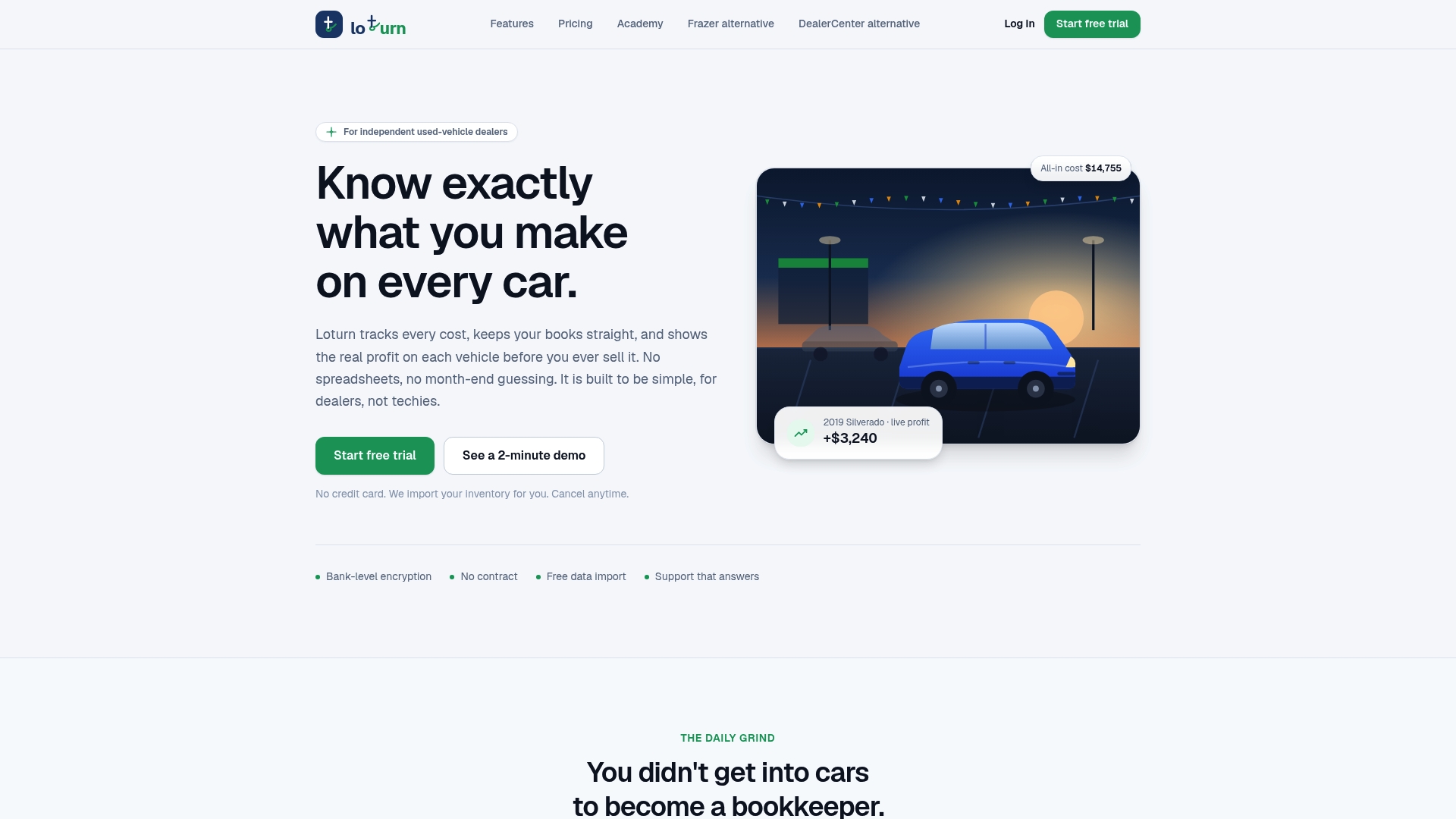
Loturn tracks per-car profit automatically as acquisition, transport, and recon costs post to each VIN, so the number on your screen matches what your books will show at close, not an estimate you’ll correct later. Charts and reports are built for the weekly review this article walks through, aging buckets and gross per unit included. Data sits behind bank-level encryption, and switching over doesn’t mean re-entering your current inventory by hand: Loturn’s team helps with free data import so you’re running live numbers within days, not weeks.
If you’re ready to see your real gross on every car without waiting for month-end, start with Loturn’s dealer accounting page and set up a 30-day pilot on your own lot.
Sources
- Q3 2025 Haig report: used-vehicle gross profits slip back to pre-pandemic levels
- Is freight cost included in inventory?
- Auto Inventory Aging Alert Automation: $247K Aged Stock 2026
- DMS inventory management for dealers: The full 2026 guide
FAQ
What Is Real Time Gross Tracking for Dealers?
It’s the practice of updating a vehicle’s profit calculation continuously as costs post, so you see true per-car gross the moment acquisition, transport, and recon expenses hit, instead of waiting for month-end.
How Often Should I Review Gross Per Unit?
Weekly, at a minimum, with every unit on the lot reviewed for aging and margin health rather than just the obviously slow-moving ones.
Should Recon and Transport Be Expensed or Capitalized?
Capitalized. These costs belong in inventory until the vehicle sells; expensing them immediately hides margin leakage and inflates short-term profit.
What Aging Thresholds Should Trigger Action?
Most dealers set alerts at 30, 60, and 90 days, with rules like repricing at 30 and mandatory wholesale evaluation at 60.
Can Loturn Track Floorplan Interest Automatically?
Yes. Loturn assigns floorplan interest and other carrying costs to each VIN as part of its per-car profit tracking, keeping the gross number current without manual updates.
How Do I Test if My Gross Tracking Data Is Accurate?
Pick 10 recently sold units, reconstruct their full cost history from acquisition to sale, and compare that number against what your system reported, flagging anything off by more than $250 for review.