
Account for service contracts using the five-step revenue model in ASC 606 (FASB Accounting Standards Codification Topic 606) and its international counterpart IFRS 15: identify the contract, identify performance obligations, determine the transaction price, allocate it to each obligation, then recognize revenue when or as each obligation is satisfied. That sentence is the whole framework. Everything else is judgment, documentation, and audit defense.
Three immediate actions before you open the ledger:
- Confirm the contract is in scope: collect signed terms, verify payment conditions, and assess collectibility.
- Identify any customer options or variable consideration (bonuses, penalties, usage-based fees) that affect the transaction price.
- Decide how you will measure progress toward satisfying each performance obligation — cost-to-cost, labor hours, milestones, or units delivered.
Quick-audit checklist to save with every contract file:
- Signatures or written approval from both parties
- Agreement includes payment terms defined to enable revenue recognition
- A documented collectibility assessment (credit check, payment history, or equivalent)
Table of Contents
- How do you determine whether ASC 606 applies to a service contract?
- Are the services in your contract distinct performance obligations?
- How do you calculate the transaction price for a service contract?
- When do you recognize revenue over time vs. at a point in time?
- How do contract modifications, combinations, and terminations affect revenue?
- Which other standards intersect with service contract accounting?
- What disclosures and internal controls does ASC 606 require for service contracts?
- Worked examples and sample journal entries
- Key Takeaways
- The part of ASC 606 that most teams get wrong
- Authoritative sources and further reading
- Loturn gives dealers the contract-level cost visibility ASC 606 demands
- FAQ
How do you determine whether ASC 606 applies to a service contract?
ASC 606 and IFRS 15 require five criteria to be met before you can apply the revenue standard to any arrangement. All five must pass — not four out of five.
| Criterion | Practical test | Documentation to retain |
|---|---|---|
| Approval and commitment | Both parties signed or provided written authorization | Executed contract, email confirmation, board approval |
| Identifiable rights and obligations | Each party’s deliverables are specified | Statement of work, service schedule |
| Payment terms | Amounts and timing are stated | Invoice schedule, rate card |
| Commercial substance | The arrangement changes future cash flows | Business case, pricing rationale |
| Probable collectibility | You expect to collect the consideration | Credit report, payment history, AR aging |
If any criterion fails, you do not have a contract under ASC 606 yet. You recognize revenue only when the contract criteria are subsequently met or when one of the standard’s limited exceptions applies (e.g., the customer has received all goods or services and payment is nonrefundable).
Portfolio approach. When you have a large volume of similar service contracts — think recurring maintenance agreements or subscription renewals — ASC 606 permits a practical expedient to account for them as a portfolio rather than contract by contract, provided the financial-statement effect would not differ materially from individual analysis. Document the homogeneity criteria and the basis for your materiality conclusion.
When another standard takes over. Leases (ASC 842), financial instruments (ASC 815/825), insurance contracts, and guarantees are scoped out of ASC 606 entirely. Government contracts subject to the Federal Acquisition Regulation may also trigger CAS and DFARS obligations that layer on top of — or in some cases complicate — the revenue model. Flag these at contract inception, not at year-end.
Are the services in your contract distinct performance obligations?
Identifying performance obligations is, in practice, the step where most service-contract accounting goes wrong. Industry guidance consistently flags it as the most difficult judgment, and auditors know it.
A promised service is a distinct performance obligation only when it passes both tests:
- Capable of being distinct: The customer can benefit from the service on its own or together with other resources it already has.
- Distinct within the contract: The service is not highly interrelated with or dependent on other promises in the same contract.
If a service fails either test, combine it with the related promises until the bundle passes both.
The series exception. A series of distinct services that are substantially the same and have the same pattern of transfer to the customer (e.g., monthly janitorial service, weekly security patrol) is treated as a single performance obligation. This matters for allocation: you allocate the transaction price to the series as a whole, not to each monthly occurrence. SaaS subscriptions with uniform monthly access typically qualify; SaaS plus a one-time implementation project typically does not — the implementation is a separate obligation unless it is not distinct.
Decision checklist for distinctness:
- Does the customer receive a standalone benefit from this service independent of the rest of the contract?
- Could the customer buy this service from another vendor without significantly diminishing the value of the remaining services?
- Is the service integrated with other deliverables such that separating them would require significant re-work?
- Does the contract price for this service reflect its standalone value, or is it bundled at a discount that only makes sense as a package?
Pro Tip: Auditors focus on the second test — distinct within the contract — more than the first. Document your analysis of interdependency explicitly: describe what would happen to the remaining services if this one were removed. A one-paragraph memo per obligation, saved in the contract file, is far easier to defend than reconstructed reasoning six months later.
How do you calculate the transaction price for a service contract?
The transaction price is the amount you expect to be entitled to in exchange for transferring services. It is not always the number on the face of the contract.
Types of consideration to include:
- Fixed fees (straightforward — use the stated amount)
- Variable consideration: bonuses, penalties, rebates, usage-based fees, refunds
- Noncash consideration: fair value at contract inception
- Consideration payable to the customer: reduces the transaction price unless it is for a distinct good or service
Constraining variable consideration. You must estimate variable amounts using either the expected-value method (probability-weighted average) or the most-likely-amount method, then apply a constraint: include variable consideration in the transaction price only to the extent it is probable that a significant revenue reversal will not occur when the uncertainty resolves. Conservative estimates are not optional — they are required. Practitioners who include optimistic bonus estimates without constraint documentation are setting up a restatement.
Worked snippet — variable consideration:
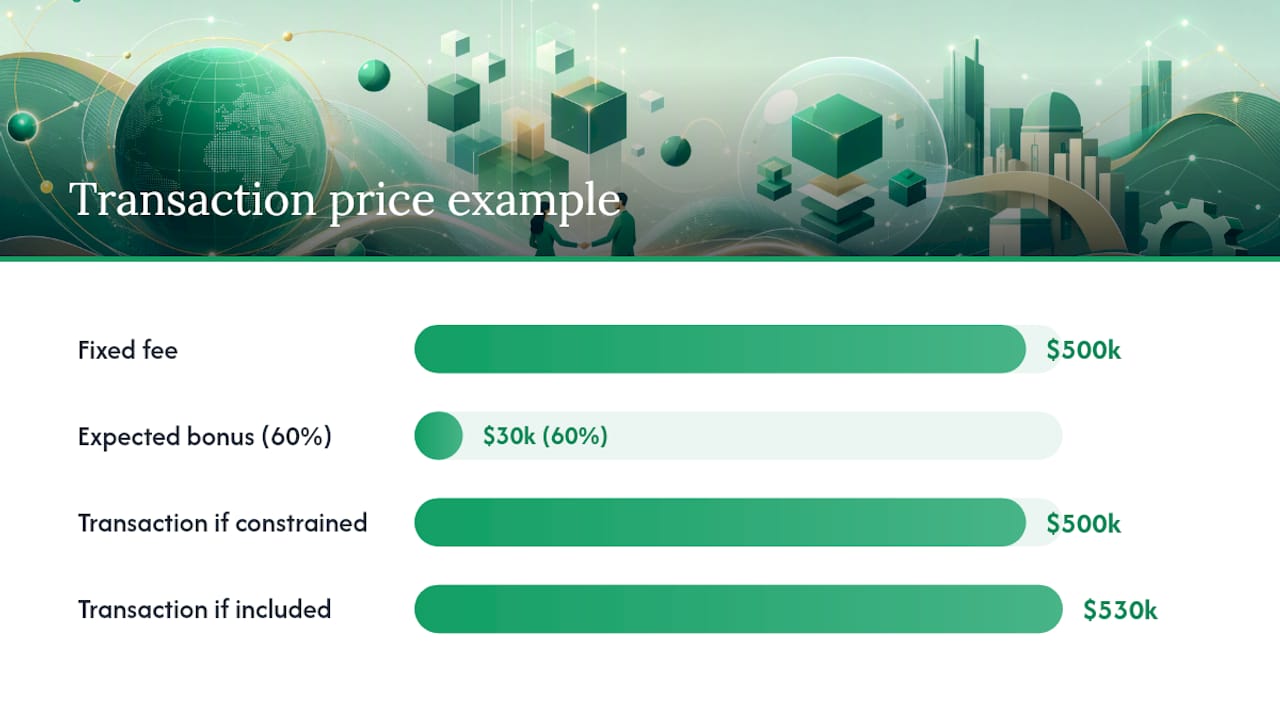
Contract: a fixed fee plus a potential performance bonus contingent on timely completion. Historical data shows a 60% probability of on-time completion.
Expected value: ($50,000 × 60%) + ($0 × 40%) = $30,000. Constraint assessment: Is it probable that including $30,000 will not cause a significant reversal? If yes, transaction price = $530,000. If the project is high-risk and the bonus is material, constrain to $500,000 until the uncertainty resolves.
Significant financing component. If the timing of payments provides either party with a significant financing benefit, you must adjust the transaction price for the time value of money. The practical expedient: if you expect the period between transfer of services and payment to be one year or less, you may skip the financing adjustment entirely. Most short-term service contracts qualify. For multi-year contracts with upfront payments or extended payment terms, calculate the financing component using a discount rate that reflects a separate financing transaction between the parties.
When do you recognize revenue over time vs. at a point in time?
Revenue is recognized over time when any one of three conditions is met:
- The customer simultaneously receives and consumes the benefits as the entity performs (e.g., cleaning services, payroll processing).
- The entity’s performance creates or enhances an asset the customer controls as it is created (e.g., construction on customer-owned land).
- The entity’s performance does not create an asset with an alternative use to the entity, and the entity has an enforceable right to payment for performance completed to date.
If none of these conditions is met, recognize revenue at the point in time when control transfers.
Measuring progress — input vs. output methods:
| Method | Examples | Best for | Watch out for |
|---|---|---|---|
| Cost-to-cost (input) | Costs incurred / total estimated costs | Long-term service contracts, construction | Uninstalled materials inflate progress; exclude them |
| Labor hours (input) | Hours worked / total estimated hours | Professional services, consulting | Requires reliable time-tracking controls |
| Milestones (output) | % of milestones achieved | Fixed-deliverable contracts | Milestones must faithfully depict performance |
| Units delivered (output) | Units transferred / total units | Recurring uniform services | Works only when units are homogeneous |
Sample journal entries — cost-to-cost method:
Contract with fixed fee; progress measured as proportion of costs incurred
Revenue recognized: $200,000 × 25% = $50,000.
Dr. Contract costs expense $40,000 Cr. Accrued costs $40,000
Dr. Contract asset $50,000 Cr. Revenue $50,000
If cumulative costs exceed estimates, revise the completion percentage immediately and recognize the catch-up adjustment in the current period.
Pro Tip: Input methods require tight cost-tracking controls. Auditors will test whether costs recorded to a contract are actually contract-specific or are reallocated overhead. Segregate cost centers by contract from day one — retrofitting that structure at audit time is painful and often unconvincing.
How do contract modifications, combinations, and terminations affect revenue?
A contract modification is any change in scope or price approved by both parties. The accounting depends on what changed.
-
Treat as a separate contract when: (a) the modification adds distinct goods or services, AND (b) the price increases by an amount that reflects the standalone selling price of those additions. The original contract continues unchanged.
-
Treat as a termination of the old contract and creation of a new one when: the remaining goods or services are distinct from those already transferred. Reallocate the remaining transaction price (including any unrecognized variable consideration) to the remaining performance obligations at updated SSPs.
-
Treat as a modification of the existing contract when: the remaining goods or services are not distinct from those already transferred (i.e., they form part of a single performance obligation). Recognize the effect as a cumulative catch-up adjustment in the current period.
Combining contracts. Combine two or more contracts entered into at or near the same time with the same customer when: they are negotiated as a package, the price of one depends on the other, or the goods and services together constitute a single performance obligation.
Termination clauses. A termination-for-convenience clause does not automatically mean the contract lacks commercial substance. Assess whether the termination penalty or payment-for-performance-to-date provision gives you an enforceable right to payment. If it does, over-time recognition may still apply. Document this analysis at contract inception — do not wait until a customer actually terminates.
Which other standards intersect with service contract accounting?
Service contracts rarely exist in a vacuum. Several other standards frequently apply to part or all of the arrangement.
- ASC 842 (Leases): If a service contract conveys the right to control the use of an identified asset for a period of time, the lease component must be separated and accounted for under ASC 842. Common triggers: dedicated equipment, exclusive-use facilities, named assets. Use the practical expedient to not separate lease and non-lease components only when it does not materially distort either standard’s results.
- ASC 340-40 (Contract costs): Incremental costs to obtain a contract (e.g., sales commissions) and costs to fulfill a contract that meet specific criteria must be capitalized and amortized consistently with the transfer of the related services. ASC 340-40 draws a hard line between incremental costs (capitalize) and general overhead (expense as incurred). The practical expedient: expense incremental costs with an amortization period of one year or less.
- ASC 350 / IAS 38 (Intangible assets): When a service contract includes a software license or IP transfer, evaluate whether the license is distinct. If it is, the license component may be subject to different recognition timing than the service component.
- Warranties: Assurance-type warranties (the service performs as promised) are not separate performance obligations — accrue them under ASC 460. Service-type warranties (the customer can purchase extended coverage) are distinct performance obligations under ASC 606 and must be allocated a portion of the transaction price.
- Government contracts (CAS and DFARS): Federal contractors must align cost estimates in proposals with actual cost accumulation. DFARS 252.242-7006 requires an accounting system that segregates direct from indirect costs, maintains a consistent cost accounting practice, and supports audit by the Defense Contract Audit Agency. Misallocating indirect costs as direct costs can trigger penalties or debarment. RSM’s guidance for federal contractors also highlights that the series exception and variable consideration constraints require extra care in government work, where contract modifications and definitization are common.
- IRS safe harbor for ratable service contracts: For tax purposes, IRS Revenue Procedure 15-39 allows accrual-basis taxpayers to treat economic performance ratably for service contracts of a period not exceeding one year where each service occurrence provides independent value. This is simpler than the book treatment and creates a book-tax difference practitioners often miss.
What disclosures and internal controls does ASC 606 require for service contracts?
ASC 606 disclosure requirements are more demanding than the old revenue standard. For service contracts specifically, the following are non-negotiable:
- Disaggregation of revenue: Break revenue into categories that depict how economic factors affect the nature, amount, timing, and uncertainty of revenue and cash flows.
- Contract balances: Opening and closing balances of contract assets, contract liabilities, and receivables; revenue recognized from opening contract liabilities.
- Performance obligations: Description of when obligations are satisfied, significant payment terms, and the nature of goods or services promised.
- Significant judgments: Methods used to determine transaction price (including variable consideration and constraint), SSP estimation methods, and methods used to measure progress.
- Remaining performance obligations: Aggregate transaction price allocated to unsatisfied obligations and when you expect to recognize it (the “backlog” disclosure). The practical expedient: omit this disclosure for contracts with an original expected duration of one year or less.
Audit guidance consistently finds that organizations conflate contract administration with accounting, producing unreliable contract-level margins and weak disclosure support. Segregating cost centers by contract is the structural fix.
Internal controls checklist:
- Segregation of duties between contract execution (sales/ops) and revenue recognition (accounting)
- Cost-tracking controls that tie costs to specific contracts, not to general overhead pools
- Manual journal-entry approval requirements for revenue recognition entries and catch-up adjustments
- Change-control procedures requiring accounting sign-off before contract modifications are executed
- Periodic reconciliation of contract asset and liability balances to the contract register
Workpapers to retain per contract:
- SSP analysis memo (methodology, inputs, conclusion)
- Variable consideration estimate with constraint documentation
- Contract modification log with accounting treatment for each change
- Progress measurement support (cost reports, milestone sign-offs, time records)
- Sample journal entries with approval signatures
Worked examples and sample journal entries
Fixed-fee annual maintenance contract
Terms: $120,000 fixed fee for a series of uniform monthly maintenance services. Single performance obligation (series of uniform monthly services). Payment received at contract inception
| Period | Cumulative % | Revenue recognized | Contract liability balance |
|---|---|---|---|
| Inception | 0% | $0 | $120,000 |
| Month 3 | 25% | $30,000 | — |
| Month 6 | 50% | $30,000 | $80,000 |
| — | 100 percent | $80,000 | $0 |
Journal entry at inception: Dr. Cash $120,000 / Cr. Contract liability $120,000
Monthly recognition (each month): Dr. Contract liability $10,000 / Cr. Revenue $10,000
Contract file checklist: signed agreement, payment receipt, monthly service completion sign-offs, SSP memo confirming series treatment.
Time-and-materials consulting contract
Terms: $150/hour, estimated 1,000 hours, capped at $160,000. Variable consideration: the cap creates a constraint. Expected hours: 950 (most-likely-amount). Transaction price = min($142,500, $160,000) = $142,500 (constrained to expected hours × rate, below cap).
Revenue is recognized over time as hours are worked (output method: units of service delivered).
After hours billed at stated hourly rate Dr. Accounts receivable $30,000 / Cr. Revenue $30,000
If actual hours trend toward the cap, reassess the constraint each reporting period and recognize a catch-up adjustment when it becomes probable the cap will not cause a reversal.
Contract file checklist: rate card, cap clause, hours log, constraint reassessment memos.

SaaS subscription with a paid upgrade option
Terms: a SaaS subscription with optional premium feature available for additional fee The option is a material right only if it provides a discount incremental to what other customers receive. Assume it does not — treat the option as a marketing offer, not a performance obligation. Transaction price = $24,000.
| Period | Revenue recognized | Contract liability |
|---|---|---|
| — | $24,000 cumulative | $0 |
If the customer exercises the upgrade option mid-year, assess whether it is a separate contract (distinct service, SSP-based price) or a modification. If the $6,000 reflects SSP, treat as a separate contract.
Contract file checklist: subscription agreement, option pricing analysis, upgrade exercise documentation if applicable.
Key Takeaways
Proper service contract accounting under ASC 606 requires applying all five steps with documented judgments, constrained variable consideration, and contract-level cost controls that support both financial reporting and audit defense.
| Point | Details |
|---|---|
| Five-step model is mandatory | Apply all five ASC 606 steps at contract inception; document each judgment in the contract file. |
| Distinctness drives obligation count | Services that are highly interrelated must be combined; the series exception applies to uniform recurring services. |
| Constrain variable consideration | Use expected-value or most-likely-amount methods and apply the constraint; undocumented optimism causes restatements. |
| Over-time recognition needs cost controls | Input methods require segregated cost centers per contract; auditors test whether costs are truly contract-specific. |
| Loturn for per-contract cost tracking | Loturn’s per-car profit tracking and native automotive chart of accounts give dealers the contract-level cost segregation ASC 606 requires. |
The part of ASC 606 that most teams get wrong
The five-step model looks clean on paper. In practice, the failure point is almost never the mechanics — it is the documentation that should have been written at contract inception and was not.
Distinctness assessments are the clearest example. Teams spend real time deciding whether a service is a separate performance obligation, reach a defensible conclusion, and then write nothing down. Six months later, an auditor asks for support, and the accounting team reconstructs reasoning from memory. That reconstruction is almost always less convincing than the original analysis would have been, and it signals to auditors that the judgment was not actually made at the right time.
Variable consideration is the second chronic failure. The constraint exists precisely because ASC 606’s authors knew practitioners would be optimistic about bonuses and incentive fees. The standard does not ask you to be pessimistic — it asks you to be honest about uncertainty. A well-documented constraint memo that says “we included $X because the probability of reversal is low based on Y evidence” is audit-proof. An undocumented inclusion of the full bonus is not.
The internal-controls gap is subtler but equally costly. Many organizations track costs at the department or project-type level rather than at the individual contract level. That works fine for budgeting. It fails for ASC 606, where progress measurement under the cost-to-cost method requires knowing exactly how much cost has been incurred against a specific contract’s total estimated cost. Retrofitting that structure after the fact is expensive and often produces estimates auditors will not accept.
The fix is structural: require accounting sign-off before contracts are executed, not after. Sales teams negotiate terms that have direct accounting consequences — variable fees, termination-for-convenience clauses, customer options, bundled pricing. If accounting is not at the table when those terms are set, the revenue recognition problem is baked in before the ink dries.
Authoritative sources and further reading
Save these references in your contract-file workpapers and cite them in your accounting policy documentation.
Primary authoritative literature (US GAAP and IFRS):
- Revenue from contracts with customers
- 2.6 Identifying the contract
- Topic 606: Recognizing Revenue for Service Contracts — Articles
- Revenue recognition considerations for federal government contractors
- IRS revenue procedure on ratable service contracts
- DFARS 252.242-7006 — Accounting system administration
- Service Contract Accounting and Revenue Recognition — Accounting Insights
- Auditor handbook and internal audit guidance
Industry and practitioner guidance:
Government contractor references:
Internal audit and controls:
Loturn gives dealers the contract-level cost visibility ASC 606 demands
The hardest part of service contract accounting is not the journal entries. It is having clean, contract-level cost data when the auditor asks for it. Generic accounting software tracks costs by category or department. That is not enough for ASC 606’s cost-to-cost method or for defending your progress-measurement inputs.
Loturn is built specifically for independent used-vehicle dealers who need to know exactly what they made on every transaction before they close the books. Every cost — purchase price, transport, recon, floorplan interest — is assigned to the specific vehicle or deal, not pooled into overhead. That per-contract cost structure is exactly what ASC 606 requires for input-method progress measurement, and it is what auditors want to see in your workpapers. Loturn’s dealer accounting features include a native automotive chart of accounts, double-entry accounting, and real-time gross tracking, so your contract-level numbers are audit-ready from day one. Free data migration and a quick setup mean you are not rebuilding your cost structure from scratch.
See how Loturn tracks per-car profit and whether it fits your dealership’s accounting workflow.
FAQ
What is a service contract in accounting?
A service contract is an arrangement where one party promises to perform services for another in exchange for consideration. Under ASC 606, it is accounted for using the five-step revenue recognition model.
What is ASC 606 for service companies?
ASC 606 is the FASB standard requiring companies to recognize revenue in a way that depicts the transfer of promised services to customers in an amount reflecting the consideration they expect to receive. Service companies apply it by identifying performance obligations and recognizing revenue as each is satisfied.
What is the journal entry for providing services?
For over-time recognition using the cost-to-cost method, debit Contract costs expense and credit Accrued costs for costs incurred, then debit Contract asset and credit Revenue for the proportional amount earned. When the customer is billed, debit Accounts receivable and credit Contract asset.
What is an SLA in accounting?
A service-level agreement (SLA) defines the performance standards a service provider must meet. In accounting, SLA terms often create variable consideration (bonuses for exceeding targets, penalties for missing them) that must be estimated and constrained under ASC 606 Step 3.
How does ASC 340-40 relate to service contract costs?
ASC 340-40 requires capitalizing incremental costs to obtain or fulfill a service contract (such as sales commissions) and amortizing them consistently with the transfer of the related services. Costs that do not meet the capitalization criteria are expensed as incurred.