
Track every transport and recon dollar to the vehicle that earned it. Assign each cost to a VIN or stock number, capitalize what belongs on the balance sheet, and reconcile weekly against carrier invoices. That’s the whole system in one sentence: transport cost tracking works when it happens at the individual vehicle level, not as a lump line on a P&L.
The right class of solution is VIN-level costing built into your dealer accounting and inventory software, not a spreadsheet bolted onto QuickBooks. Three things to implement this week:
- Pick an identifier strategy. Every cost gets tagged to a VIN or stock number the moment it hits your books.
- Assign invoices at the source. Carrier bills, auction fees, and recon tickets attach to the vehicle record, not a general expense account.
- Reconcile weekly, report against KPIs. Match invoices to trip records every week and feed the numbers into time-to-line and cost-per-unit reports.
If you can’t tell an owner what a specific unit cost to land and recondition before it sold, you’re guessing at profit. Guessing at profit on 40 cars a month adds up to a real number by year end.
Key Takeaways
Accurate per-car profit depends on assigning every transport and recon dollar to a VIN at the moment it’s incurred, then reconciling weekly against carrier invoices.
| Point | Details |
|---|---|
| Use VIN-level identifiers | Assign every cost to a specific stock number, not a general expense account. |
| Capitalize the right costs | Inbound transport and recon are capitalizable; abnormal freight is typically a period expense under ASC 330. |
| Reconcile weekly | Match carrier invoices to trip records every week to catch discrepancies early. |
| Track time-to-line | Every extra day off-lot costs roughly $40 in holding expense per NCM Associates. |
| Use software built for it | Loturn assigns transport and recon costs per VIN and produces auditable per-car profit roll-ups automatically. |
Table of Contents
- What Does Transport Cost Tracking Mean for Used-Vehicle Dealers?
- Why Per-Vehicle Transport Tracking Changes Your True Profit Math
- How Do You Record Transport and Recon Costs on the Books?
- What’s the Daily Workflow From Pickup Through Recon?
- Which KPIs and Reports Actually Control Transport Costs?
- What Documentation Do Auditors and Lenders Expect?
- 30-Day Plan to Get Transport Cost Tracking Running
- Why This Workflow Holds Up in Practice
- How Loturn Handles Transport Cost Tracking for You
- Sources
- FAQ
What Does Transport Cost Tracking Mean for Used-Vehicle Dealers?
For an independent dealer, transport cost tracking means recording every transport and reconditioning expense inside your accounting system and tying it to a specific VIN or stock number, from the day the vehicle arrives until the day it sells. This is different from generic freight or logistics cost management. It’s per-unit vehicle cost accounting, and it lives inside your dealer management or accounting platform, not a separate logistics tool.
Costs that belong in this bucket include inbound shipping, auction pickup fees, carrier driver fees, loading and unloading charges, fuel surcharges, short-term storage at the point of arrival, and recon parts and labor tied directly to that unit.
Some costs typically stay out of vehicle cost, or get expensed in the current period instead of added to inventory value:
- Abnormal freight charges caused by rerouting, damage claims, or carrier error, which PwC’s inventory guidance treats as period expenses rather than capitalizable cost under ASC 330.
- General lot utilities or overhead not traceable to one unit.
- Late fees or penalties unrelated to bringing the vehicle to sellable condition.
Accountants generally recommend the specific identification method for used-vehicle dealers: it ties every capitalized dollar to one unit rather than averaging costs across a batch, which is what lenders and auditors expect to see.
Why Per-Vehicle Transport Tracking Changes Your True Profit Math
A car sitting in transit or in the recon bay isn’t earning money. NCM Associates puts average holding cost at roughly $40 per day per vehicle when you factor in floorplan interest, storage, and insurance.
Run the math on a single unit: a car that sits extra days due to transport or recon delays incurs significant holding expenses that reduce profitability, before you count the opportunity cost of a spot on your lot that could’ve turned twice in that window.
- Every day off-lot adds floorplan interest, whether or not the delay was your fault.
- Slower time-to-line drags down inventory turnover and GROI, since cost-to-market climbs while the car sits.
- Transport inefficiency compounds: a late pickup delays recon, which delays listing, which delays the sale.
Dealers who tighten dispatch timing and demand consistent ETAs from carriers see the payoff directly in inventory turnover, because fewer days off-lot means fewer dollars bleeding out in holding cost.
How Do You Record Transport and Recon Costs on the Books?
Under ASC 330, inventory cost includes the expenditures needed to bring an item to its condition and location for sale. For a used vehicle, that covers acquisition price, inbound transport, and recon labor and parts. Abnormal freight, damage-related charges, and spoilage generally get expensed as incurred rather than added to the vehicle’s basis.
The specific identification method is the standard here. Each cost gets coded to one stock number, so your ledger shows exactly what it took to land and prep that unit, not a blended average across your lot.
Sample entries look like this:
- Acquisition + inbound transport: Debit Vehicle Inventory (Stock #4471), credit Accounts Payable, for the purchase price and the carrier invoice, both coded to the same stock number.
- Recon invoice: Debit Vehicle Inventory (Stock #4471), credit Accounts Payable, for parts and labor, posted to that unit’s work-in-process.
- Sale: Debit Cost of Goods Sold, credit Vehicle Inventory (Stock #4471), for the full accumulated cost, transport, recon, and acquisition together.
Timing matters. Capitalize costs as they’re incurred, before the sale, not retroactively at month end. For high-volume, low-dollar charges like fuel surcharges, batch them by trip ID rather than tracking every line item separately. Dealer bookkeeping guides that build recon worksheets tied to stock numbers make this far easier to audit than a general ledger with unassigned freight expense.
Pro Tip: Attach the digital invoice image directly to the vehicle record with a memo noting the trip ID or recon vendor. When a lender or auditor asks for support six months later, you want a two-click answer, not a folder search.
What’s the Daily Workflow From Pickup Through Recon?
Costs get lost when there’s no single point where a VIN and an invoice meet. Build the workflow around that meeting point.
- Intake at acquisition. Capture the VIN and assign a stock number the moment you buy the car, whether at auction or a private purchase, and open the vehicle record immediately.
- Transport dispatch. Get a carrier estimate before pickup, assign a trip ID, and tie that trip ID to the stock number.
- Receiving. Require the receiver to collect the proof of delivery and the carrier invoice at drop-off, then attach both to the vehicle record the same day.
- Recon scheduling. Open a recon work order against the stock number, log the start date, and route vendor invoices straight to that unit.
- Time-stamp completion. Record the date recon finishes and the car is ready for the lot, which becomes your time-to-line figure.
- Weekly reconciliation. Match every carrier invoice against its trip record and fix any assignment errors before they pile up.
A few things separate a clean system from a messy one:
- Automated invoice capture that reads carrier paperwork and suggests a VIN match.
- OCR that recognizes VINs on scanned documents instead of requiring manual entry.
- Real-time carrier tracking so you know a unit’s ETA without a phone call.
Pro Tip: Designate one person as the sole receiver responsible for signing off on proof of delivery. When responsibility is split across three people, invoices get misfiled and nobody notices until reconciliation.
Which KPIs and Reports Actually Control Transport Costs?
Five numbers tell you whether your transport spend is under control: time-to-line, transport cost per unit, holding cost per day, invoice variance rate (quoted versus billed), and delays broken out by source, auction pickup, inbound carrier, or interlot transfer.
Montway’s dealer metrics guide recommends calculating transport cost per unit by dividing total transport spend by units shipped, then folding that figure into your broader cost-to-market equation alongside acquisition and recon.
Run these on a schedule:
- Weekly: outstanding carrier invoices by stock number, vehicles in transit with current ETAs, and recon work-in-process aging.
- Monthly: landed cost per vehicle, transport cost by lane, and how time-to-line trends are affecting inventory turnover.
Cutting one day off average time-to-line, using NCM Associates’ roughly $40 per day holding-cost figure, saves that amount per vehicle in floorplan interest and storage. Across 30 units a month, that’s a number worth putting in front of your CPA.
What Documentation Do Auditors and Lenders Expect?
Floorplan lenders and auditors want to see that every capitalized dollar traces back to a specific unit and a specific document. Four controls make that possible: unique VIN and stock numbering assigned in sequence, invoices attached directly to the vehicle record, an approval step before recon costs post, and separate people handling receiving versus posting to the ledger.
Keep these on file for every unit:
- Carrier invoices and signed proofs of delivery.
- Recon invoices with mechanic or vendor sign-off.
- Title transfer paperwork where applicable.
- Bank or floorplan statements showing the advance against that unit.
At month end, prepare a schedule that ties each vehicle record to the general ledger and your floorplan financing report, following the kind of stock-number sequencing GM’s dealer accounting guidance outlines for inventory records. When a carrier dispute comes up, log it, hold payment until it’s resolved, and only adjust the vehicle’s cost basis after you’ve settled the disagreement, never before.
30-Day Plan to Get Transport Cost Tracking Running
You don’t need a quarter to stand this up. Four weeks, done in order, gets you there.
- Week 1: Set your stock-number policy, map how invoices currently flow into your books, and configure your accounting or DMS software to accept per-vehicle charge coding.
- Week 2: Train receiving and recon staff to capture VINs and stock numbers on every document, and start requiring carrier trip IDs and proofs of delivery.
- Week 3: Run reconciliation in parallel with your old process. Post costs to vehicle records, match carrier invoices, and correct misassignments as they surface.
- Week 4: Lock in your weekly KPI cadence, present the first per-car profit roll-up to the owner or CPA, and document the controls you’ll use going forward.
Before you call it done, confirm you’ve assigned roles for receiving and posting, collected vendor contacts for every carrier you use, and run at least three test transactions through the full flow, from invoice to journal entry to report.
Why This Workflow Holds Up in Practice
Loturn was built around a problem independent dealers kept describing the same way: costs scattered across spreadsheets, invoices, and memory, with no clean answer to “what did this car actually cost me?” The VIN-level workflow in this guide reflects what actually closes that gap, specific identification, attached documentation, and weekly reconciliation, rather than a monthly guess. If you want to see it applied to your own inventory, a live walkthrough shows the difference fast.
How Loturn Handles Transport Cost Tracking for You
Loturn is built specifically for the workflow this article describes, so you’re not retrofitting generic accounting software to handle per-vehicle costs. Every transport invoice, recon bill, and auction fee attaches directly to the VIN it belongs to, which means your per-car profit roll-up is accurate the moment a vehicle sells, not after a bookkeeper untangles it weeks later.
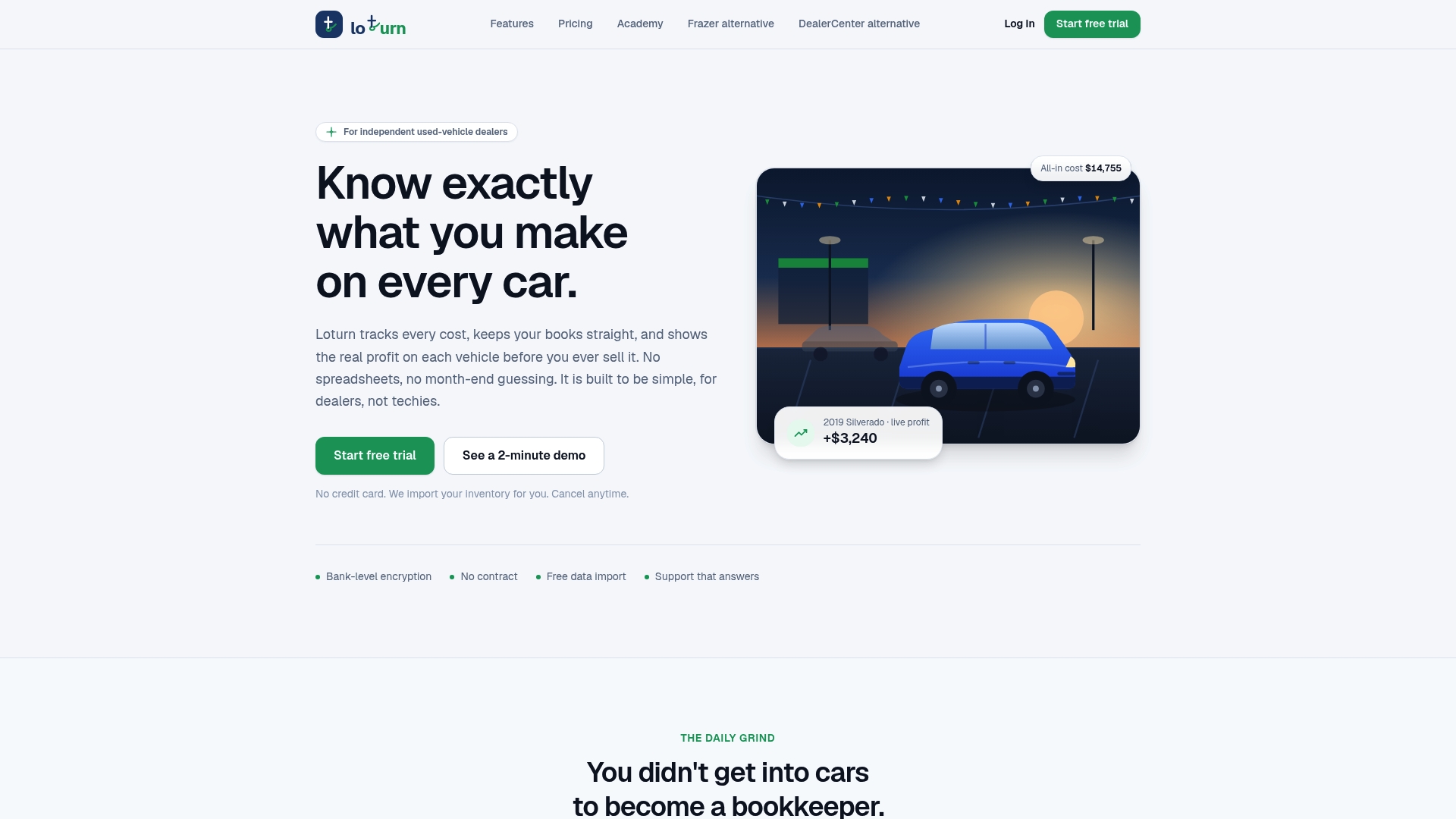
The platform’s accounting tools use the specific identification method by default, tracking recon work-in-process, floorplan interest, and landed cost per unit in one place. Invoice attachments and time stamps create the auditable trail lenders ask for, without you building a separate recon worksheet by hand. Data is protected with bank-level encryption, and free data migration means you can move your existing inventory records over without weeks of manual entry.
If you’re still coding transport costs to a general expense account, start a free trial and import your current vehicle data to see what your true per-car profit looks like once transport and recon costs are assigned correctly.
Sources
FAQ
What Is Transport Cost Tracking for Car Dealers?
It’s the practice of recording every transport, auction, and reconditioning expense against a specific vehicle’s VIN or stock number inside your accounting system, so you know the true cost of that unit before it sells.
Should Transport Costs Be Capitalized or Expensed?
Routine inbound transport and recon costs that bring the vehicle to sellable condition are capitalizable under ASC 330; abnormal freight charges from errors or damage are typically expensed in the current period.
How Do I Calculate Transport Cost Per Unit?
Divide total transport spending for a period by the number of units shipped in that period, then compare it against your holding-cost and cost-to-market figures.
What Software Handles VIN-Level Transport Cost Tracking?
Loturn assigns transport and recon invoices directly to each vehicle’s stock number, producing per-car profit roll-ups and an auditable ledger without manual spreadsheet work.
How Much Does a Delay in Recon or Transport Actually Cost?
Using NCM Associates’ estimate of roughly $40 per day per vehicle in holding cost, delays add significantly to floorplan interest and storage expense for each unit.