We owe tracking is the per-vehicle ledger that records every liability tied to a specific unit: floorplan principal, accrued daily interest, curtailment amounts, vendor invoices, transport and recon bills, and title hold status. It is not a generic accounts-payable list. Every entry ties to a stock number or VIN, and the ledger follows that unit from acquisition through payoff and title release. The immediate action: open a ledger row for every vehicle on your lot today and record the remaining payoff balance and any outstanding vendor holdbacks before you do anything else.
Minimum fields to capture right now for each unit:
- Lender name and account number tied to that VIN
- Current principal balance as of the last statement
- Daily interest rate (annual rate ÷ 365)
- Next curtailment due date and amount
Pro Tip: Set up your ledger in whatever tool you use today — even a spreadsheet — and commit to adding every new unit within 24 hours of acquisition. The habit matters more than the tool at this stage.
Key Takeaways
Per-vehicle liability tracking, done consistently, is the only way to know your true net profit before a car leaves the lot.
| Point | Details |
|---|---|
| Start the VIN ledger today | Record lender, principal, daily rate, and curtailment date for every unit on the lot now. |
| Assign stock number to every invoice | Require the stock number on all vendor invoices to eliminate manual assignment at reconciliation. |
| Reconcile weekly, not monthly | Weekly lender statement matching catches missed payoffs and title holds before they compound. |
| Forecast curtailments 30 days ahead | Surface next-30-day curtailment totals in the weekly report to prevent surprise cash shortfalls. |
| Loturn automates the full cycle | Loturn tracks per-car landed cost, daily floorplan interest, and payoff status in one platform with free data import. |
Table of Contents
- What data should you track on every vehicle’s we owe ledger?
- What does a reliable daily and weekly we owe workflow look like?
- How do you manage floorplan curtailments and title release to stay compliant?
- How do you reconcile vendor payables and forecast cashflow per vehicle?
- What reports and KPIs reveal true per-car profit and floorplan exposure?
- How does dealer-focused software automate we owe tracking?
- Seven steps to implement reliable we owe tracking
- Why Loturn is qualified to help you track per-vehicle liabilities
- The cost of not tracking this closely enough
- Loturn puts per-car profit on autopilot for independent dealers
- Sources
- FAQ
What data should you track on every vehicle’s we owe ledger?
Dealership accounting uses specific identification by VIN, meaning every acquisition cost and add-on expense must attach to that unit until the day it sells. That principle drives the full field list below.
Per-VIN fields to record:
- Stock number and VIN (your canonical key)
- Acquisition cost (auction price + buyer’s fee)
- Lender name, account number, and advance date
- Principal remaining and daily interest rate
- Accrued interest to date
- Curtailment schedule: amounts and due dates
- Lender statement ID and statement date
- Vendor invoices: transport, recon, parts — each with invoice number and due date
- Title hold status and expected release trigger
- Sale date, payoff amount at sale, and posted payoff transaction date
Landed cost is the number that flows into cost of goods sold on the day of sale. It equals auction price + transport + recon + dealer-installed accessories + auction fees. Fuzen’s inventory tracking guide confirms that small-dealer systems need stock number, acquisition cost, reconditioning status, and per-unit cost fields to support accurate per-car profit calculations.
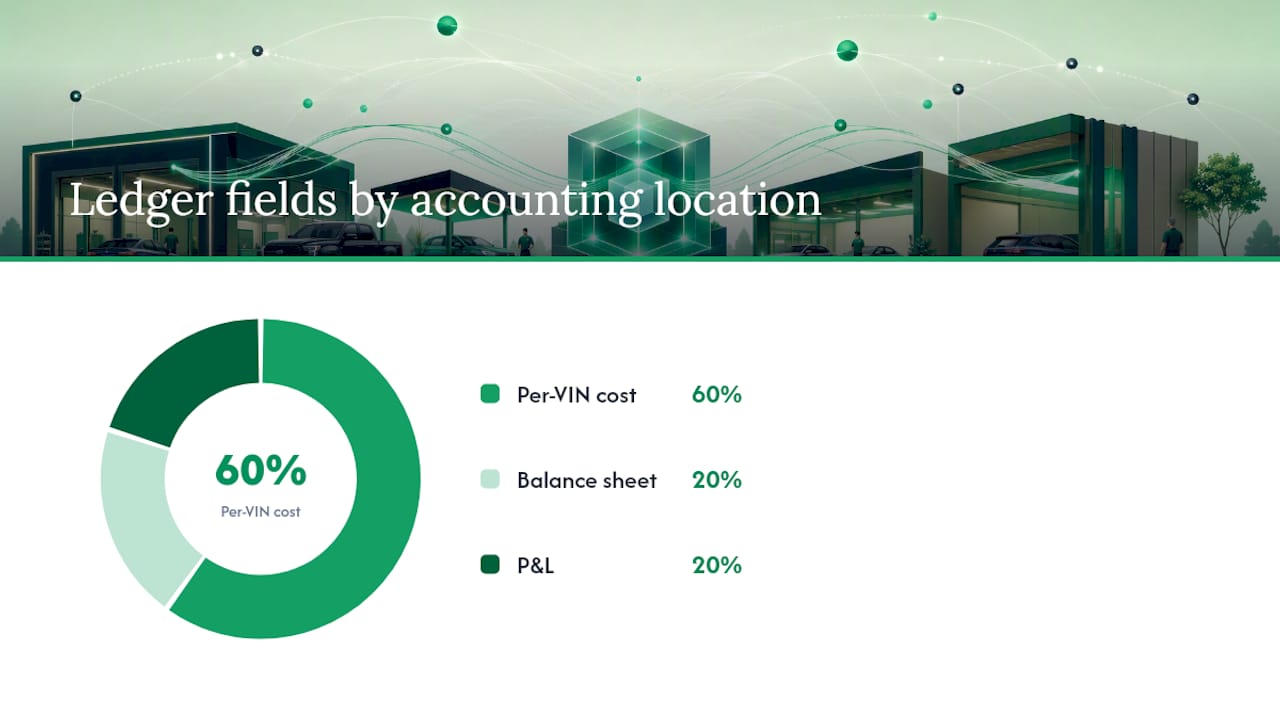
One accounting distinction that trips up many dealers: floorplan principal sits on the balance sheet as a liability, while accrued interest posts to interest expense. Misclassifying interest into COGS hides your true front-end margin and makes every per-car profit report misleading.
| Ledger Field | Where It Lives | Accounting Treatment |
|---|---|---|
| Floorplan principal | Balance sheet | Liability reduction on payoff |
| Accrued floorplan interest | P&L | Interest expense |
| Transport invoice | Per-VIN cost | Rolled into landed cost / COGS |
| Recon invoice | Per-VIN cost | Rolled into landed cost / COGS |
| Vendor invoice (parts) | Per-VIN cost | Rolled into landed cost / COGS |
Pro Tip: Print your stock number on every vendor purchase order and require it on every invoice you receive. That single habit eliminates most manual assignment errors at reconciliation time.
What does a reliable daily and weekly we owe workflow look like?
Accuracy in per-vehicle liability tracking comes from consistent, role-specific routines, not from periodic catch-up sessions.
Daily tasks:
- Record every incoming unit: create the VIN ledger row, attach the auction invoice, and flag title hold status.
- Post transport and recon invoices to the correct VIN as they arrive.
- Record any payoffs executed that day and clear the lender balance on the ledger.
- Update title hold flags when release confirmations arrive.
Weekly tasks:
- Import lender and floorplan statements; match each line to a VIN ledger row.
- Flag any mismatches (unit on statement but sold, or unit missing from statement) for investigation.
- Update accrued interest totals across all open units.
- Circulate an aging report of floorplan interest and vendor payables to management.
Bradyware recommends monthly reconciliation between lender statements and internal records as the minimum to prevent accrued interest from silently eroding profit. Weekly matching catches problems before they compound.
Role responsibilities:
- Sales desk: flags sold units same day; confirms payoff wire is initiated.
- Recon manager: submits invoices with stock number within 48 hours of job completion.
- Controller: runs weekly statement import, resolves mismatches, and signs off on accrued interest totals.
Pro Tip: A vehicle inventory management system that tracks reconditioning stages and vendor quotes per VIN makes the recon manager’s weekly submission nearly automatic — no chasing paper invoices.
How do you manage floorplan curtailments and title release to stay compliant?
Every floorplan advance creates a payable per VIN. Payoff equals principal plus accrued interest plus any curtailment or audit fees the lender assesses. Title release typically does not happen until the lender receives and posts the payoff wire, which means a delayed or unrecorded payoff directly blocks your ability to transfer title to a buyer.
ACV Auctions notes that dealers must proactively manage curtailment schedules and payoff timelines and align financing with inventory turnover to avoid delayed title releases and lender strain. Floorplan problems usually stem from operational mismatches, not just lending terms — the accounting system needs to reflect what is physically on the lot.
Practical steps to stay ahead:
- Reconcile lender statement IDs to VIN rows every week, not monthly.
- Calculate next-30-day curtailments and add them to your cash forecast.
- Build a short escalation flow: if title is not released within the lender’s stated SLA after payoff, the controller contacts the lender rep with proof of wire and requests a written release confirmation.
A unit sold but still appearing on the lender statement is one of the most common and costly errors in independent dealerships. Confirm the payoff wire posted, obtain proof of release from the lender, and escalate to the lender rep if the title is not released within their stated SLA. Document every step.
Compliance risks are real. Delayed title releases expose you to audit fees, lender holdbacks, and potential regulatory penalties. Dealers are also required to display a Buyers Guide on every used vehicle under the FTC Used Car Rule — missing that disclosure while a title dispute drags on compounds the risk. State-specific compliance forms are available by state and worth reviewing alongside your lender agreements.
Pro Tip: Maintain a curtailment calendar visible in your weekly report. Surfacing next-30-day curtailments gives sales and finance time to prioritize aged units for retail or wholesale before the cash hit arrives.
How do you reconcile vendor payables and forecast cashflow per vehicle?
Reconciliation converts your ledger into a cash forecast. The process has four steps:
- Match every vendor invoice to a VIN; reject or hold any invoice missing a stock number.
- Match lender statement lines to VIN ledger rows; clear payoffs when wire confirmation arrives.
- Adjust COGS and operating expense accounts: landed cost items go to COGS; floorplan interest goes to interest expense.
- Produce a per-car profit figure: sale price minus landed cost (purchase + transport + recon + auction fees) minus accrued floorplan interest and curtailment impact, adjusted for any F&I reserves or chargebacks.
Red flags to watch for:
- A VIN appearing on the lender statement after its recorded sale date
- A vendor invoice with no stock number
- A large unassigned recon work-in-progress balance sitting in the GL
Pro Tip: Run a daily “cash needed in the next 7 days” metric: sum all curtailments due, vendor invoice due dates, and payoffs required for vehicles with confirmed delivery dates. It takes 10 minutes and prevents the surprise short-pay that strains lender relationships.
What reports and KPIs reveal true per-car profit and floorplan exposure?
The reports below are the minimum set for any independent dealer running a floorplan. Bradyware’s dealership financial management guidance recommends monthly reconciliation between floorplan statements and internal inventory as the baseline; these KPIs make that reconciliation meaningful.
Essential KPIs:
- Per-car front-end gross: sale price minus landed cost
- Per-car back-end F&I contribution: finance reserve plus product gross
- True per-car net profit: front-end gross minus accrued floorplan interest minus any curtailment impact
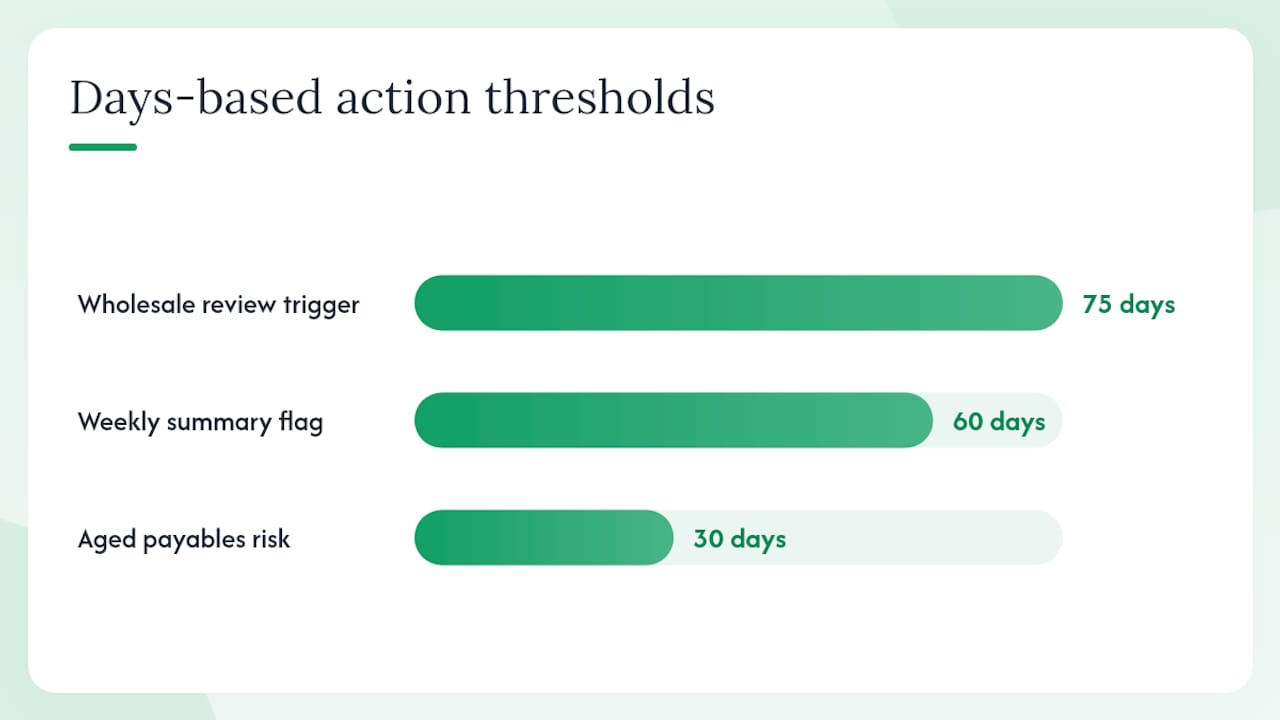
- Days in inventory: tracks interest drag; units past 75 days should trigger a wholesale review
- Days-to-payoff: average lag between sale and payoff wire; a long average signals a cash management problem
- Aged vendor payables: invoices past 30 days without a VIN assignment are a reconciliation risk
- Curtailment calendar: next-30-day and next-60-day exposure by VIN
Sample per-car report layout:
Pro Tip: Schedule an automated daily snapshot for the controller and a weekly summary for ownership that flags any unit where accrued floorplan interest has exceeded $300 or days-in-inventory has passed 60. Those two thresholds catch most margin-eroding situations before they close.
How does dealer-focused software automate we owe tracking?
Manual spreadsheets break at scale. The features that matter for automating per-vehicle liability tracking:
- VIN-based ledger with auto-assignment by stock number
- Invoice import with OCR and automatic stock number matching
- Lender statement import and line-by-line VIN matching
- Daily interest accrual calculated from advance date and rate
- Curtailment calendar with alerts
- Payable aging by VIN and by vendor
- Per-car profit roll-up that combines landed cost, interest, and sale price
- Audit log for every ledger change
- Role-based access controls so sales staff cannot alter cost records
Integrating recon workflows with cost tracking reduces assignment errors and speeds per-unit costing, which is what makes per-car profit figures trustworthy rather than approximate.
Loturn is built specifically for independent used-vehicle dealers and addresses each of these requirements directly. It tracks every cost per VIN from acquisition through payoff, calculates accrued floorplan interest daily, and produces per-car profit reports without requiring a separate accounting system. Setup includes free data import from existing spreadsheets or CSVs, and the platform uses bank-level encryption to protect financial records. For dealers comparing software options, the dealer accounting software guide walks through what dealer-specific features actually look like versus generic bookkeeping tools.
Pro Tip: During onboarding, import your lender statements first, then your inventory. Mapping lender accounts to VINs before you add vendor invoices means your first reconciliation run catches real mismatches rather than setup gaps.
Seven steps to implement reliable we owe tracking
- Choose your canonical key (stock number or VIN) and apply it consistently across every system. (1 day)
- Import current inventory and acquisition invoices into your ledger or software. (1–3 days with free migration)
- Import and map lender statements to VIN rows; confirm advance dates and principal balances. (1 day)
- Capture and code all outstanding vendor invoices with stock numbers; hold any missing one. (1–2 days)
- Enable daily interest accrual and build the curtailment calendar. (1 day)
- Run your first monthly reconciliation and resolve every mismatch before closing the period. (3–5 days)
- Set recurring reports and assign team responsibilities for daily posting and weekly review. (1 day)
Checklist for step 6:
- Every VIN on the lender statement matches a ledger row
- Every sold unit has a posted payoff and a title release confirmation
- Accrued interest totals match lender statement figures within rounding
- No vendor invoices older than 30 days are unassigned
Why Loturn is qualified to help you track per-vehicle liabilities
Loturn’s platform is built around the problems this guide describes:
- Per-car profit tracking from acquisition through sale, including landed cost and F&I contribution
- Dealer chart of accounts designed for automotive, not adapted from generic bookkeeping
- Floorplan interest tracking with daily accrual per VIN
- Bank-level encryption for all financial data
- Free data import from spreadsheets, CSVs, or prior systems
- BHPH support for dealers managing in-house notes and loss reserves
- Dealer Academy with free guides on floorplan financing, per-car costing, and dealership accounting
For dealers who want to go deeper, the per-car profit guide and the floorplan financing guide are practical starting points. Onboarding includes dedicated migration support so the transition from spreadsheets to automated matching does not require a consultant.
The cost of not tracking this closely enough
A dealer sells a unit on a Friday afternoon. The payoff wire does not go out until Monday because no one flagged it as a same-day requirement. The lender does not release the title until Wednesday. The buyer calls Tuesday morning. That four-day gap costs the dealer the relationship, a potential chargeback, and two days of unnecessary floorplan interest on a car that is no longer on the lot.
Tracking per-VIN liabilities is not optional bookkeeping hygiene. It is the mechanism that converts a gut-feel operation into one where you know, before you price a car, exactly what it costs you per day to hold it. Run the seven-step checklist this week. The first reconciliation is the hardest; every one after that takes less than an hour.
Loturn puts per-car profit on autopilot for independent dealers
Independent dealers who track liabilities manually spend hours each week on reconciliation that should take minutes. Loturn replaces that grind with a per-VIN financial engine: every transport bill, recon invoice, and floorplan interest charge attaches to the right unit automatically, and your true net profit per car is visible before the deal closes.
- Per-car profit calculated from landed cost through payoff, including accrued floorplan interest
- Floorplan interest tracking with daily accrual so you never underestimate holding costs
- Free data import to get from spreadsheets to automated matching in days, not weeks
Start with a free trial or bring your current inventory data and let Loturn’s team handle the migration. See what your dealer accounting looks like when every cost is where it belongs.
Sources
- Independent car dealer financing · ACV Auctions (blog)
- Car Dealership Financial Management | Auto Dealership CPA · Bradyware
- Vehicle Inventory Tracking Software for Car Dealers (2026 Guide) - Fuzen
- vinRECON - Dealership Operations Management Platform
FAQ
What is we owe tracking in a dealership?
We owe tracking is the practice of recording every liability tied to a specific vehicle — floorplan balance, accrued interest, vendor invoices, transport, and recon costs — against that unit’s stock number or VIN so true per-car profit is calculable at any point.
How do curtailments affect title release after payoff?
Curtailments are partial principal reductions required by the lender on a schedule; missing one can trigger audit fees or a hold on title release. Full payoff, including any outstanding curtailment amounts, is typically required before the lender releases the title.
How often should dealers reconcile floorplan statements?
Weekly matching of lender statements to VIN ledger rows is the practical standard; Bradyware recommends at minimum monthly reconciliation to prevent accrued interest from eroding profit undetected.
What fields does a we owe ledger need per vehicle?
At minimum: stock number, lender name, current principal, daily interest rate, curtailment due dates, vendor invoice numbers with amounts, title hold status, and posted payoff date.
How does Loturn help with per-vehicle liability tracking?
Loturn assigns every cost — transport, recon, floorplan interest — to the correct VIN automatically, calculates daily interest accrual, and produces a true net profit figure per car, with free data import to get dealers set up quickly.