
A BHPH dealer must treat every retail sale as two events, a vehicle sale and a loan origination, then set up a dealer chart of accounts, unearned finance income tracking, and a credit-loss reserve immediately. Get those three pieces right and your financials become auditable, lender-ready, and honest about per-car profit. Get them wrong, and you’re guessing at margins while your reserve quietly eats your cash.
TL;DR:
- Properly separating vehicle sale revenue from notes receivable and unearned finance income is essential to accurately reflect cash flow and profit.
- A dealer-specific chart of accounts should include distinct line items for inventory, repossessed vehicles, receivables, allowances for credit losses, and finance income, to streamline lender audits.
- Capitalizing all recon, transport, and detailing costs on a per-VIN basis ensures accurate gross margins and prevents misleading profit figures.
- Reconciling notes receivable and true-up allowances for credit losses monthly is critical for maintaining trust with lenders and ensuring financial accuracy.
- Specialized accounting platforms like Loturn automate key BHPH processes, including per-VIN costing and finance reserve tracking, reducing errors and simplifying compliance.
Table of Contents
- Chart of Accounts Built for BHPH Dealers
- Per-VIN Costing: Getting Reconditioning Right
- Booking the Sale and the Loan as Separate Events
- Notes Receivable, Reserves, and Repossessions
- Floorplan Financing: What Belongs Where
- Month-End Close: Your Reconciliation Checklist
- The KPIs That Actually Reveal Your Numbers
- Internal Controls That Fit a Small Lot
- Mapping Your DMS to the General Ledger
- Common BHPH Bookkeeping Mistakes and Quick Fixes
- How Loturn Puts These Basics Into Practice
- Regulatory and Compliance Basics Dealers Can’t Skip
- Tax Implications and Reporting for BHPH Operations
- Cash Flow Management for BHPH Dealerships
- What I’d Fix First If I Ran Your Books
- Get Your Books Built for BHPH, Not Retrofitted for It
- Sources
- FAQ
Chart of Accounts Built for BHPH Dealers
Generic small-business accounting software assumes you sell a product and get paid once. BHPH dealers get paid over a multi-year period, and their general ledger has to reflect that reality or your balance sheet becomes fiction. Departmentalizing your chart of accounts by revenue stream—retail, special finance, BHPH, and wholesale—lets you see which part of the business actually makes money instead of blending everything into one murky number.
At minimum, your chart of accounts needs distinct line items for:
- Vehicle inventory (retail-ready units)
- Repossessed inventory (separate from fresh stock)
- Notes receivable, BHPH (the loan asset)
- Unearned finance income (contra account against notes receivable)
- Allowance for credit losses (contra asset, reduces receivables to net realizable value)
- F&I revenue accounts, split from vehicle sale revenue
This separation isn’t just bookkeeping hygiene. A dealer-tailored chart of accounts speeds up lender due diligence dramatically, because underwriters can see exposure and performance by department instead of digging through a single blended P&L.
Per-VIN Costing: Getting Reconditioning Right
Every dollar you spend making a car sellable belongs on that car’s file, not buried in a general expense account. Recon labor, parts, transport, detailing, and even auction fees are inventory costs, and industry guidance under IRC Sections 471 and 263A generally requires you to capitalize them rather than expense them immediately.
Here’s the practical sequence:
- Tag every vendor invoice (transport company, recon shop, detailer) to the specific VIN before it hits your books.
- Roll those tagged costs into a per-VIN worksheet that tracks acquisition price plus every add-on cost as they accumulate.
- Hold the running total in inventory until the car sells, then move the full capitalized amount into cost of goods sold at the sale date.
Skip this discipline and your front-end gross numbers lie to you. A car that looks like a $2,400 profit might actually be a $600 profit once you account for the $1,800 in recon nobody logged against it.
Booking the Sale and the Loan as Separate Events
Recognize vehicle sale revenue at delivery, at the cash-equivalent price of the car, never at the total face value of the promissory note. This is the single most common error in BHPH books, and it inflates revenue while hiding the fact that most of that “sale” hasn’t been earned yet.
The loan itself gets recorded separately: notes receivable at gross contract value, offset by unearned finance income representing the interest you’ll collect over the life of the note. Each month, a portion of that unearned income converts to earned finance income, either on a constant-yield basis or per the method your contract specifies.
A few mechanics worth locking in:
- Vehicle sale revenue = cash price, not note face value
- Unearned finance income amortizes monthly as the note ages
- Bundled extras like a service contract or free maintenance can trigger separate performance obligations under ASC 606, which may require deferring part of that revenue rather than booking it all at delivery
Get this wrong and your income statement shows a burst of revenue at the point of sale that doesn’t match the cash actually coming in the door.
Notes Receivable, Reserves, and Repossessions
Every BHPH note follows the same posting pattern at origination: debit notes receivable for the gross contract amount, credit unearned finance income for the interest portion, and recognize sales revenue and cost of goods sold at the cash-equivalent price. That’s the foundational entry structure every BHPH ledger should follow.
Reserve sizing is where dealers either build real credibility with lenders or lose it. Two common methodologies work:
- Static pool analysis: track loss performance for loans originated in the same month or quarter, then apply that vintage’s loss curve to new originations with similar characteristics.
- Roll-rate modeling: measure the probability a note in one delinquency bucket (30 days, 60 days, 90 days) rolls into the next, then size your allowance for credit losses off that migration pattern.
Repossession accounting has its own sequence: derecognize the receivable, record the recovered vehicle at net realizable value, log the recon cost to get it resalable again, and track any recovery against the original charge-off separately.
Pro Tip: Reconcile your allowance for credit losses against actual delinquency and recovery data every month, not just at year-end. A reserve that hasn’t been true-upped in six months is a number nobody, including you, should trust.
Floorplan Financing: What Belongs Where
Floorplan interest is an operating expense on your P&L. Principal repayment is a balance-sheet movement, moving cash out and reducing the floorplan liability, and it should never touch cost of goods sold. That distinction matters because treating floorplan advances as part of inventory cost basis is one of the fastest ways to misstate your gross margin.
Curtailment schedules, the forced partial paydowns lenders require as inventory ages, deserve their own tracking line since missing one triggers fees or worse.
- Track floorplan interest separately from principal curtailments in your monthly reporting
- Flag units approaching curtailment deadlines before the lender does
- Reconcile floorplan payoffs against the specific VIN they retire, not a lump balance
Month-End Close: Your Reconciliation Checklist
A clean close depends on daily habits, not a scramble on the 30th. Build your calendar around three tiers of urgency.
- Daily: reconcile the cash sheet against deposits, verify payment postings match the DMS, and flag any exception immediately.
- Weekly: run bank reconciliations, review aging on notes receivable, and spot-check recon invoices against per-VIN worksheets.
- Monthly: true up the allowance for credit losses against actual delinquency movement, accrue floorplan interest, lock the prior period, and assemble your lender-ready financial package.
A monthly cash flow checklist built for small operations can help structure this cadence if you’re building the habit from scratch. Document every adjusting entry with a reason, not just a number, so next year’s you (or your CPA) understands why the reserve moved.
The KPIs That Actually Reveal Your Numbers
Front-end metrics tell you if you’re buying and pricing right. Portfolio metrics tell you if you’re lending right. Track both, or you’re flying half-blind.
- Per-unit gross (after recon capitalization, not before)
- Inventory turn and average days-to-sell
- Delinquency by bucket (30, 60, 90-plus days)
- Charge-off rate by origination vintage
- Repossession recovery rate
One ratio deserves special attention: interest income against repossession losses. A healthy BHPH finance operation generally expects interest income to exceed repossession losses; when it doesn’t, your finance side may be quietly subsidizing your sales side, and no amount of front-end gross fixes that. Use these trends to reset down-payment minimums and reprice risk before the portfolio tells you the hard way.
Internal Controls That Fit a Small Lot
Full segregation of duties is a luxury most independent lots can’t staff for, but compensating controls close most of the gap. If one person handles collections and another reconciles the bank statement, even part-time, you’ve closed the biggest fraud window on a BHPH lot.
- Reconcile the daily cash sheet against actual bank deposits, not just DMS totals
- Require a second signature or review on refunds and early payoffs
- Rotate who processes repossession paperwork, or at minimum, review it monthly
- Watch exception logs for payments applied to the wrong account or VIN
Pro Tip: Mandatory vacation policies aren’t just a perk. They force someone else to touch the books periodically, which is often how covered-up errors or fraud finally surface.
Mapping Your DMS to the General Ledger
Your dealer management system generates the transaction data; your GL has to interpret it correctly every single time or your reconciliations turn into detective work. Map these events explicitly:
- Vehicle sale and payment allocation (principal vs. interest split)
- Repossession triggers and inventory reclassification
- Recon invoices flowing to the correct VIN
- Fees remitted to third parties (title, registration, taxes)
Test your posting rules against a handful of sample deals before trusting them at scale, and keep a change log every time you adjust an integration rule. Run periodic sample audits comparing DMS output to GL postings, because drift happens quietly and compounds fast.
Common BHPH Bookkeeping Mistakes and Quick Fixes
- Booking note face value as sales revenue. Reverse the entry, recognize only the cash-equivalent sale price, and reclassify the remainder into notes receivable and unearned finance income.
- Posting floorplan interest to cost of goods sold. Move it to an operating expense line and restate affected periods if the misclassification is material.
- No documented allowance for credit losses methodology. Build a static pool or roll-rate schedule now, and commit to a monthly true-up rather than a once-a-year guess.
How Loturn Puts These Basics Into Practice
Some financial management platforms are built around the structure this guide describes: per-car profit tracking that capitalizes recon and transport automatically, a native chart of accounts designed for dealers instead of retrofitted from generic software, and finance reserve accounting that supports static pool and roll-rate methodologies. Some also offer data import tools to carry existing DMS records over without a manual rebuild.
- Per-VIN costing that updates true profit as recon costs post
- Finance reserve tracking built into the ledger, not a spreadsheet side project
- DMS data migration handled during setup, not left to the dealer
The Dealer Academy carries free, dealer-specific guides that expand on the reserve modeling and close checklist covered here.
Regulatory and Compliance Basics Dealers Can’t Skip
BHPH accounting doesn’t operate in a vacuum. It intersects with federal and state rules that shape how you record, disclose, and report every transaction. The FTC’s Used Car Rule governs what you must disclose on the Buyer’s Guide sticker, and your accounting records need to support those disclosures if a regulator ever asks.
Truth in Lending Act (Regulation Z) requirements apply to nearly every BHPH note, since you’re extending consumer credit. That means your finance charge calculations, APR disclosures, and payment schedules have to tie back cleanly to the numbers in your accounting system, not live in a separate finance-office silo. If your GL’s earned interest doesn’t reconcile to what’s disclosed on the retail installment contract, you have a compliance problem, not just a bookkeeping one.
Cash transactions carry their own reporting obligation. Any cash payment over $10,000, including certain related payments on the same deal, triggers a Form 8300 filing requirement with the IRS. BHPH dealers who take larger cash down payments need a documented process for catching these thresholds, because missing a filing carries real penalties.
State-level licensing and record-keeping requirements vary, but most states expect dealers to retain deal jackets, payment histories, and repossession documentation for several years. Build your chart of accounts and document retention policy with an eye toward supporting an audit trail, not just producing a monthly P&L. Compliance and accounting aren’t separate departments on a BHPH lot. They’re the same discipline viewed from two angles.
Tax Implications and Reporting for BHPH Operations
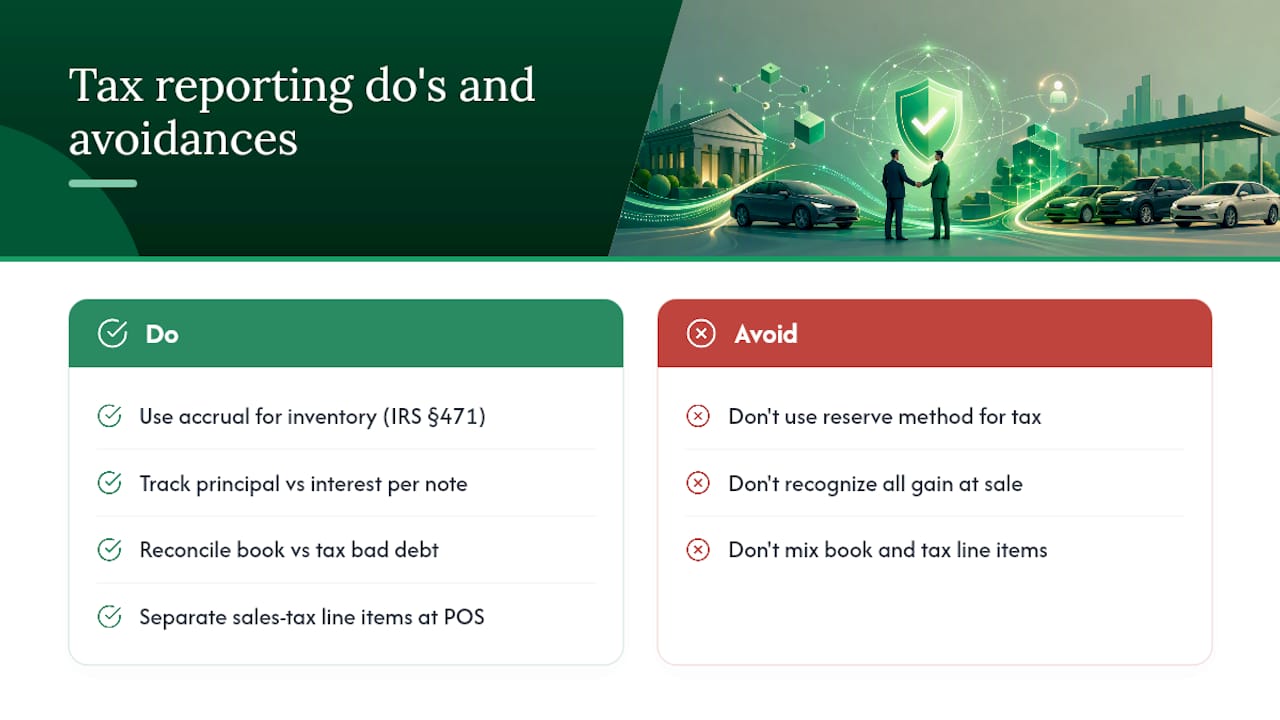
BHPH dealers generally have a choice between cash-basis and accrual-basis tax reporting, but that choice carries real weight once inventory and installment notes are involved. Most dealers with inventory are required to use accrual accounting for tax purposes under IRS rules tied to Section 471, meaning revenue and cost recognition timing for tax reporting should mirror the capitalization approach used for recon and transport costs discussed earlier in this guide.
Installment sale treatment is where things get specific to BHPH. The installment method allows you to spread the recognition of gain over the period you actually collect payments rather than recognizing it all at the point of sale. That can smooth taxable income across years, but it also requires meticulous tracking of each note’s principal and interest components, since only the gain portion of principal collections gets deferred, not the interest.
Bad debt deductions for repossessed and charged-off accounts follow their own rules, and they don’t automatically match your book allowance for credit losses. Tax law generally requires a specific charge-off method rather than a reserve method for bad debts, which means your book reserve (the allowance you use for financial reporting) and your tax deduction timing can diverge. Keep a reconciliation schedule between the two so your CPA isn’t rebuilding it from scratch every filing season.
Sales tax and use tax on vehicle sales add another layer, since rates and rules on trade-in credits, doc fees, and warranty add-ons vary by state and sometimes by county. A dealer accounting system that separates these line items cleanly at the point of sale saves hours of reconstruction work when it’s time to file.
Cash Flow Management for BHPH Dealerships
Cash flow in a BHPH operation looks nothing like cash flow in a retail-only lot, because most of your revenue arrives in small monthly installments instead of a lump sum at the point of sale. That mismatch between when you spend cash (acquiring and reconditioning inventory) and when you collect it (over 24 to 48 months of payments) is the single biggest operational risk on a BHPH lot.
Floorplan financing exists precisely to bridge that gap, letting you acquire inventory without tying up all your working capital at once. But floorplan curtailments demand cash on a schedule that doesn’t care whether your collections are running ahead or behind that month, so forecasting curtailment due dates alongside expected collections needs to happen weekly, not monthly.
Down payment policy is your first cash flow lever. A dealer collecting adequate down payments recovers acquisition and recon cost faster and reduces exposure if the note goes bad later. Dealers who compete on minimal down payments often win more deals upfront and bleed cash for years afterward when delinquency catches up.
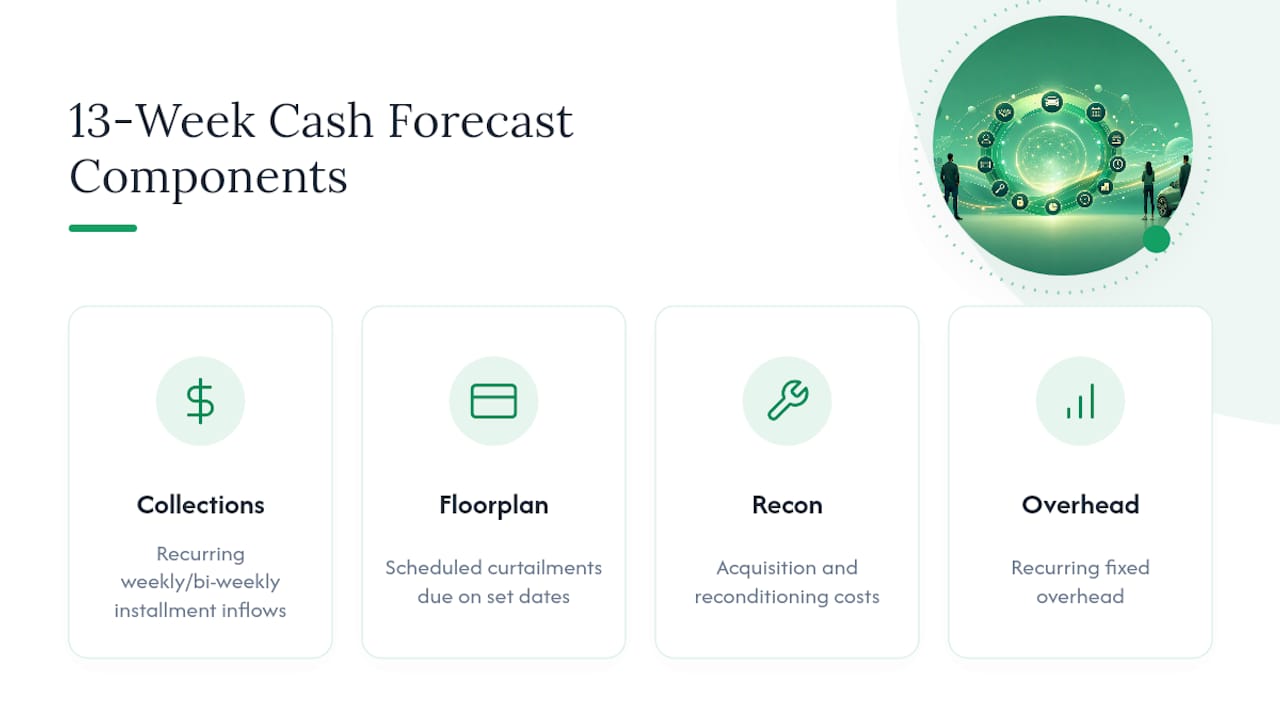
Collections cadence matters just as much as collections policy. Weekly or bi-weekly payment structures, common in BHPH, create more frequent but smaller cash inflows, which smooths your weekly cash position but requires tighter payment-processing discipline than a monthly-payment retail loan. Build a rolling 13-week cash flow forecast that separates collections, floorplan curtailments, recon spending, and fixed overhead, so you can see a cash crunch coming before it arrives instead of after.
What I’d Fix First If I Ran Your Books
If you fixed only one thing this month, reconcile your notes receivable subledger against your DMS and true up your allowance for credit losses. Everything else, per-VIN costing, floorplan tracking, KPI dashboards, matters less if the core receivable number is already wrong. Run the month-end checklist described above within 30 days, then lean on the Dealer Academy for the reserve and close templates that make the second month faster than the first.
— Eric Dosset
Get Your Books Built for BHPH, Not Retrofitted for It
Loturn exists because generic accounting software was never built to handle notes receivable, unearned finance income, or reserve modeling the way a BHPH lot needs. It automates the parts of this guide that eat the most hours: per-VIN costing that updates as recon invoices post, finance reserve accounting that supports static pool and roll-rate methods, and DMS data mapping that keeps your GL and subledgers aligned without manual reconciliation every month.
Setup may include data import to avoid manually rebuilding deal history, and data security measures are typically applied to protect information while you work. If your books currently blend sale revenue with note face value, or your reserve hasn’t been touched since last tax season, start by looking at Loturn’s dealer accounting tools and see what a rebuild actually takes.
Sources
- Buy-here-pay-here used-car lot accounting: installment note receivable & repo reserve guide
- Accounting for special finance and BHPH differences
FAQ
What are the 7 basic accounting categories?
The core categories are assets, liabilities, equity, revenue, expenses, gains, and losses. For a BHPH dealer, notes receivable and unearned finance income sit inside the assets and liabilities categories but deserve their own dedicated line items rather than being lumped into generic accounts.
What are the 5 basic accounting skills?
Recording transactions accurately, reconciling accounts, interpreting financial statements, managing cash flow, and applying revenue recognition rules correctly are the five core skills. BHPH dealers lean hardest on reconciliation and revenue recognition, since those two areas cause the most misstated financials on dealer lots.
How does a BHPH dealership work from an accounting standpoint?
A BHPH dealer sells a vehicle and simultaneously originates a loan, so the accounting treats these as two distinct events: sale revenue recognized at delivery, and a note receivable recorded separately with unearned finance income amortizing over the loan term.
What are BHPH accounting principles in practice?
The core principles are separating the sale from the loan, capitalizing recon and transport costs per VIN, and maintaining a documented allowance for credit losses tied to actual delinquency and recovery data rather than a rough estimate.
What software helps automate BHPH accounting basics?
Platforms like Loturn are built specifically around per-VIN costing, finance reserve accounting, and dealer-specific chart-of-accounts structures, which generic accounting software typically can’t replicate without heavy manual customization.