
Floorplan utilization analysis measures how your floorplan borrowing and days-on-lot convert into real interest cost, so you can see the drain before it shows up in your monthly statement. Run it with five numbers: inventory turns, days on lot, daily interest accrual per unit, curtailment timing, and your inventory-to-floorplan ratio. Track those weekly and you catch aging units, protect your credit line, and cut per-unit interest before it eats your gross.
TL;DR:
- Keeping inventory turns at 8 to 12 annually helps prevent interest costs from surpassing recoverable margins, with 12 turns considered ideal in used-vehicle operations.
- Units exceeding 45 days on lot should prompt pricing or channel adjustments within the same week to avoid interest escalation, especially beyond 60 days which require wholesale evaluation.
- Daily logging of five key data points per vehicle and weekly review of aging buckets and turn rate trends enables proactive management of aging inventory and interest costs.
- A dashboard focused on aging heatmap, interest accrual, curtailment alerts, trend lines, and loan headroom improves engagement and reduces the likelihood of late remittance or audit failures.
- Implementing automated software that tracks per-vehicle interest, curtailment, and remittance can save time, prevent errors, and support better compliance and negotiation with lenders.
Table of Contents
- What Floorplan Utilization Analysis Actually Measures
- How to Run a Floorplan Utilization Analysis Every Week
- Building a Dashboard That Actually Gets Used
- What Your Lender Is Actually Watching
- The Levers That Actually Cut Your Interest Bill
- Why Most Dealers Only Measure This After It’s Too Late
- How Loturn Handles the Floorplan Math for You
- Where to Verify These Numbers
- Sources
- FAQ
What Floorplan Utilization Analysis Actually Measures
Floorplan utilization analysis is the practice of tracking how much of your floorplan credit line is tied up in aging inventory versus units that are turning fast enough to justify the interest cost. Most dealers call this “watching the floorplan,” but that phrase hides what’s actually happening: every day a car sits unsold, it accrues interest, and that interest quietly erodes the gross you thought you’d made.
The core formula starts with inventory turns, calculated as cost of goods sold divided by average inventory cost, annualized. Convert that into days on lot by dividing 365 by your turn rate. A dealer turning inventory 12 times a year, the target NADA’s inventory analysis guide treats as healthy for used operations, averages roughly 30 days on lot. Fall to eight turns and you’re averaging closer to 46 days, which is where interest cost starts outpacing what pricing discipline can recover.
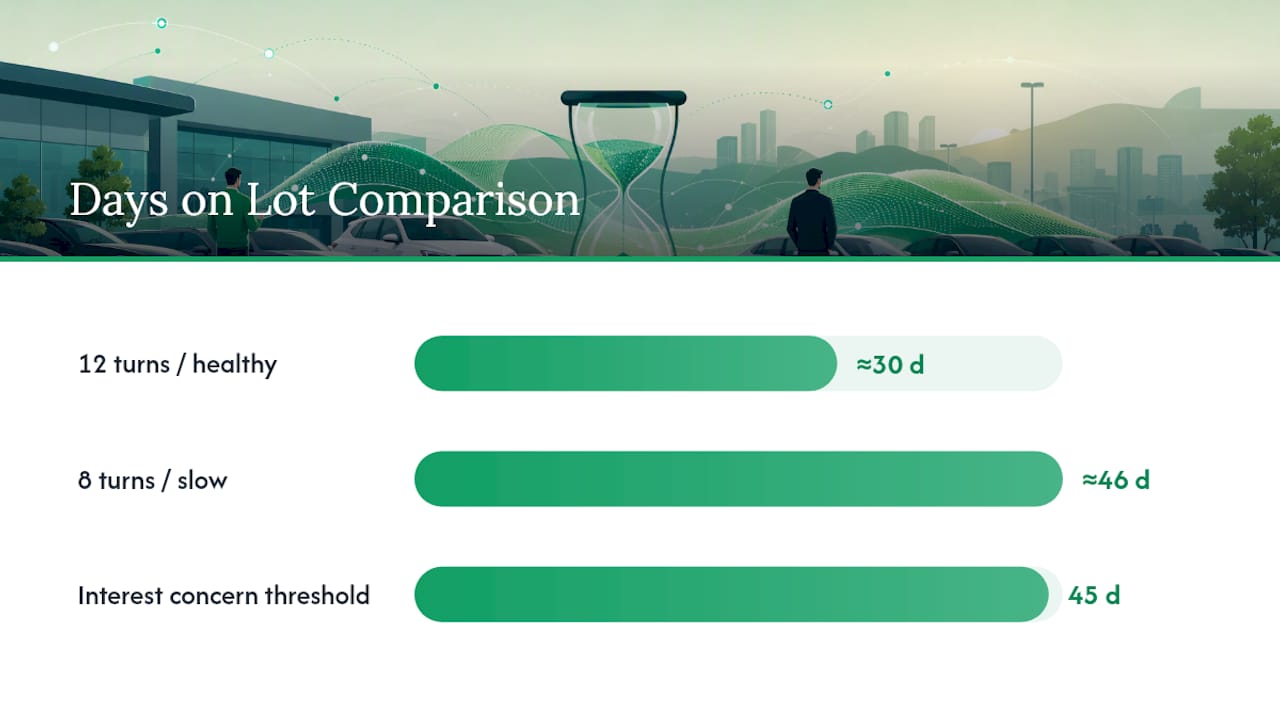
Per-unit daily interest is simpler than most managers assume: multiply the vehicle’s floored cost by the annual rate, then divide by 365. Hold it 60 days instead of 30, and you’ve spent an extra $259 in interest alone, before lot rent, insurance, and depreciation. Combined carrying costs on a 90-day hold of a similar vehicle can exceed $2,500 once you stack all four.
Your inventory-to-floorplan ratio, the share of your outstanding balance tied to units still on the lot versus units sold but not yet remitted, is what lenders watch most closely. A ratio that climbs steadily signals slow turns or delayed remittance, either of which invites tighter terms.
| Aging bucket | Days on lot | Typical action |
|---|---|---|
| Fresh | 0–30 | Hold price, monitor |
| Watch | 31–45 | Review pricing, check demand |
| Action | 46–60 | Price cut or wholesale evaluation |
| Critical | 60+ | Wholesale or trade immediately |
- Target 8 to 12 turns per year for a healthy used-vehicle operation
- Keep 60% or more of inventory inside the 0 to 30 day bucket
- Flag anything crossing 45 days for a pricing or channel decision the same week
How to Run a Floorplan Utilization Analysis Every Week
You don’t need new software to start this. You need a daily habit and a place to log five fields per VIN: floored cost, floor date, current rate, curtailment due date, and days on lot. Most DMS platforms already capture these; the problem is nobody pulls them together into one view.
- Daily (10 to 15 minutes): Pull the aging report, flag any unit hitting a curtailment date in the next 7 days, and total yesterday’s interest accrual across the lot.
- Daily: Reconcile yesterday’s sales against remittances sent to the lender. A sale not remitted within your lender’s window is the single fastest way to trigger an out-of-trust flag.
- Weekly: Run the bucket report (0 to 30, 31 to 45, 46 to 60, 60 plus) and share a one-page summary with sales managers so pricing decisions happen before month-end panic sets in.
- Weekly: Compare this week’s turn rate against your trailing 12-week average. A dip of more than one full turn is worth a floor walk.
- Monthly: Total floorplan interest paid, divide by units sold, and track that per-unit interest figure over time. Rising cost per unit sold, even with flat inventory, usually means aging is creeping up quietly.
- Monthly: Check covenant compliance against your loan agreement, specifically advance rate usage and any sublimit thresholds you’re approaching.
Pro Tip: Build the daily 10 minute scan into someone’s actual job description, not a “when I get to it” task. The dealers who let this slip almost always blame the lender for tightening terms, when the real problem was three weeks of unflagged 60 day units.
Building a Dashboard That Actually Gets Used
A good floorplan dashboard has five widgets, not fifteen. More than that and nobody checks it daily, which defeats the point.
- Aging heatmap showing every VIN colored by bucket, so a slow corner of the lot is visible at a glance
- Daily interest accrual as a running total, so the dollar cost of aging isn’t an abstraction
- Curtailment watchlist listing units approaching their curtailment date, sorted by urgency
- Turn-rate trend line over the trailing 12 weeks, not just a single snapshot number
- Floorplan balance versus advance limit, so you see headroom before you’re bumping against it
Set alert thresholds that trigger a specific action, not just a notification. A unit crossing 45 days should automatically prompt a pricing review; a unit crossing 60 should trigger a wholesale evaluation the same day. Early alerts at these checkpoints, paired with weekly reconciliation, are what stock-management research points to as the difference between catching aging early and discovering it during a lender audit.
Reconcile your dashboard numbers against your lender’s statement monthly. A mismatch of even a handful of units usually points to a remittance timing issue rather than a real inventory problem, but you want to find that out before your lender does.
What Your Lender Is Actually Watching
Floorplan agreements aren’t uniform, but most independent dealers are working under the same basic structure: an advance rate against each vehicle’s cost, a curtailment schedule that forces partial paydown at set intervals, and sublimits that cap how much of your line can sit in aged inventory. The Comptroller’s Handbook on floor plan lending outlines advance rates for used vehicles that commonly run 90 to 100% of cost, with curtailment terms tied to how long a unit has been floored.
Audit triggers are predictable once you know what to watch for:
- Out-of-trust sales, meaning a vehicle sold but not remitted within the lender’s required window
- Late remittances, typically flagged once they pass 24 to 48 hours
- Missing or mismatched titles during a physical count
- VIN counts on the lot that don’t match the lender’s floorplan report
Lenders also track your floorplan-to-inventory ratio and remittance timeliness as ongoing risk signals, not just audit-day checks. The fix is procedural: a daily remittance habit, rotating physical counts you run yourself before the lender does, and retained documentation on every unit. Dealers who keep books clean and F&I performance strong consistently negotiate better renewal terms, since audit readiness is one of the clearest signals a lender uses to judge risk.
The Levers That Actually Cut Your Interest Bill
Not every fix costs the same effort, so work in this order.
- This week: Apply price discipline to anything past 45 days. WardsAuto’s reporting on dealer floorplan practices supports a strict 45-day guideline for used inventory, and units past that point rarely sell themselves out of the hole with patience alone.
- This week: Set a hard trigger to wholesale or trade any unit approaching its curtailment date rather than eating the curtailment and continuing to hold it.
- Next few weeks: Tighten your acquisition filters based on what’s actually aging, not what you assumed would sell.
- Next few weeks: If you run multiple lots, reallocate slow trims to the location where that body style is actually moving instead of letting it age in place.
- Ongoing: Fix recon bottlenecks. A unit sitting in recon for 10 extra days is accruing floorplan interest the whole time, even though it isn’t technically for sale yet.
- Financial planning: Build curtailment payments into your monthly cash forecast rather than reacting to them, since curtailments create step-function cash demand that catches unprepared dealers off guard and forces fire-sale wholesale decisions.
Pro Tip: Run the math on one action before you commit staff time to it. If moving a $30,000 unit from 60 days to 30 days saves roughly $150 in interest but costs $400 in a wholesale discount, that’s not a win. Compare the actual dollar savings against the actual dollar cost every time.
Why Most Dealers Only Measure This After It’s Too Late
The dealers who struggle with floorplan cost almost never lack the data. They lack the habit of looking at it daily instead of at month-end, when the interest is already spent and the only options left are painful ones.
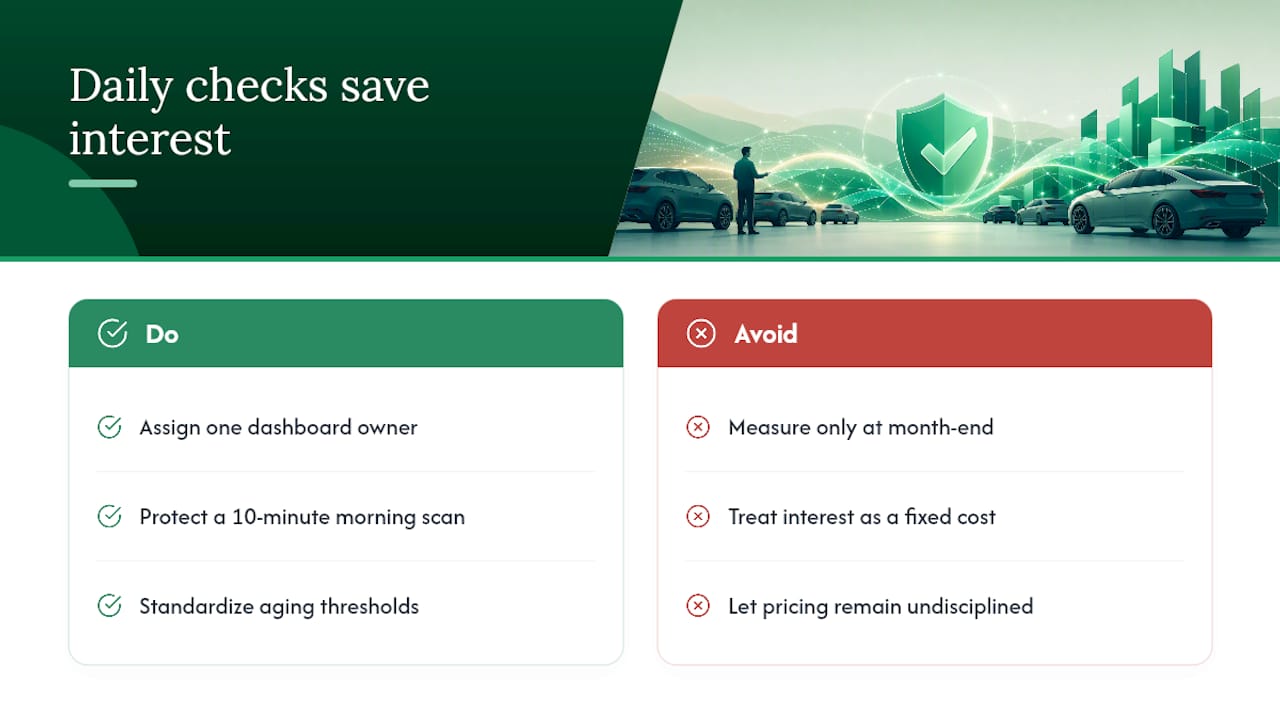
I’d argue the biggest misconception in this business is that floorplan interest is a fixed cost you absorb, like rent. It isn’t. It’s the most controllable variable expense on your income statement, because it’s directly tied to how fast you move metal, and turn speed responds to daily decisions, not quarterly strategy sessions.
Adoption is simpler than dealers expect: assign one person to own the dashboard, protect a 10-minute morning scan on their calendar, and standardize your aging thresholds so pricing decisions stop being a debate every single week.
— Eric Dosset
How Loturn Handles the Floorplan Math for You
Running this workflow by hand in a spreadsheet works, until you’re managing 40 units across two lots and the daily reconciliation eats an hour instead of ten minutes. Some financial management platforms track per-vehicle floorplan interest, curtailment dates, and carrying cost automatically, on the same screen where purchase price, transport, and recon costs are tracked.
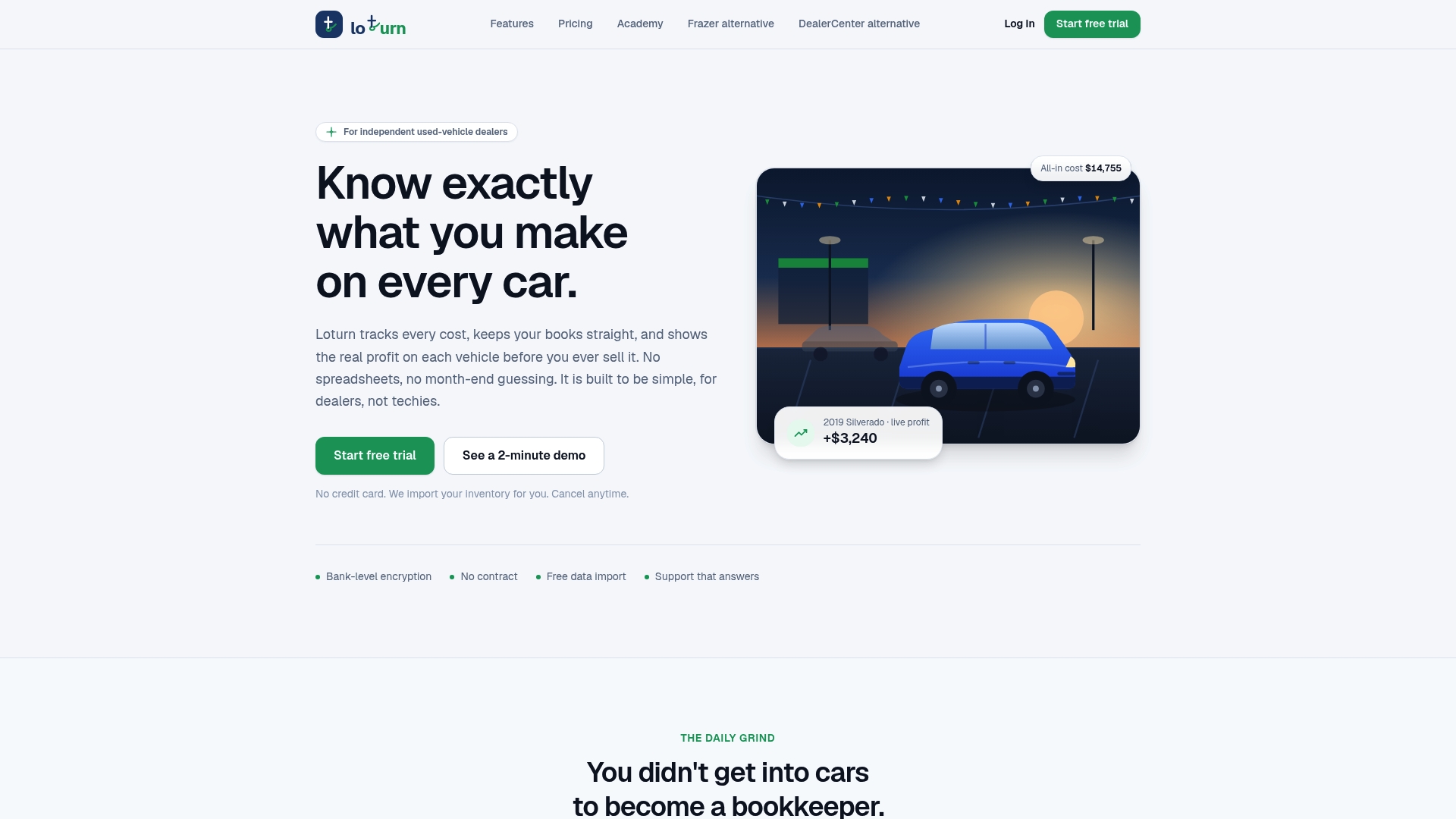
Every vehicle shows live floorplan interest accrual alongside its running gross, helping dealers see units that are accruing interest before this results in larger financial issues. Such platforms may include free inventory data import during setup, data security measures, and customer support during migration from existing systems. Pricing runs flat monthly across three plans: Flipper at $99, Dealer at $349, and Multi-Lot at $699, with no per-transaction add-ons. If you want the underlying mechanics first, the floor plan financing guide walks through curtailment math in more depth before you look at pricing.
Where to Verify These Numbers
- Comptroller’s Handbook: Floor Plan Lending, for advance rates and curtailment structure
- NADA’s inventory analysis guide, for turn-rate formulas and benchmark targets
- WardsAuto’s coverage of dealer floorplan practices, for aging guidelines
- Loturn Academy’s floor plan financing resources, for dealer-specific workflow guidance
- For general profitability and cash-planning context, this small-business profitability guide covers finance checks worth pairing with your floorplan review
Sources
- Comptroller’s Handbook: Floor Plan Lending (OCC)
- OCC exam handbook: inventory financing (excerpts)
- NADA inventory analysis guide (sample forms and turn calculations)
- Floorplan power plays: what smart dealers do differently (WardsAuto)
FAQ
What is a good inventory turn rate for a used-car dealer?
Most healthy used-vehicle operations target 8 to 12 turns per year, with NADA’s benchmark treating roughly 12 turns as the ideal for used inventory. That works out to an average of about 30 days on lot per unit.
How do I calculate floorplan interest per vehicle?
Multiply the vehicle’s floored cost by the annual interest rate, then divide by 365 to get a daily figure.
What triggers a floorplan audit failure?
The most common triggers are out-of-trust sales, where a vehicle sells but isn’t remitted within the lender’s required window, and late remittances typically flagged past 24 to 48 hours. Missing titles and VIN count mismatches during a physical count round out the list.
How often should I review my floorplan utilization?
Check daily for curtailment dates and remittance status, review aging buckets weekly, and run a full financial reconciliation monthly against your lender’s statement. That cadence catches aging units before they become curtailment problems.
Can software track floorplan interest automatically?
Yes. Platforms like Loturn track per-vehicle floorplan interest, curtailment timing, and carrying cost alongside purchase price and recon costs, which removes the manual reconciliation most dealers currently do in spreadsheets.