
Trade-ins and dealer exchanges are balance-sheet events, not income events. When a customer trades a car, you debit used-vehicle inventory for the allowance or fair value and adjust the receivable or sale proceeds; profit shows up only when that unit resells. Your first job is attaching a defensible cost basis to the VIN, allowance plus recon, transport, and accrued floor-plan interest, and pulling the paperwork that backs it up.
TL;DR:
- Trade-ins are recorded at cost, including allowances, recon, transport, and interest, with profit recognized only upon resale of the vehicle.
- Dealer exchanges are booked as inventory transfers if settled immediately, but may be treated as sales if there is a delay or retained risk of loss.
- Most dealers use per-VIN costing for used inventory, tracking acquisition costs and costs related to recon, transport, and interest in real time to ensure accuracy.
- Floor-plan interest adds ongoing costs that must be accrued daily and reconciled monthly to prevent accounting discrepancies and audit issues.
- Proper documentation, including signed agreements, valuations, payoff statements, and photos, is critical for audit compliance and should be attached immediately upon vehicle intake.
Table of Contents
- What Is a Dealer Trade in Accounting Terms, and Why Does It Matter?
- How Do You Record a Customer Trade-In? A Step-by-Step Guide
- How Should Dealer Exchanges (DX) Be Posted?
- Which Inventory Valuation Method Fits Trade-Ins Best?
- How Does Floor-Plan Interest Affect Trade Accounting?
- What Belongs on the Month-End Checklist for Trade Accounting?
- How Per-VIN Cost Tracking Maps to Your Accounting Controls
- Disciplined Trade Accounting Cuts Cost and Audit Risk
- Put Per-Car Costing on Autopilot With Loturn
- Sources
- FAQ
What Is a Dealer Trade in Accounting Terms, and Why Does It Matter?
A customer trade-in happens when a buyer applies the value of their current vehicle toward a purchase. A dealer exchange (often shortened to DX) is different: it’s a swap between two dealerships, usually to get a specific unit a customer wants without paying full wholesale for it. Both look similar on paper, but they hit the books differently than a cash sale.
Here’s the part that trips up a lot of bookkeepers: neither transaction generates revenue at the moment it happens. The trade-in vehicle lands on your inventory schedule at cost, not at the number printed on the deal jacket. You only recognize gain or loss when that traded unit actually sells to a new customer, a point confirmed by standard trade-in journal entry practice.
A few distinctions worth keeping straight from day one:
- Customer trade-ins move a used vehicle onto your books at an agreed allowance or fair market value, whichever your appraisal policy defines.
- Dealer exchanges often involve holdback, co-op, or Lease Assistance Money (LAM) contributions that franchise dealers must track separately.
- Independent used-vehicle dealers rarely deal with factory holdback, but they still need the same per-unit cost discipline when acquiring inventory through exchanges with other independents or at auction.
How Do You Record a Customer Trade-In? A Step-by-Step Guide
The core entry is simpler than most new bookkeepers expect, but the supporting work is where accuracy lives or dies.
- Debit Inventory, Used Vehicles for the trade allowance (or fair value, if you use a separate appraisal standard) and credit Accounts Receivable or reduce the recorded sales proceeds on the new-vehicle deal.
- Post recon invoices directly to the VIN. Every reconditioning cost, detail, tires, mechanical work, gets coded to that unit’s inventory record, not to a general shop-expense account.
- Hold the unit at cost until resale. When the traded vehicle sells, move the accumulated cost (allowance plus recon plus transport) to Cost of Goods Sold and recognize the gross profit then, matching the treatment Journal Entries Hub lays out for trade-in acquisitions.
- Flag the gap when allowance differs from fair market value. If you gave a customer a trade allowance higher than the unit’s appraised value using NADA or KBB guides, some dealers book the difference as a marketing or sales-incentive expense rather than inflating inventory cost. Either method works as long as it’s applied consistently.
Documentation is not optional paperwork you get to later. Auditors and floor-plan lenders want a signed trade-in agreement, a written appraisal referencing an industry valuation guide, the payoff statement on any lien, an odometer disclosure, and photos of the vehicle’s condition at intake. Missing pieces here are the single most common reason a trade-in entry gets questioned during a dealer audit, according to documentation checklists built around trade-in acquisition accounting.
Pro Tip: Scan and attach every trade-in document to the deal jacket the same day you take the vehicle in. Waiting until month-end means someone is reconstructing an appraisal from memory, and that’s how audit findings happen.
How Should Dealer Exchanges (DX) Be Posted?
A dealer exchange gets a slightly different entry structure because money or credit often moves between two dealership entities instead of just adjusting one deal.
- Record the incoming unit to Inventory at the agreed exchange value, the same way you’d book any acquired vehicle.
- Post factory holdback, LAM contributions, or co-op advertising credits to Other Income when your franchise agreement makes you eligible for them, following the account structure GM’s own accounting manual for new-vehicle inventory uses as a model.
- Settle the difference in value with cash or an inter-dealer receivable, depending on whether the exchange was even-value or one side owed the other.
Whether a DX should be treated as a straight inventory transfer or a full sale comes down to timing. If title transfers and settlement happens immediately, it’s a clean inventory swap. If there’s a delay, or if one party retains risk of loss until the unit physically moves, some dealer accountants argue it should be booked as a sale with a matching purchase, particularly when the two dealerships are unrelated entities filing separate returns.
Which Inventory Valuation Method Fits Trade-Ins Best?
Most independent used-vehicle dealers use specific unit costing, sometimes called per-VIN costing, rather than FIFO or LIFO pooling. That’s because used inventory isn’t fungible the way new-vehicle allocations are; a 2021 Silverado with 40,000 miles is not interchangeable with another 2021 Silverado that has different history and condition.
Franchise dealers selling new vehicles more commonly use LIFO for tax purposes, which lowers taxable income during periods of rising vehicle costs, but LIFO comes with a conformity requirement. If you use it for tax reporting, you generally must use it for your financial statements too, and switching methods later triggers its own set of adjustments, a point dealer-specific CPA guidance covers in detail.
- For trade-in valuation, set the acquisition figure using a consistent policy tied to NADA or similar market guides, then document any deviation from that number.
- Track the difference between allowance and appraised fair value in a separate account so it doesn’t quietly distort your gross profit reporting later.
- If you run LIFO on new inventory, maintain the LIFO reserve schedule every period; skipping it is one of the fastest ways to fail a lender or CPA review.
How Does Floor-Plan Interest Affect Trade Accounting?
Floor-plan interest accrues daily on financed inventory, and it adds real cost to every unit sitting on your lot, trade-in or not. A vehicle that’s been floored for 75 days carries meaningfully more interest expense than one that sold in 12, even if the acquisition cost was identical.
- Calculate the daily accrual based on your floor-plan rate and the outstanding balance on each unit, then post it to the vehicle’s carrying cost, not as a lump general ledger expense.
- Record curtailment payments or paydowns as they hit your floor-plan statement, reducing the principal balance tied to that specific VIN.
- Reconcile the lender’s statement against your vehicle inventory schedule monthly. Pull days-on-lot for every unit and confirm the interest accrual matches what the lender actually charged.
Mismatches between the floor-plan balance and the VIN schedule are where most dealership accounting errors surface, and they compound fast if left uncorrected for more than one cycle, according to dealer accounting workflow analysis. Reviewing how floor-plan curtailment math works before you build your reconciliation process saves a lot of guesswork later.
Pro Tip: Run your floor-plan reconciliation weekly, not just at month-end. A four-week gap between checks turns a $200 discrepancy into a $2,000 one before anyone notices.
What Belongs on the Month-End Checklist for Trade Accounting?
Every dealership needs a set of schedules that prove the balance-sheet numbers are real, not just plausible. For trade-ins and exchanges specifically, that means:
- A VIN-level vehicle inventory schedule showing acquisition cost, allowance, recon, transport, and accrued interest for every unit on hand.
- Contracts in transit, tracking retail deals sent to the bank but not yet funded.
- Factory receivables, warranty receivables, chargeback reserves, and we-owes, the open promises (accessories, repairs, second keys) tied to closed deals.
The five-step close that works well for trade-heavy dealerships: reconcile cash and contracts in transit, reconcile floor-plan balances against the inventory schedule, prove every supporting schedule ties to the general ledger, post accruals and recognize income on units that delivered, then review gross profit deal by deal, a sequence WickedFile’s dealer accounting breakdown recommends as standard practice. Each deal jacket for a trade-in or exchange should hold the appraisal, payoff statement, title documentation, and every recon invoice tied to that VIN, matching the same file structure covered in state-specific dealer form requirements.
How Per-VIN Cost Tracking Maps to Your Accounting Controls
The accounting principle is straightforward: attach every dollar to the unit it belongs to. The hard part is doing it consistently across dozens or hundreds of vehicles without a spreadsheet falling apart by the third week of the month.
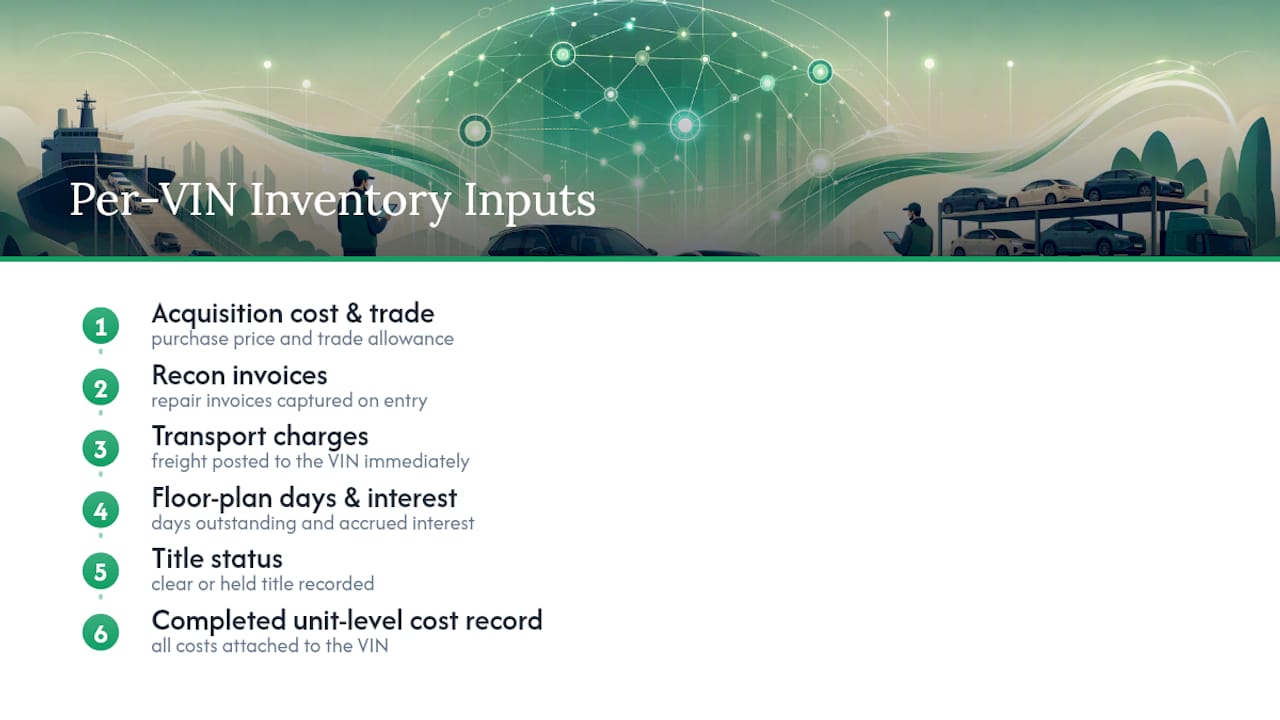
A system built for this needs to capture, per VIN: acquisition cost and trade allowance, every recon invoice as it’s entered, transport charges, floor-plan days and accrued interest, and title status. When those fields stay current in real time instead of getting batched at month-end, your inventory schedule is already proven before you start the close, which is the exact discipline dealer-focused financial coverage points to when it argues that deal-level cost tracking is what separates accurate gross from guesswork. Loturn builds its per-car profit tracking around this exact structure, so recon and transport costs land on the VIN the moment they’re entered rather than sitting in a general ledger bucket waiting for someone to sort them out later.
Disciplined Trade Accounting Cuts Cost and Audit Risk
Most dealerships treat trade-in accounting as an afterthought bolted onto the sale, and that’s backwards. The trade-in is the transaction where cost accuracy matters most, since nobody watches it as closely as they watch the retail sale price. Do the five-step close every month without skipping steps, and bring in a dealership CPA for LIFO elections, holdback treatment, or anything touching your tax return. In-house staff can absolutely handle the daily postings and reconciliations once the schedules are built correctly.
— Eric Dosset
Put Per-Car Costing on Autopilot With Loturn
Loturn is built for dealers who are done reconstructing gross profit from a spreadsheet and a stack of recon invoices at month-end. It applies the same discipline this article walks through, per-VIN cost tracking, automatic recon and transport assignment, floor-plan interest tracked to the day, and a chart of accounts built for dealership operations instead of retrofitted from generic bookkeeping software.

Every acquisition, whether it’s a customer trade-in or a dealer exchange, gets logged with its full cost history from day one, so your vehicle inventory schedule is already proven when the close starts. Data is protected with bank-level encryption, and onboarding includes free data import so you’re not rebuilding your inventory records from scratch. If you’re currently piecing this together across QuickBooks and a whiteboard, see how per-car profit tracking works and start a trial to see your real gross on every unit before your next month-end close.
Sources
- How to Master the Journal Entry for Trade-In Vehicle Acquisitions | Journal Entries Hub
- 231 New Cars (GM accounting manual)
- Car Dealership Accounting: How It Works — WickedFile
- Report of cash payments over $10,000 received in a trade or business: motor vehicle dealership Q&A (IRS)
FAQ
What Is the Journal Entry for a Vehicle Trade-In?
Debit Inventory, Used Vehicles for the trade allowance or fair value, then credit Accounts Receivable or reduce the recorded sales proceeds on the new-vehicle deal; gross profit posts only when the traded unit resells, per standard trade-in accounting practice.
What Is the “Dealer Trick” in Accounting?
The most common issue isn’t intentional fraud, it’s letting trade-in allowance and appraised fair value diverge without tracking the difference, which quietly inflates inventory cost and distorts gross profit on the eventual resale.
How Much Does a Car Salesman Make Off a $20,000 Car?
Commission structures vary widely by dealership and pay plan, but they’re typically a percentage of the front-end gross profit on the deal, not the full sale price, so the actual payout depends heavily on acquisition cost, recon, and any spiff or bonus tied to that specific unit.
What Accounting Systems Do Dealerships Use?
Dealerships range from generic small-business software adapted with workarounds to dealer-specific platforms built around a per-VIN chart of accounts; tools like Loturn’s dealer accounting features are designed specifically for used-vehicle inventory, recon costing, and floor-plan tracking rather than retrofitted general ledgers.
Do Dealer Exchanges Get Reported to the IRS?
Cash payments over $10,000 tied to a trade or business transaction, including some dealer exchange settlements, fall under IRS reporting rules, and dealerships should retain documentation supporting how the transaction was valued and settled, per IRS dealership guidance.