
Floorplan interest gets expensed as incurred under US GAAP, not capitalized into inventory cost. For most dealerships, it’s also carved out of the Section 163(j) business interest limitation on federal returns, which usually makes it fully deductible, though claiming that carve-out can cost you bonus depreciation elsewhere. The practical work is simpler than the tax nuance: accrue interest daily, keep it in its own general ledger account, and reconcile against your lender’s statement every month.
TL;DR:
- Floorplan interest accrues daily based on the outstanding balance of each vehicle, with a typical APR around 7.5%, resulting in measurable monthly costs.
- US GAAP requires dealers to expense floorplan interest as incurred, not add it to inventory value, which simplifies reconciliation and tax reporting.
- Electing the floorplan interest carve-out from Section 163(j) usually makes interest fully deductible but disqualifies dealers from claiming bonus depreciation for that year.
- Monthly reconciliations must verify VIN-level balances and curtailments to prevent timing mismatches and ensure accurate interest calculation.
- Automating interest tracking with specialized software reduces errors, improves visibility, and streamlines Form 8990 preparation compared to manual spreadsheets.
Table of Contents
- What Is Floorplan Interest and How Do Lenders Charge It?
- How Do You Calculate Floorplan Interest?
- GAAP Treatment: Expense It, Don’t Capitalize It
- How Does Section 163(j) Treat Floorplan Interest on Federal Returns?
- What Does a Month-End Floorplan Reconciliation Look Like?
- What Actually Lowers Your Floorplan Interest Cost?
- How Loturn Supports Floorplan Interest Accounting
- What Most Dealership Accountants Get Wrong Here
- Get Floorplan Interest Off Your Spreadsheet and Into Your Books
- Sources
- FAQ
What Is Floorplan Interest and How Do Lenders Charge It?
Floorplan interest is the carrying cost on a revolving line of credit that finances your vehicle inventory, with each unit pledged as collateral by VIN. Lenders track exposure at the unit level and expect you to pay down or “curtail” a portion of the balance on a schedule, often at 30, 60, or 90 day marks, regardless of whether the vehicle has sold.
Most facilities charge simple interest, calculated daily as APR divided by 365 and applied to the outstanding balance. That structure means every day a car sits unsold adds a small, measurable cost to your floor.
- Interest accrues daily on the unit’s outstanding floorplan balance, not just at billing.
- Curtailment schedules force partial paydowns even before a sale closes.
- Origination and renewal fees are separate from interest and should never share a GL line with it.
- Manufacturer floorplan assistance, common during promotional periods, offsets interest for a set holding window and should be booked as a reduction to interest expense, not as other income.
Lenders manage these facilities as asset-based lending arrangements, with advance rates tied to a borrowing base and periodic field audits to confirm collateral, according to the Comptroller’s Handbook on accounts receivable and inventory financing. Expect an audit, and keep your VIN and lien documentation current.
How Do You Calculate Floorplan Interest?
The formula behind nearly every dealer floorplan statement is the average daily balance method:
Interest = ADB × (APR ÷ 365) × days in period
Here’s how to build the ADB and apply it:
- Pull the daily ending floorplan balance for each unit or the portfolio over the period.
- Sum those daily balances and divide by the number of days in the period to get the ADB.
- Multiply the ADB by the daily rate (APR ÷ 365).
- Multiply that result by the number of days in the billing period to get total interest.
Say a typical unit carries a floorplan balance for about a month at a common APR rate around 7.5%. The daily interest on such an average unit accrues at a modest daily rate, resulting in a measurable carrying cost that adds up through the month. Multiply that cost across a fleet of units with similar balances, and monthly carrying expenses become a significant factor, which is why lenders and floorplan cost calculators rely on the average daily balance method rather than static snapshots.
A vehicle carrying a typical floorplan balance at a moderate interest rate accrues a small daily interest cost that can total several hundred dollars over a couple of months, excluding any fees or curtailments.
GAAP Treatment: Expense It, Don’t Capitalize It
US GAAP requires you to expense floorplan interest as it’s incurred rather than adding it to the vehicle’s carrying cost. ASC 835-20 limits interest capitalization to assets being constructed or otherwise prepared for their intended use, and a used vehicle sitting on your lot ready for resale doesn’t qualify, according to practitioner guidance on ASC 835-20. Capitalizing it anyway would bury your true carrying cost inside inventory value and make it harder to see which units are actually profitable.
The journal entries are straightforward once the GL is structured correctly.
Accrual entry (typically daily or at each period close):
- Debit: Floorplan Interest Expense
- Credit: Accrued Floorplan Interest Payable
Payment entry (at curtailment or unit payoff):
- Debit: Accrued Floorplan Interest Payable (interest portion)
- Debit: Floorplan Payable (principal portion)
- Credit: Cash
Keep interest, fees, and principal in three separate GL accounts under your floorplan payable structure. Lumping them together is the single most common misclassification finance teams make, and it makes both reconciliation and tax prep harder than it needs to be.
Pro Tip: Set up your chart of accounts with a dedicated “Floorplan Interest Expense” line separate from all other interest expense before your first month-end close. Retrofitting this after a year of blended entries means manually reconstructing every transaction to isolate the floorplan piece for Form 8990.
How Does Section 163(j) Treat Floorplan Interest on Federal Returns?
Section 163(j) generally caps the business interest expense deduction at 30% of adjusted taxable income, but floorplan financing interest carries a specific statutory carve-out that exempts it from that limitation, according to IRS guidance on the business interest expense limitation. For many dealers, that makes floorplan interest effectively fully deductible regardless of the 30% cap.
The trade-off: electing the floorplan interest carve-out disqualifies you from claiming bonus depreciation on vehicles and other qualifying property for that year. That’s a meaningful decision, not a formality.
- Floorplan interest must be reported and isolated on Form 8990 separately from other business interest, since the carve-out only applies to that specific category.
- Dealers with heavy capital spending (new equipment, facility upgrades, service department build outs) may lose more from forfeited bonus depreciation than they gain from the interest carve-out.
- Model both positions every year: the carve-out with lost bonus depreciation, versus the 30% ATI cap with bonus depreciation preserved, since the right answer changes based on capital expenditures and interest magnitude.
Run this modeling with your tax preparer before year-end, not after. The election has real cash consequences either direction, and it depends on numbers only your finance team has visibility into.
What Does a Month-End Floorplan Reconciliation Look Like?
Reconciling floorplan interest is really an inventory reconciliation wearing an accounting hat. Get the unit-level tie-out wrong and the interest number will be wrong no matter how clean your journal entries look.
- Pull the lender’s VIN-level statement for the period, showing balance, curtailment activity, and interest charged per unit.
- Match every VIN against your dealer management system inventory to confirm which units are still floored.
- Flag units marked sold in your DMS that still show an outstanding floorplan balance with the lender, and vice versa.
- Reconcile curtailment amounts charged against your own curtailment schedule to catch timing mismatches.
- Isolate the interest expense line and confirm it matches your accrued daily balances before posting the final adjusting entry.
The most common breakdowns are timing lags between a sale and the lender’s payoff processing, sold units that never got flagged for payoff, and curtailment amounts that don’t match your internal schedule. Daily ADB reporting and a monthly variance report between your books and the lender statement catch most of these before they become an audit finding, a practice dealer accounting guides consistently recommend.
What Actually Lowers Your Floorplan Interest Cost?
Interest cost is a function of balance and time, and time is the lever you control. Inventory turn is the single biggest driver of floorplan cost per unit, because every extra day in stock adds a predictable, compounding charge.
- Prioritize recon on units close to curtailment deadlines so they hit the lot ready to sell before the paydown clock runs out.
- Price aging inventory more aggressively once it crosses your dealership’s average days-in-stock threshold.
- Build a same-day payoff workflow so sold units get flagged and paid off with the lender immediately, not at week’s end.
- Track manufacturer floorplan assistance expiration dates by unit so you’re not caught paying full interest after the credit window closes.
- Revisit your APR, origination fees, and curtailment terms with your lender annually. Rates and terms are negotiable, especially with strong payment history.
Pro Tip: Run a weekly “aging floor” report sorted by days until next curtailment. Units within 10 days of a curtailment deadline should jump to the top of your recon and pricing priority list, not the bottom.
How Loturn Supports Floorplan Interest Accounting
Manually tracking daily accruals across dozens or hundreds of units in a spreadsheet is where most reconciliation errors start. A per-car costing engine can attribute floorplan interest to each VIN automatically, allowing carrying cost to accumulate in real time rather than requiring reconstruction at month-end.
- Per-VIN interest accumulation tied directly to inventory records, not a separate spreadsheet.
- Segregated GL accounts for floorplan interest, fees, and principal can match the structure this article recommends.
- Reconciliation reports can be designed to help tie books to lender statements without manual VIN matching.
- Reference material on curtailment math and finance reserve accounting in the Loturn academy for teams building out these controls for the first time.
Automating the daily math means your Form 8990 prep starts with clean, already-isolated floorplan interest figures instead of a manual sort through blended interest expense.
What Most Dealership Accountants Get Wrong Here
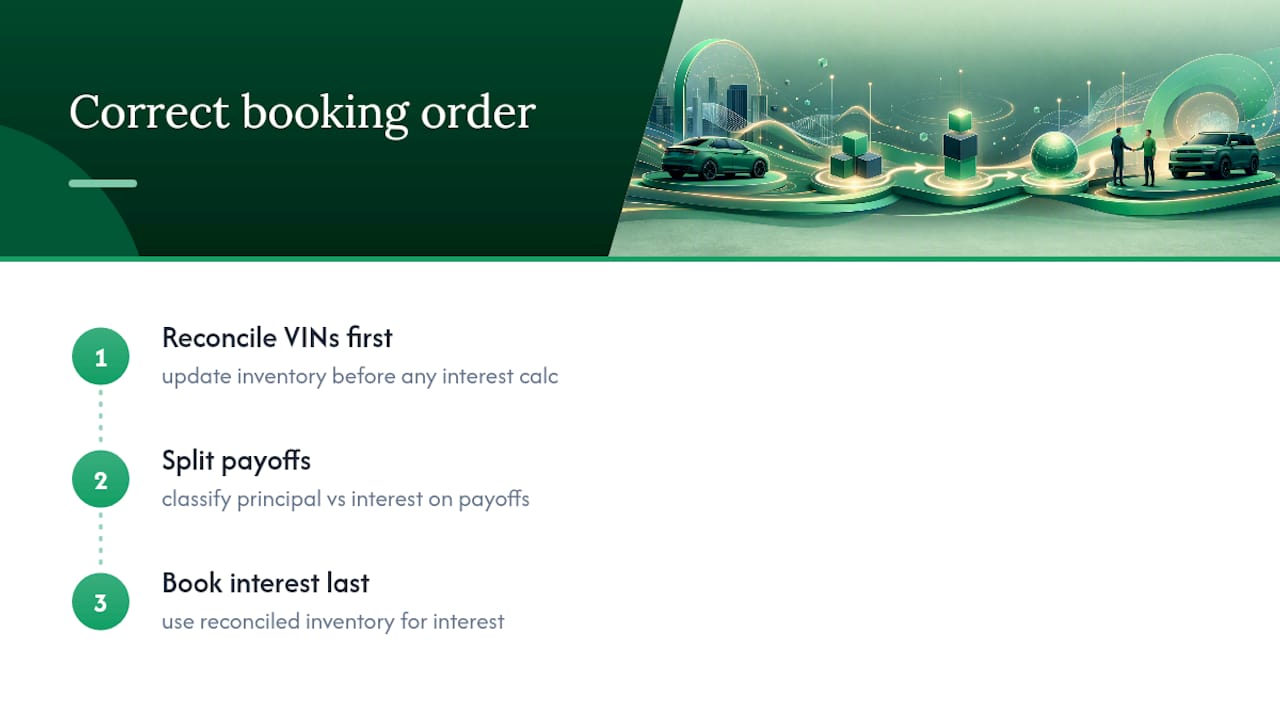
The errors that cost dealers the most aren’t complicated. They’re misclassifying a payoff entry as pure interest instead of splitting principal and interest, or letting VIN reconciliation slide for two or three months until the gap between the lender statement and the books becomes a real project to untangle.
If you fix one thing, fix the order of operations: reconcile VINs before you book interest, not after. Interest calculated against a stale or incorrect inventory list is wrong by definition, and every downstream entry inherits that error.
— Eric Dosset
Get Floorplan Interest Off Your Spreadsheet and Into Your Books
Most dealers still manage floorplan interest with a side spreadsheet and a monthly scramble to match it against the lender’s statement. That works until volume grows, curtailment dates start slipping past you, and Form 8990 season arrives with a mess to untangle. This system is built specifically for independent used-vehicle dealers who need per-car cost visibility, not a generic accounting system retrofitted for automotive.

Loturn’s dealer accounting tools track floorplan interest per VIN alongside every other cost tied to a vehicle, from acquisition to transport to recon, so your true per-car profit is visible before you ever list it for sale. GL accounts for interest, fees, and principal can stay separated automatically, with reconciliation reports built to match against lender monthly statements without a manual VIN hunt. Setup can include data migration from existing systems, so switching may not require rebuilding books from scratch. Start a free trial and see your first floorplan reconciliation come together in minutes instead of an afternoon.
Sources
- IRS Q&A about the limitation on the deduction for business interest expense
- Floorplan interest cost calculator — AutoAuctionAtlas
- Comptroller’s Handbook: Accounts receivable and inventory financing (ARIF)
- Is Floor Plan Financing Interest Expense Deductible? — LegalClarity
FAQ
What Is Floor Plan Financing Interest Expense?
It’s the interest charged on a revolving line of credit that finances your vehicle inventory, calculated daily against each unit’s outstanding balance and expensed as incurred under GAAP rather than added to inventory cost.
Can You Give an Example of Floorplan Financing?
A dealer floors a used vehicle at a common APR around 7.5%; the lender charges daily interest based on the outstanding balance, and the dealer must curtail part of the balance on a set schedule, typically every 30 to 90 days, until the unit sells or is paid off.
What Is Floorplan Lending?
Floorplan lending is asset-based financing where a bank or captive lender extends a revolving credit line secured by vehicle inventory, with each VIN serving as individual collateral under a borrowing-base structure.
What Is a Floorplan Credit Line?
It’s the total revolving credit facility a dealership draws against to purchase inventory, with the outstanding balance, curtailment requirements, and interest rate governed by the lender’s borrowing-base agreement and UCC lien filings.
Is Floorplan Interest Fully Deductible on Federal Taxes?
For most dealers, yes. Floorplan interest is generally excluded from the Section 163(j) limitation, but claiming that carve-out disqualifies you from bonus depreciation for that tax year, so the trade-off needs annual modeling with your tax preparer.