
Specific identification inventory tracks the exact cost of each individual item from purchase to sale, giving you an ending inventory value and cost of goods sold that match reality instead of an average. Use it when you can uniquely tag every unit and reliably record what it actually cost, which is why it fits vehicles, jewelry, art, and heavy equipment far better than a shelf of identical widgets.
TL;DR:
- Specific identification tracks each item’s actual purchase cost, making it ideal for high-value, low-volume inventories like vehicles, jewelry, or art.
- Accurate cost allocation relies on unique identifiers such as VINs, serial numbers, or RFID tags, which are recorded at intake and tied to all associated expenses.
- The method’s precision allows for exact COGS and ending inventory calculations, but it can lead to earnings volatility and potential manipulation risks without proper controls.
- Shared costs like transportation are allocated proportionally across units at intake, ensuring each sale reflects the true cost of the specific item.
- Automation and strict recordkeeping are essential to manage overhead and ensure auditability when using the specific identification inventory valuation method.
Table of Contents
- What Is the Specific Identification Method?
- How Specific Identification Works: A Worked Example
- When Should You Use Specific Identification?
- Advantages and Disadvantages of Specific Identification
- Specific Identification vs. FIFO, LIFO, and Weighted Average
- Implementing Specific Identification: Recordkeeping and Controls
- Practical Tools for Per-Item Costing
- Choosing Accuracy Over Simplicity
- Get Per-Car Accuracy Without the Manual Work
- Sources
- FAQ
What Is the Specific Identification Method?
Specific identification assigns an actual, traceable cost to every unit of inventory rather than applying a cost-flow assumption across a pool of interchangeable goods. FIFO assumes the oldest cost leaves first. LIFO assumes the newest cost leaves first. Weighted average blends everything together. Specific identification skips the assumption entirely and asks: what did this exact item cost you?
That only works if each unit carries a permanent identifier. Common options include:
- Vehicle Identification Numbers (VINs) for cars, RVs, and boats
- Serial numbers for machinery, electronics, and equipment
- Title numbers for titled assets
- RFID tags or lot numbers for jewelry, art, and custom manufacturing runs
“Cost” under this method isn’t just the sticker price you paid. It includes the purchase price plus any allocable expense tied to getting that item ready for sale, such as transport, insurance, and reconditioning. Financial reporting standards generally accept item-level costing for inventory that’s genuinely non-interchangeable, though this is a practical accounting approach rather than legal guidance, and you should confirm treatment with a tax professional for your specific situation.
How Specific Identification Works: A Worked Example
The mechanics follow a consistent sequence, whether you’re costing a single sedan or a warehouse of custom furniture:
- Tag the item with a unique identifier at intake (VIN, serial number, RFID tag).
- Record its purchase cost at the moment of acquisition.
- Allocate any shared costs, like a shipment of three vehicles on one transport invoice, across the units it covers.
- At the point of sale, pull the exact recorded cost for that specific unit.
- Relieve that unit’s full cost from inventory and post it to cost of goods sold.
Here’s how that plays out with three vehicles bought together. A dealer buys three used sedans on one invoice for $30,000 total, then pays $900 for a single transport run covering all three.
Vehicle costs before allocation: Car A cost $9,000, Car B cost $10,000, Car C cost $11,000.
Allocated transport cost: Splitting the $900 shipping bill evenly adds $300 to each vehicle, bringing total landed cost to $9,300, $10,300, and $11,300.
If the dealer sells Car A and Car C during the month, specific identification sets COGS at exactly $9,300 plus $11,300, or $20,600. Car B, still on the lot, sits in ending inventory at its actual $10,300 cost, not some blended average of the three.
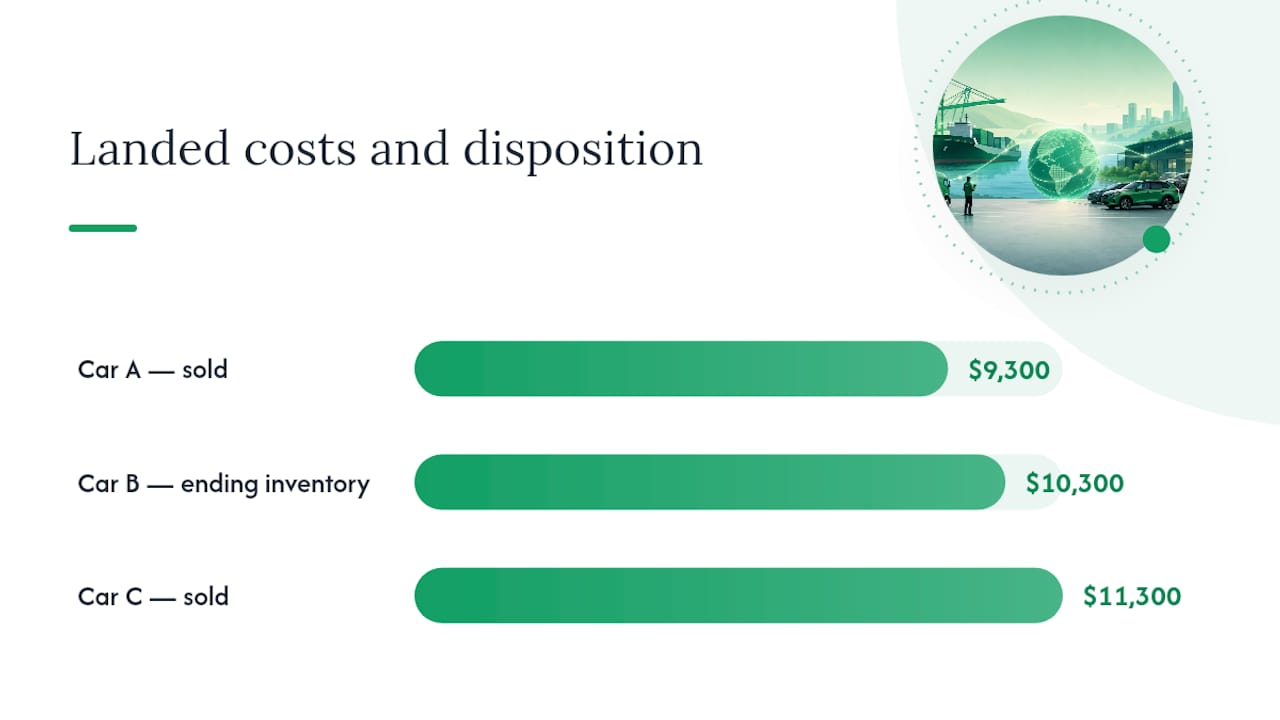
Which receipts land in COGS versus ending inventory depends entirely on transaction dates. Your inventory-aging data tells you which units are still on hand, how long they’ve sat there, and which cost record attaches to each one once it finally sells.
When Should You Use Specific Identification?
This method earns its keep with high-value, low-turn inventory, not with anything you buy by the pallet. Industries where it’s the practical default include:
- Vehicle dealerships (cars, RVs, boats, motorcycles, trailers)
- Jewelry and fine goods dealers
- Art dealers and galleries
- Heavy equipment and machinery sellers
- Custom manufacturers running job-order costing
The specific identification method works because each unit is genuinely distinct and usually valuable enough to justify the tracking effort. A rough threshold: if an item is worth tagging individually and you sell fewer than a few dozen of that type per month, specific identification is realistic. Once you’re moving thousands of identical SKUs, like a grocery distributor or a bulk hardware retailer, the per-unit tracking overhead stops paying for itself and FIFO or weighted average becomes the more efficient choice.
Advantages and Disadvantages of Specific Identification
| Advantage | Disadvantage |
|---|---|
| Matches actual cost to actual item sold, no averaging distortion | Requires labor and systems to tag and track every unit |
| Produces precise ending inventory and COGS figures | Allocating shared costs across units adds complexity |
| Supports tax-lot selection for assets like securities and collectibles | Opens the door to management manipulation by choosing which unit’s cost hits COGS |
The manipulation risk is real. Because you’re selecting which specific unit’s cost becomes cost of goods sold, a seller could quietly pick the highest-cost unit to shrink taxable profit, or the lowest-cost unit to inflate it, depending on which number looks better that quarter. Formal, documented lot-selection rules and an audit trail) close that gap.
Pro Tip: Automate tagging at intake instead of doing it manually at sale time. If a VIN or serial number gets entered into your system the day you acquire the item, there’s no room to “choose” a cost later. The record already exists.
Specific Identification vs. FIFO, LIFO, and Weighted Average
When prices are rising, FIFO pushes older, cheaper costs into COGS and inflates reported profit. LIFO does the opposite, pushing recent, higher costs into COGS and shrinking taxable income. Weighted average smooths both extremes into a single blended figure. Specific identification does none of that. It reports whatever the actual unit cost, full stop, which means your earnings can swing more sharply from one sale to the next.
Most businesses skip specific identification not because it’s inferior, but because it’s impractical at volume:
- High-volume, uniform goods (canned food, screws, T-shirts) make per-unit tracking pointless since units are truly interchangeable
- FIFO and weighted average require far less recordkeeping infrastructure
- LIFO can offer tax deferral in inflationary periods that specific identification doesn’t provide by design
For a dealer selling forty cars a month, though, the earnings volatility from specific identification isn’t a bug. It’s the whole point, because it tells you the real margin on each vehicle rather than a fiction smoothed over the fleet.
Implementing Specific Identification: Recordkeeping and Controls
A working system needs a few non-negotiable pieces:
- Unique ID capture at intake. Every unit gets a VIN, serial number, or RFID tag logged the day it arrives.
- Timestamped purchase records. Cost, date, and source tied permanently to that identifier.
- A documented allocation method for shared costs like freight or insurance, applied consistently, not case by case.
- Sales transaction linkage. Every sale record pulls the exact unit’s cost, no substitutions.
Inventory-aging reports are where this all comes together. A useful aging report tracks these fields:
| Field | What it tells you |
|---|---|
| On-hand quantity | How many units remain unsold |
| On-hand value | Total cost tied up in remaining units |
| Inventory value | Running valuation across all buckets |
| Aging buckets | How long each unit has sat since intake |
| Average unit cost | Sanity check against individual tags |
For dealers running dozens of units across multiple lots, saving and exporting these reports beats running ad hoc queries every time an accountant asks a question. On the controls side, require documented authorization before anyone selects which lot’s cost applies at sale, run monthly reconciliations between physical counts and book value, and keep exported reports on file. That combination is what makes an audit painless instead of a scramble.
Practical Tools for Per-Item Costing
Spreadsheets can handle specific identification for a handful of units, but they buckle once you’re tracking dozens of vehicles with recon, transport, and floorplan costs stacking up on each one. A platform built for per-VIN costing automates the parts that break down manually:
- Capturing acquisition price, transport, and recon cost against a single VIN automatically
- Generating audit trails without a separate spreadsheet layer
- Reconciling per-car profit against the aging report without manual cross-checking
That maps directly onto the checklist above: less manual allocation, fewer reconciliation surprises at month-end.
Choosing Accuracy Over Simplicity
Specific identification costs you time and systems overhead most methods don’t demand. I’d still choose it for any high-ticket, low-volume inventory where profit per unit actually varies, because a blended average hides exactly the information you bought the system to see. The fix for the overhead isn’t skipping the method. It’s automation, a written lot-selection policy, and an audit trail nobody can argue with.
— Eric Dosset
Get Per-Car Accuracy Without the Manual Work
Some platforms are built to help dealers manage specific identification day to day, with records covering acquisition price, transport, and recon cost per vehicle, so your cost of goods sold and ending inventory reflect what each car really cost rather than a shop-wide average.

That per-car view feeds straight into per-car profit tracking, so you see real margin on every unit as it sells instead of waiting for a month-end spreadsheet to tell you the truth. If you’re currently piecing this together across sticky notes and separate ledgers, start with the dealer accounting features page to see what a purpose-built system looks like, or check pricing to find the plan that fits your lot size.
Sources
- Specific Identification Method for Inventory Valuation — Fit Small Business
- Specific identification inventory valuation method — Investopedia
- Inventory aging report storage — Microsoft Learn
FAQ
What Is the Specific Identification Method for Inventory?
It’s an inventory valuation method that assigns the actual purchase cost to each individual unit, tracked by a unique identifier like a VIN or serial number, rather than applying a cost-flow assumption across similar items.
How Do You Calculate Ending Inventory Under Specific Identification?
Add up the exact recorded cost, including allocated shared expenses, of every unit still on hand. There’s no averaging: each unsold unit contributes its own actual cost to the total.
What Is an Example of the Specific Identification Method?
A used-car dealer who buys three vehicles on one invoice, allocates the shared transport cost across them, and then records the exact cost of each specific car as COGS when that car sells is using specific identification.
How Can You Tell if a Company Uses FIFO or LIFO Instead of Specific Identification?
Check the inventory footnote in the financial statements, which discloses the cost-flow method used; specific identification is unusual outside industries with unique, high-value units like vehicles, art, or jewelry.