
Time to line (T2L) is the number of days between when you acquire a vehicle and when it’s parked on the lot, priced, and ready to sell. Best-in-class independent dealers hold that number to 3 to 5 days; most stores run far longer without realizing it. Every extra day adds holding cost and delays the next turn, so T2L isn’t a back-office stat. It’s a direct lever on gross profit.
TL;DR:
- Most stores do not track all aspects of vehicle acquisition, missing delays caused by transport, paperwork, or inspection, which inflate T2L estimates.
- Reducing T2L by a few days can significantly increase inventory turns and Gross Profit through lower holding costs and fresher listings.
- Accurate T2L measurement starts from acquisition date and ends when the vehicle is priced and listed, not just repairs or recon completion.
- Simple tracking methods, like a per-VIN log in a spreadsheet, can identify bottlenecks and improve process visibility within a week.
- Target best-in-class T2L of 3 to 5 days, especially for high-volume dealers, by mapping every step, assigning ownership, and running daily process reviews.
Table of Contents
- What Time to Line Actually Measures
- Why Time to Line Drives Your Bottom Line
- How to Measure Time to Line at Your Store
- What Good Time to Line Looks Like By Dealer Type
- The Fastest Ways to Cut Time to Line
- Turning Days Saved Into Real Gross: A Worked Example
- Making Time to Line Visible: Per-VIN Costing in Practice
- A GM’s Weekly Checklist for Time to Line
- See Your Real T2L and True Profit on Every Car
- Sources
- FAQ
What Time to Line Actually Measures
T2L starts at the acquisition timestamp, the moment you take title or the vehicle physically arrives, whichever your process defines as the trigger. It ends at the frontline-ready timestamp, when the car is priced, photographed, and listed. Everything between those two points counts, not just the shop time.
That distinction trips up a lot of dealers. Rapid Recon’s analysis of recon time versus full T2L points out that stores often track only mechanical and cosmetic recon, missing the days lost to title work, transport delays, or a car sitting untouched before anyone even opens a work order. Real T2L includes all of it.
Common measurement errors worth avoiding:
- Starting the clock at “arrival at the shop” instead of acquisition, which hides transport and intake delays.
- Ending the clock at “recon complete” instead of “listed and priced,” which hides photo and paperwork lag.
- Averaging T2L across the whole month without separating different acquisition sources, since they may have different profiles.
Why Time to Line Drives Your Bottom Line
Every day a vehicle sits unsold costs money, whether that’s floorplan interest, insurance, storage, or simple depreciation risk on a car losing market relevance. Trade estimates commonly use a conservative range of $30 to $40 per day in holding cost per unit, and that number compounds fast across a 20 or 30 car lot.
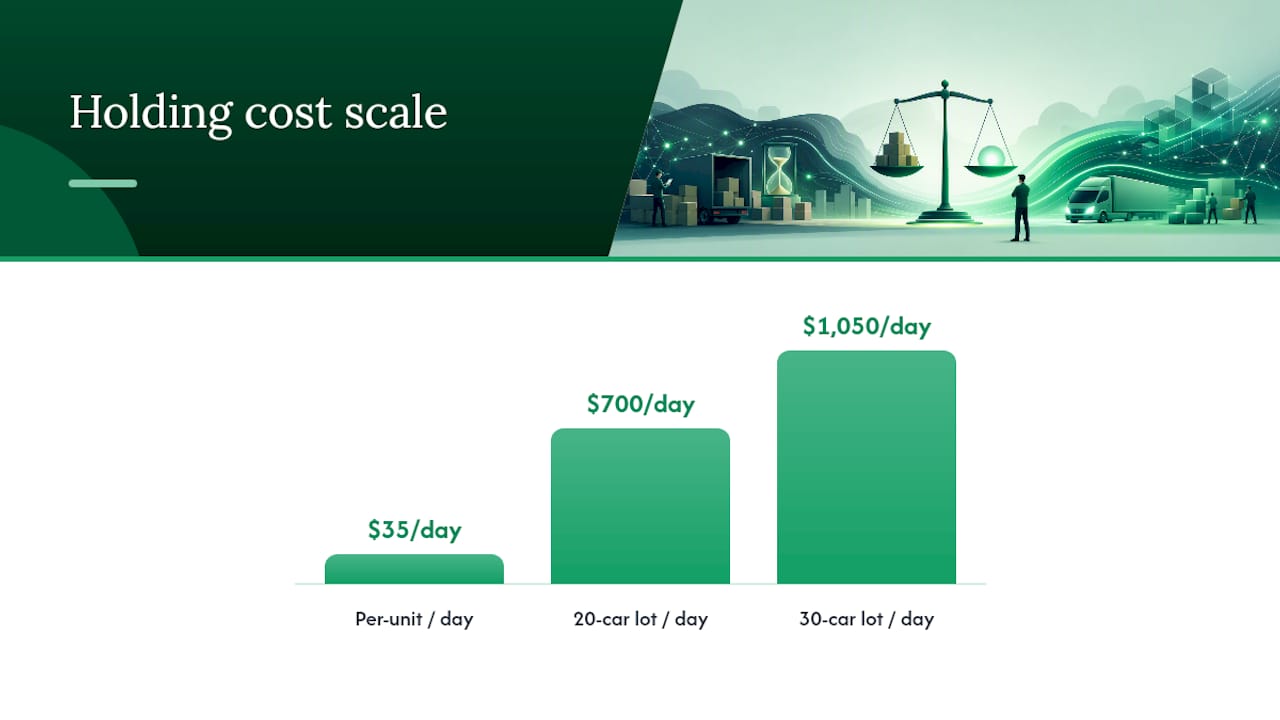
Cutting T2L by a few days can add roughly one extra inventory turn per year for many dealers, according to trade analysis on the connection between T2L and turn velocity. More turns from the same capital means more gross without buying a single additional car.
A few reasons this compounds beyond the obvious:
- Faster T2L means fresher listings, which tend to price and sell better before a vehicle ages into markdown territory.
- Reduced floorplan exposure frees up buying power sooner, letting you replace inventory faster.
- Lower holding cost per unit protects margin even before the car sells.
How to Measure Time to Line at Your Store
You don’t need enterprise software to start tracking T2L accurately. A simple per-VIN log, whether inside your DMS, a recon workflow tool, or a shared spreadsheet, gets you a usable baseline within a week.
- Capture two timestamps per VIN: acquisition date and frontline-ready date. Nothing else is mandatory to start.
- Add step-level timestamps if you want diagnostic detail: intake, mechanical inspection start, mechanical complete, detail complete, photos taken, listed.
- Calculate T2L per unit: frontline-ready date minus acquisition date, in calendar days, not business days.
- Log every VIN daily rather than batching it weekly. Delayed data entry is the single biggest reason recon tracking falls apart.
- Review a rolling 30-day average, not single-car outliers, since one weather delay or parts backorder shouldn’t skew your whole read on process health.
A basic spreadsheet needs just six columns: VIN, acquisition date, frontline-ready date, T2L (days), acquisition source (trade-in, auction, wholesale), and a notes field for delay causes. That notes field matters more than people expect. It’s where you’ll spot patterns, like a specific vendor or a specific reconditioner consistently running slow.
Pro Tip: Tag each VIN’s acquisition source in your log. Trade-ins and auction buys almost always have different T2L profiles, and blending them into one average hides which channel actually needs fixing.
What Good Time to Line Looks Like By Dealer Type
Industry sources put the average independent dealer somewhere in the 10 to 12 day range, while operators who’ve invested in workflow discipline routinely hit 3 to 5 days. That gap isn’t about budget. It’s about process visibility.
Targets should flex by business model:
- High-volume independents moving 40+ units a month should push hard toward the 3 to 5 day range, since holding cost scales fast with volume.
- BHPH dealers often carry older, higher-mileage inventory needing more mechanical work; a realistic first-year target is closer to 6 to 8 days, tightening from there.
- Franchise-affiliated used departments with dedicated shop capacity can often match the best-in-class range once photo and pricing steps are standardized.
The Fastest Ways to Cut Time to Line
Most T2L bloat isn’t mechanical. It’s coordination. Cars sit waiting for someone to make a decision, assign a task, or approve a part, not because the work itself takes long.
- Map every step from acquisition to listing and cut anything that doesn’t add value, including duplicate inspections or unnecessary sign-offs.
- Assign a single owner per vehicle with a clear service-level agreement, such as “mechanical assessment within 4 business hours of intake.”
- Run a daily recon stand-up, five minutes, reviewing every car currently in process and flagging what’s stuck. Time management frameworks built around short daily check-ins translate directly to recon floors.
- Pre-negotiate parts and sublet SLAs with vendors so a windshield or alignment doesn’t add three days to a car that’s otherwise ready.
- Standardize your photo and listing SOP so cars don’t wait on a photographer’s schedule after recon wraps.
For sublet work like glass, tires, or detail, a reliable vendor relationship matters as much as the shop’s own speed. Parts logistics partners such as Anytime Fuel Pros illustrate the broader point: any external dependency in your workflow needs its own SLA, or it becomes your bottleneck by default.
Pro Tip: Pick one week and name a “recon flow owner,” someone whose only job is to chase every stuck car and report blockers at day’s end. Dealers who try this almost always find the same two or three chokepoints causing most of the delay.
Turning Days Saved Into Real Gross: A Worked Example
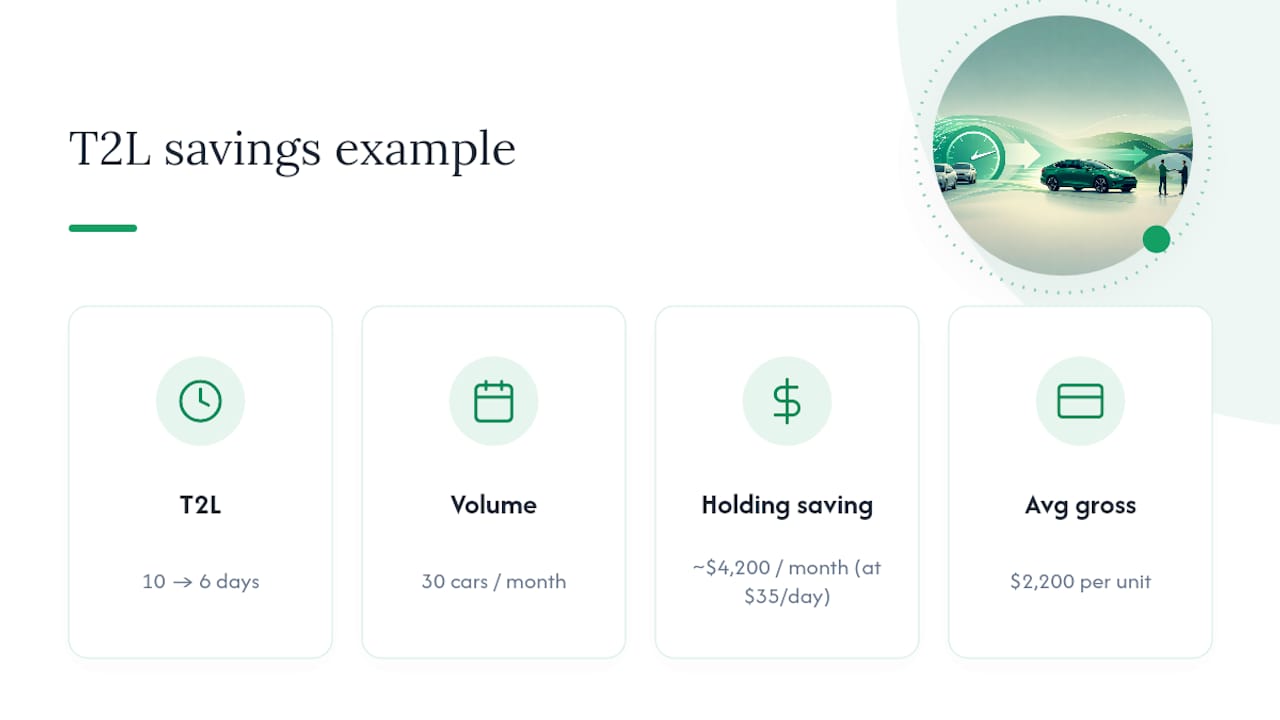
The math connecting T2L to profit is straightforward once you have a baseline. Assume a dealer sells 30 cars a month, carries average gross of $2,200 per unit, and cuts average T2L from 10 days to 6.
A 4-day T2L reduction on 30 units a month saves roughly $4,200 a month in holding cost alone, before counting the added gross from extra turns. That figure moves with your own holding-cost assumption; a dealer using $30/day instead of $35 will see a smaller number, and one carrying higher floorplan rates will see more. Run it with your own numbers rather than borrowing this one, since the turns math scales directly with your specific volume and gross.
Making Time to Line Visible: Per-VIN Costing in Practice
The reason T2L stays invisible at most stores is simple: recon costs and holding costs live in different systems, or nowhere at all. Per-VIN costing fixes that by tying every dollar, and every day, to a specific car from the moment it’s acquired.
A typical workflow looks like this: a vehicle is acquired and logged, recon tasks get assigned with owners and due dates, parts and labor costs attach directly to that VIN as they’re incurred, and the car gets marked retail-ready the moment it clears the final step. Loturn’s acquisition and recon tracking builds this timeline automatically, which means you get an auditable T2L number per car without a separate tracking spreadsheet.
- Recon and holding costs attach to the VIN in real time, not after the sale.
- Task assignment creates natural accountability, since delays show up against a name, not a vague “in process” status.
- Quick setup options and data import features can help dealers start logging T2L efficiently.
A GM’s Weekly Checklist for Time to Line
Put T2L on the same weekly agenda as sales and gross. Pull the rolling 30-day average every Monday with your sales manager and reconditioner in the room, and look at outliers first, not the average.
Start with one KPI and one experiment. Pick your worst acquisition channel, appoint a flow owner for two weeks, and measure the delta. If T2L drops, you’ve found your next process fix. If it doesn’t, the bottleneck sits somewhere your data isn’t yet capturing, which is itself useful information. KPI cadence built around small, testable changes beats a big process overhaul most stores never finish.
— Eric Dosset
See Your Real T2L and True Profit on Every Car
Loturn attaches recon costs, holding costs, and every dollar spent to the exact VIN it belongs to, so your T2L numbers connect directly to what each car actually earns instead of living in a separate spreadsheet.
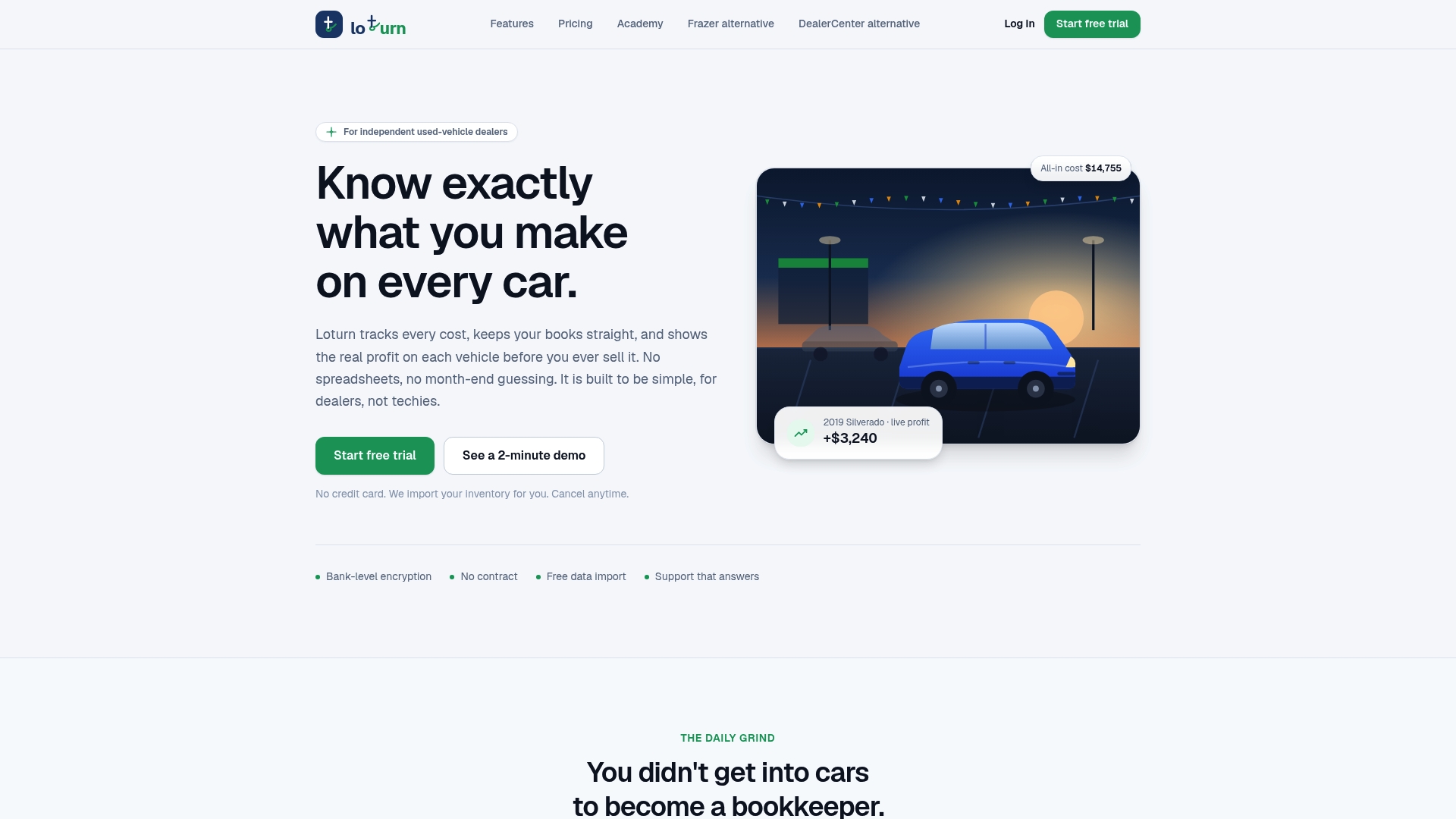
Instead of reconciling recon invoices against a generic chart of accounts, you see acquisition cost, recon spend, and days on lot lined up against one vehicle, updated as the work happens. That’s the gap most dealership accounting tools leave open: they track money, not time, and T2L needs both. Loturn’s per-car profit tracking shows exactly where gross erodes while a car sits waiting on parts or paperwork. If you’re ready to see what your own T2L numbers are actually costing you, start with Loturn’s dealer accounting features or request a walkthrough to see your inventory’s true days-to-line broken down car by car.
Sources
- Whatever your used-car volume, claim the advantage
- Recon Time vs Time-to-Line | Rapid Recon
- Happy With Your Time to Line? - AutoSuccessOnline
FAQ
Which Is Correct: “Timeline” or “Time to Line”?
They’re different terms entirely. “Timeline” refers to a chronological sequence of events, while “time to line” (T2L) is a dealership metric measuring days from acquisition to frontline-ready.
What Are the Techniques Used in Time Line Therapy?
Time Line Therapy is a personal-development technique unrelated to automotive recon metrics; it deals with mapping personal memories along an imagined timeline, not vehicle reconditioning. It has no connection to how dealers calculate or manage T2L.
How Many Days Should Time to Line Take?
Best-in-class dealers target 3 to 5 days, while industry averages commonly run from 10 to 12 days for stores without structured recon tracking.
What’s the Difference Between Recon Time and T2L?
Recon time only covers mechanical and cosmetic work in the shop, while full T2L includes intake, title processing, parts delays, photos, and listing, everything from acquisition to frontline-ready.
Can Software Actually Shorten Time to Line?
Workflow and per-VIN costing tools don’t do the recon work themselves, but they expose bottlenecks and assign accountability, which is usually what shortens T2L in practice. Platforms like Loturn tie recon tasks and costs to each VIN so delays become visible instead of buried in separate systems.