
Collect a completed Form W-9 from any U.S. vendor before you make the first payment. It gives you the taxpayer identification number and certification you need to file accurate 1099s and avoid backup withholding. Foreign vendors don’t fill out a W-9 at all; they need a Form W-8 instead. Get the habit right at onboarding, and January stops being a fire drill.
TL;DR:
- Collect the W-9 before issuing your first payment to ensure accurate 1099 filing and avoid backup withholding obligations.
- Re-request a W-9 whenever a vendor updates their legal name, entity type, or TIN to maintain accurate records and prevent IRS notices.
- Only U.S. persons or entities paid for services require a W-9; foreign vendors need a W-8 form instead.
- Use a TIN matching service to verify vendor information before filing, reducing errors and potential penalties.
- Store W-9 forms securely for at least four years after the related 1099 filing to ensure compliance and support audit readiness.
Table of Contents
- Quick Checklist for Collecting W-9s From Vendors
- What Is Form W-9 and What Does It Tell You?
- When Should You Request a W-9 From a Vendor?
- Who Actually Needs to Provide a W-9?
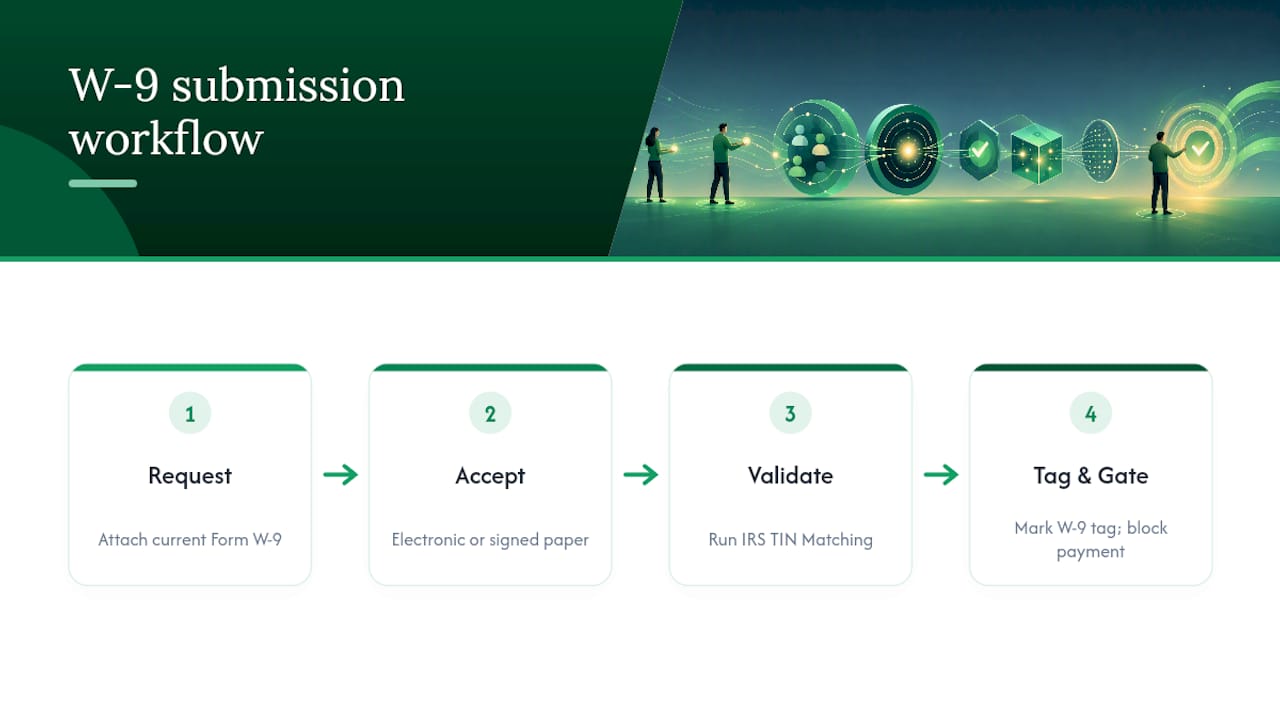
- How to Request, Accept, and Validate a Vendor’s W-9
- When a W-9 Isn’t Required
- Backup Withholding, CP2100 Notices, and What Happens if You Skip This
- How Long Should You Keep W-9s, and How Should You Store Them?
- When to Refresh Vendor W-9 Information
- Why “No W-9, No Payment” Should Be Non-Negotiable
- Keep Vendor Documents Organized Without the Manual Chase
- IRS Pages Worth Bookmarking
- Sources
- FAQ
Quick Checklist for Collecting W-9s From Vendors
Before you release a single payment to a new vendor, run through this list:
- Collect the W-9 before the first payment goes out, not after.
- Block payment in your accounts payable process until the form is on file.
- Request a W-9 from U.S. persons and entities providing services: contractors, freelancers, attorneys, and most unincorporated vendors.
- Send foreign vendors a Form W-8 series document instead of a W-9.
- If a vendor refuses to provide one, start backup withholding and document every solicitation attempt in writing.
- Store completed W-9s securely for a period lasting for several years after the related 1099 filing.
That’s the whole system in miniature. Everything below explains the mechanics behind each line, and where small business owners typically trip up.
What Is Form W-9 and What Does It Tell You?
Form W-9, officially the “Request for Taxpayer Identification Number and Certification,” exists for one purpose: it lets you collect a vendor’s TIN along with a signed certification that the number is correct. The IRS instructions for requesters spell out exactly what the form needs to contain and how you’re allowed to accept it.
A properly completed W-9 gives you five pieces of information you actually need:
- Legal name and, if different, business name
- Federal tax classification (individual, sole proprietor, partnership, C corp, S corp, LLC, trust or estate)
- Taxpayer identification number: Social Security Number, Employer Identification Number, or ITIN
- Address for 1099 mailing
- Signature and date certifying the information
Pro Tip: Check that the name on line 1 matches IRS records exactly, not the vendor’s “doing business as” name. A mismatch here is the single most common cause of a CP2100 notice down the road.
By signing, the vendor certifies three things: the TIN is correct, they’re not subject to backup withholding, and they’re a U.S. person. That certification is what shifts liability protection onto you. The W-9 form itself states plainly that a properly completed and signed copy lets a requester rely on it to avoid backup withholding, provided you don’t have actual knowledge the certification is false.
Everything on that form flows directly into your 1099-NEC or 1099-MISC prep at year-end. Get the name and TIN wrong here, and you’re the one who owns the correction later.
When Should You Request a W-9 From a Vendor?
The operational rule is simpler than most bookkeepers make it: collect the W-9 before you cut the first check, full stop. Waiting until you’re assembling 1099s in January means chasing a vendor who’s moved on, changed banks, or stopped returning emails.
Here’s the sequence that keeps this from becoming a recurring headache:
- Add it to onboarding. Make a signed W-9 a required field before a vendor is entered into your accounts payable system, the same way you’d require a signed contract or a bank routing number.
- Hold the first payment. If the form isn’t in, the payment doesn’t go out. No exceptions, no “we’ll get it next time.”
- Re-request on specific triggers. A vendor that changes its business name, converts from sole proprietor to LLC, or gets a new EIN needs a fresh W-9, because the old one is now describing an entity that no longer exists on paper.
- Respond to mismatch signals. If the IRS sends a CP2100 or CP2100A notice flagging a name/TIN mismatch, that’s your cue to re-solicit immediately.
- Refresh periodically. Many accounts payable teams set a three-year cadence for active vendors as a matter of policy, even without a specific trigger, since business details drift more than owners realize.
Industry guidance on vendor onboarding consistently points to the same conclusion: collecting the W-9 upfront is dramatically cheaper than collecting it retroactively. A form that takes a vendor ninety seconds to complete during onboarding can take hours of back-and-forth to track down in December, especially if that vendor has since closed shop or changed contacts.
There’s a second reason “before first payment” matters that gets overlooked: it’s the point of maximum leverage. A vendor who wants to get paid will send you a W-9 same-day. A vendor who’s already been paid five times has no urgency to respond to your email, and now you’re the one holding the compliance risk on a form you never collected.
None of this requires exotic software. A spreadsheet with a “W-9 received: Y/N” column works for a five-vendor operation. What breaks down is discipline, not tooling, and that’s the part worth fixing first.
Who Actually Needs to Provide a W-9?
Not every vendor needs to fill one out, and knowing the difference saves you from chasing paperwork nobody was ever going to send back.
You need a W-9 from any U.S. person or U.S. entity paid for services, which in practice covers:
- Individuals working as independent contractors or freelancers
- Sole proprietors, including single-member LLCs (these are usually disregarded entities for tax purposes, which changes how the TIN box gets filled out)
- Partnerships and multi-member LLCs taxed as partnerships
- Trusts and estates that receive reportable payments
- Landlords, if you’re paying rent that needs to be reported
- Attorneys and law firms, with one notable wrinkle explained below
The tax classification box is where most confusion starts. A single-member LLC checks “Individual/sole proprietor” or writes in its disregarded-entity status, not “LLC,” unless it’s elected corporate tax treatment. That distinction determines whether the TIN should be the owner’s SSN or the LLC’s EIN, and getting it backward is a common source of mismatch notices later.
Attorneys deserve their own line item because they’re the exception that swallows the rule. Payments to corporations are generally exempt from 1099 reporting, but gross proceeds paid to attorneys are reportable even when the law firm is incorporated. That means you still collect a W-9 from your attorney or law firm regardless of their entity type, which surprises a lot of bookkeepers who assume “corporation” always means “no W-9 needed.”
How to Request, Accept, and Validate a Vendor’s W-9
This is the part that actually determines whether your year-end 1099 process is smooth or miserable. Here’s a workflow that works whether you’re running three vendors or three hundred.
Step 1: Send the request with the right form attached. Pull the current Form W-9 directly from irs.gov rather than reusing an old copy you have saved somewhere, since the IRS updates the form periodically. Attach it to your onboarding email with a short paragraph explaining why you need it: “As a vendor providing services to us, federal law requires we collect a completed W-9 before processing payment, so we can accurately report payments to the IRS.”
Step 2: Accept it electronically or on paper. The IRS allows electronic W-9 submission as long as the system preserves the required certifications and captures a valid electronic signature. A substitute W-9 built into your own onboarding portal is also acceptable, provided it’s substantially similar to the official form and keeps the certification language intact. If you’re collecting these by email as PDF attachments, that’s fine too, but confirm the signature field is actually filled in. A surprising number of returned forms arrive unsigned.
Step 3: Validate the name/TIN combination. Don’t just file the form and move on. The IRS offers a TIN Matching e-service that checks a name/TIN pair against IRS records before you file, which catches errors while you can still fix them cheaply instead of after a CP2100 notice arrives.
Step 4: Tag the record and gate the payment. Mark the vendor as “W-9 on file” in whatever system tracks your accounts payable, and configure that system, even a simple approval checklist, to block payment release until the tag exists. If you’re granting an exception (rare, and it should stay rare), document the reason in writing.
Pro Tip: Keep a copy of the original request email alongside the signed W-9 in the vendor’s file. If a TIN mismatch surfaces later, that solicitation record is exactly what the IRS wants to see as evidence you acted in good faith.
A workflow like this pairs naturally with broader invoice processing automation, where document capture and payment approval already live in one system rather than scattered across email threads and spreadsheets.
When a W-9 Isn’t Required
Requesting a W-9 from every single payee wastes your time and theirs. Some categories are exempt from the requirement outright.
- C corporations and S corporations generally don’t need to submit 1099s for most services, with the attorney exception noted above still applying regardless of incorporation status.
- Tax-exempt organizations, like registered nonprofits, are typically exempt payees.
- Government entities at the federal, state, or local level don’t require a W-9 for most payment types.
- Foreign vendors never complete a W-9. If your payee is not a U.S. person, they should complete a Form W-8BEN (individuals) or W-8BEN-E (entities) instead, which certifies their foreign status and any applicable tax treaty claim.
The practical rule most accounts payable teams settle on: request a W-9 anyway for documentation purposes even from a vendor claiming exemption, unless the exemption is obvious from the business type (a bank, a publicly traded company). If a payee marks an exempt-payee code on the form, you can generally accept that at face value unless you have actual knowledge it’s inaccurate. When in doubt, the form itself becomes your paper trail either way.
Backup Withholding, CP2100 Notices, and What Happens if You Skip This
Skipping W-9 collection doesn’t just create a filing headache. It creates a specific, statutory obligation you’re now failing to meet.
If a required W-9 is missing, or if the vendor’s TIN doesn’t match IRS records, you’re required to begin backup withholding under IRC §3406. Backup withholding means holding back a flat percentage of the payment and remitting it to the IRS on the vendor’s behalf, rather than paying the vendor in full. That’s an unpleasant conversation to have with a contractor who was expecting a full check, which is exactly why collecting the W-9 upfront is so much easier than explaining backup withholding after the fact.
If the IRS later flags a mismatch, you’ll receive a CP2100 or CP2100A notice. These require you to follow the B-Notice procedure: re-solicit a corrected W-9 from the vendor within IRS-specified timelines, generally starting backup withholding if the vendor doesn’t respond. Two mismatch notices for the same vendor within a filing period trigger a stricter “second B-Notice” process that requires the vendor to get a letter directly from the Social Security Administration or IRS confirming their TIN, not just a corrected form.
The penalty structure for filing incorrect information returns escalates based on how late the correction comes and whether the failure looks like willful neglect. What limits your exposure isn’t perfection. It’s documentation. A file showing every solicitation attempt, every request email, every date you tried to get a corrected form, is what an examiner looks for when deciding whether you exercised reasonable care.
- Missing or incorrect TINs trigger backup withholding obligations under IRC §3406.
- CP2100/CP2100A notices require re-solicitation per B-Notice timelines.
- Documented solicitation attempts are your primary defense against penalty exposure.
How Long Should You Keep W-9s, and How Should You Store Them?
Retention and security aren’t afterthoughts here. A TIN is sensitive data, and a lost or leaked W-9 is a real liability, not just a paperwork problem.
Keep completed W-9s for at least four years after the related 1099 filing. That window covers the IRS statute of limitations for most information-return issues and gives you a paper trail if a mismatch notice arrives years after the original payment.
- Restrict access to W-9 files to the people who actually process payments or file 1099s, not the whole office.
- Store forms in an encrypted system rather than a shared drive or unlocked filing cabinet; a TIN in the wrong hands is a direct path to identity theft.
- Avoid emailing completed W-9s back and forth as unencrypted attachments once collected; move them into secure storage immediately.
- Redact or shred paper copies once the retention window closes, rather than letting old vendor files pile up indefinitely.
- Flag vendor records for a status check whenever a name, address, or entity type change comes through, so nothing sits stale.
Pro Tip: A folder structure organized by vendor, not by year, makes retention audits faster. You want to find “every document for Vendor X” instantly, not dig through twelve year-folders looking for one form.
Sound document management practices for dealerships apply directly here: the goal is a searchable, access-controlled system where a W-9 is one click away when an auditor or your own bookkeeper needs it.
When to Refresh Vendor W-9 Information
A W-9 isn’t a one-time form you file and forget. Vendor details drift, and your records need to keep up.
- Refresh whenever a vendor changes its legal name, converts entity type (sole proprietor to LLC, for example), or gets a new TIN.
- Re-solicit immediately after any CP2100 notice tied to that vendor.
- Set a standing three-year refresh cadence for active vendors, even absent a specific trigger, since address and entity changes often go unreported otherwise.
- Build automatic reminders into your vendor management or accounts payable system rather than relying on someone remembering.
- Log every re-collection attempt, successful or not, since that log is your due-diligence record if a dispute ever surfaces.
A vendor management system that flags stale records automatically removes the guesswork from this entirely, which matters more as your vendor list grows past a size where manual tracking is realistic.
Why “No W-9, No Payment” Should Be Non-Negotiable
Independent dealers run lean operations, often with one person handling parts vendors, transport companies, detailers, and floorplan lenders simultaneously. That’s exactly the environment where W-9 collection slips, because nobody wants to hold up a payment to a detailer who’s waiting on a check.
Hold the line anyway. Enforce “no W-9, no payment” as a hard rule in your accounts payable process, and tag every vendor record the moment the form comes in. It costs you one uncomfortable conversation at onboarding instead of a stack of unresolved 1099 problems every January.
Where this gets harder for dealers specifically is volume. A dealership might onboard a new transport company or detail shop every few months, and each one needs the same treatment as a full-time employee vendor. Vendor management tools that tie document status directly to payment approval remove the temptation to make exceptions “just this once,” which is usually how the backlog starts.
What tends to happen instead is documents get scattered: one W-9 in an email inbox, another in a filing cabinet, a third that was never actually collected because the vendor got paid in a rush before anyone circled back. Fixing that isn’t about better intentions. It’s about building the check into the payment process itself, so the system enforces the rule even when nobody’s paying close attention.
— Eric Dosset
Keep Vendor Documents Organized Without the Manual Chase
Loturn is built for independent used-vehicle dealers, and one thing that makes vendor compliance harder in this business specifically is volume: transport haulers, detail shops, parts suppliers, and floorplan lenders rotate constantly, and each one needs a W-9 before that first check goes out. Loturn’s AI-powered document handling lets you attach and tag vendor paperwork, including W-9s, directly to the vendor record, so the form is sitting right next to every invoice and payment history you’d need in an audit.

That matters most at year-end, when a scattered vendor file turns into hours of searching instead of minutes of exporting. Loturn’s dealer accounting tools tie vendor documentation to your books natively, with bank-level encryption protecting the sensitive TINs and details you’re required to hold onto for years. If you’re currently tracking vendor paperwork across email threads and a filing cabinet, start a trial and import your existing vendor data free to see how a single, tagged record changes your January.
IRS Pages Worth Bookmarking
Keep these primary sources close, since they’re the ones that actually govern your obligations:
- Form W-9 and the Instructions for the Requester, covering the form itself, certification language, and electronic acceptance rules.
- IRS guidance on information returns and CP2100 notices, covering backup withholding and B-Notice procedures.
- About Form 1099-NEC, for how W-9 data feeds directly into your annual filings.
This article is general information, not a substitute for advice from a qualified financial advisor. Consult a qualified financial professional about your own circumstances before acting on anything here.
Sources
- Instructions for the Requester of Form W-9 (03/2024)
- Form W-9 (Rev. March 2024) Request for Taxpayer Identification Number and Certification
- Publication on information returns and CP2100 procedures
- How to Request a W-9 From a Vendor: A Bookkeeper’s Pre-1099 | Growthy
- When Is a Vendor W-9 Required? Rules and Exemptions
FAQ
Do I need to get a W-9 from every vendor?
No. You need one from U.S. persons and entities paid for services, like contractors, freelancers, and most unincorporated businesses. Corporations, tax-exempt organizations, and government entities are generally exempt, with the notable exception of attorneys and law firms, who need a W-9 regardless of entity type.
How do I get a W-9 from a vendor who hasn’t sent one?
Send the current Form W-9 directly with a brief explanation of why you need it, and hold the payment until it’s returned signed. If the vendor refuses after a reasonable number of requests, document each attempt in writing and begin backup withholding on future payments.
Do I need a W-9 from a foreign vendor?
No. Foreign vendors complete a Form W-8BEN or W-8BEN-E instead, which certifies their non-U.S. status rather than providing a domestic TIN. A W-9 only applies to U.S. persons.
Is it normal for a vendor to ask for a W-9?
It’s unusual for a vendor to request a W-9 from you unless they’re the ones paying you for services, in which case they need your TIN for their own 1099 filings. If you’re the one hiring the vendor, you should be the one requesting theirs, not the other way around.