
Yes, PCI DSS applies to your dealership if you accept credit or debit cards anywhere in the business, sales, service, parts, or F&I. There’s no revenue exemption and no small-dealer carve-out. Your first move should be mapping every place a card touches your systems, then shrinking that footprint with hosted or tokenized payments before you worry about paperwork.
TL;DR:
- Dealerships must map and minimize every system that processes or transmits card data to reduce PCI scope effectively.
- Implementing point-to-point encryption and tokenization significantly lowers the amount of cardholder data stored and the overall compliance burden.
- Maintaining an accurate, centralized record of all payment-related transactions streamlines audits and supports faster compliance reviews.
- Vendors often introduce unseen PCI risks when they store or transmit card data, so regular vendor compliance checks are essential.
- Beyond PCI, if the dealership arranges financing or leases, it must also comply with the broader FTC Safeguards Rule, including risk assessments and vendor oversight.
Table of Contents
- What PCI DSS 4.0 (and 4.0.1) Means for Dealerships
- How Do You Determine Your PCI Scope and CDE?
- Which Technical Controls Actually Shrink Your Scope?
- Does the FTC Safeguards Rule Apply to Your Dealership Too?
- Your Compliance Roadmap: What to Do in 30, 60, and 90 Days
- Where Do Vendors Create PCI Risk You Don’t See?
- How Often Do You Need to Test and Document Compliance?
- How Centralized Records Cut Down Audit Friction
- What Should Dealerships Actually Prioritize?
- Simplify Your Records Before Your Next PCI Review
- Sources
- FAQ
What PCI DSS 4.0 (and 4.0.1) Means for Dealerships
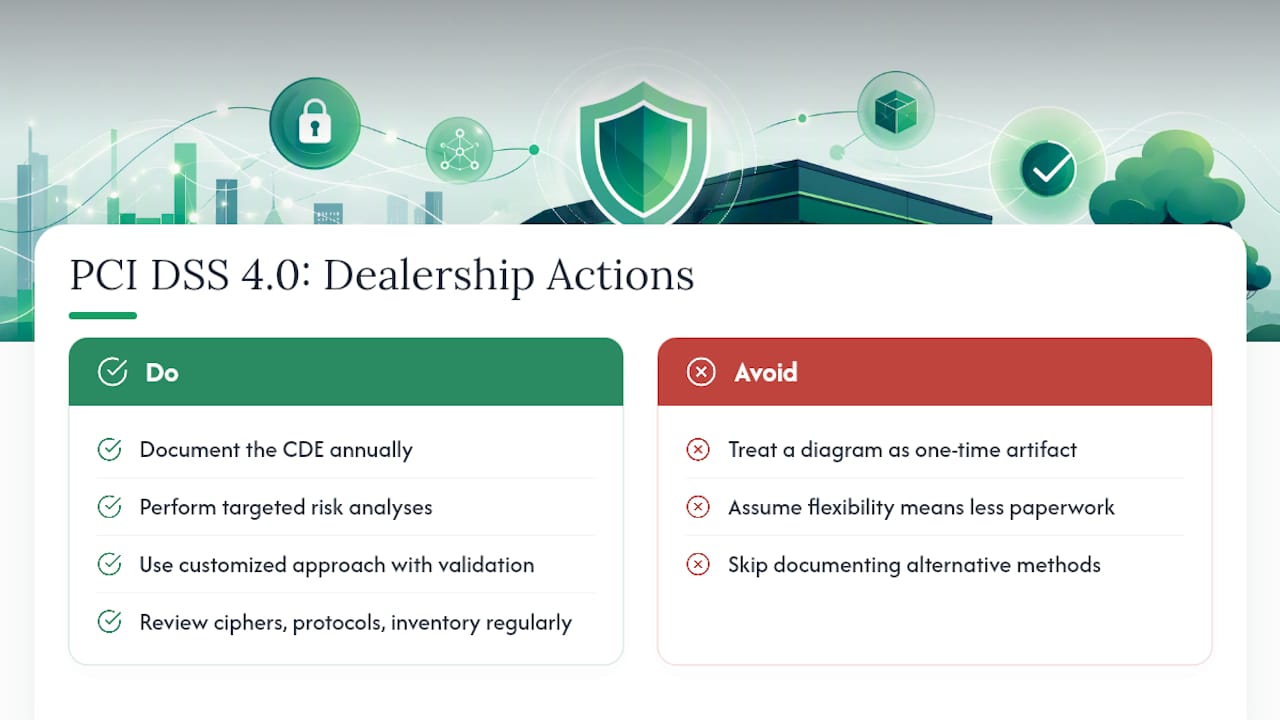
PCI DSS 4.0 rolled out with a longer runway than most standard updates, giving merchants time to phase in stricter requirements, but the documentation burden has grown substantially. Dealerships now need annual documentation of their entire cardholder data environment, not a one-time diagram gathering dust in a drawer. Targeted risk analyses are required wherever the standard gives you flexibility on frequency or method, which sounds bureaucratic until you realize it forces you to actually think through why your controls work.
For multi-rooftop groups, 4.0’s “customized approach” lets you meet a control’s intent through an alternative method, provided you document the reasoning and get it validated. That flexibility helps a five-store group with varied POS setups, but it also means more paperwork per location, not less. Expect more frequent reviews of encryption ciphers, protocols, and the hardware and software inventory tied to your payment systems.
How Do You Determine Your PCI Scope and CDE?
Your cardholder data environment, or CDE, includes every system that stores, processes, or transmits card data, plus anything connected to those systems. Most dealerships underestimate this because card data touches more departments than owners assume.
Start by walking through each channel:
- Sales desk terminals — standalone or integrated with your DMS?
- F&I office — do you key in card numbers for deposits or down payments?
- Service and parts counters — often running on older, separate POS hardware.
- Online payment or deposit pages — hosted by a processor or built in-house?
- Phone and mail order payments — manually keyed card numbers are a common blind spot.
Your Self-Assessment Questionnaire type follows from this map. SAQ A fits dealerships using fully hosted payment pages with no card data touching their servers. SAQ A-EP applies to e-commerce setups with some local processing. Standalone, non-networked terminals usually land you in SAQ B, while IP-connected terminals push you to SAQ B-IP. If you store card data locally or run a complex, multi-channel environment, you’re likely in SAQ C or D territory, and larger-volume merchants may need a Qualified Security Assessor to complete a full Report on Compliance instead of a self-assessment.
Which Technical Controls Actually Shrink Your Scope?
Point-to-point encryption, or P2PE, encrypts card data the instant it hits the terminal, so raw numbers never touch your network or DMS. That single design choice is why P2PE and tokenization are the two most effective scope-reduction tools available to a dealership. Tokenization takes it further by swapping the card number for a meaningless token you can safely store and reuse for recurring transactions like service contracts or delayed down payments.
Hosted or redirected payment pages work similarly for online transactions: the customer enters card data on the processor’s page, not yours, keeping your servers out of scope entirely.
- P2PE-validated terminals typically qualify for SAQ P2PE, a lighter questionnaire.
- Tokenization supports repeat billing without ever holding a live card number.
- Hosted checkout pages usually keep e-commerce dealers at SAQ A.
- Some vendor-specific smart terminal deployments can qualify for SAQ B-IP and skip quarterly scans entirely when configured correctly.
The integration wrinkle is your DMS. If it needs to “see” card data to reconcile deals, you’ve likely just expanded your scope back out. Push vendors toward tokenized adapters that pass a reference number, not the card number itself, into your accounting records.
Pro Tip: Ask any payment vendor for their SAQ eligibility letter in writing before you sign, not after. Verbal assurances about “PCI-friendly” terminals mean nothing during an actual assessment.
Does the FTC Safeguards Rule Apply to Your Dealership Too?
If your dealership arranges financing or leases, you’re classified as a financial institution under the FTC Safeguards Rule, and that pulls in obligations well beyond PCI. The Rule covers all customer financial information, credit applications, Social Security numbers, income data, not just card numbers, which makes it broader than PCI in scope even though the two overlap on network security and vendor oversight.
Practically, that means designating a qualified individual to own your information security program, running written risk assessments, and requiring vendors to contractually commit to safeguarding data they handle on your behalf. Depending on the nature of the incident, certain breach events may require notifying the FTC within a set window, so your incident response plan needs a compliance clock built in, not just an IT fix-it checklist.
Your Compliance Roadmap: What to Do in 30, 60, and 90 Days
- Days 1 to 30: Inventory every payment touchpoint across sales, service, parts, and F&I. Identify quick wins, like disabling keyed card entry where a terminal exists, and put compensating controls in place for anything you can’t fix immediately.
- Days 31 to 60: Migrate exposed terminals to P2PE-enabled hardware. Push online payment flows to hosted pages if they aren’t already. Start vendor conversations about tokenization for recurring billing.
- Days 61 to 90: Complete your SAQ, schedule quarterly vulnerability scans if your environment requires them, and document your CDE formally.
- Beyond 90 days: Tackle network segmentation projects and any legacy DMS remediation that requires vendor coordination or budget approval.
Cost drivers cluster around three things: new P2PE terminal hardware, QSA or managed security provider fees if you’re above SAQ eligibility, and staff time for documentation. Negotiating vendor responsibility for encryption and tokenization upfront, rather than retrofitting it later, is consistently the cheapest path.
Where Do Vendors Create PCI Risk You Don’t See?
Dealership PCI failures rarely start with a hacker breaking through a firewall. They start with a vendor relationship nobody scrutinized. A third-party DMS storing or transmitting card data can pull your dealership back into scope even when you assumed the vendor “handled all that.”
Build a vendor checklist you actually revisit annually:
- Request current PCI attestation of compliance, especially for any Level 1 service provider.
- Check the card brands’ registry of validated service providers directly rather than trusting a sales rep’s claim.
- Add contractual clauses requiring the vendor to assist with forensic investigation if a breach touches their system.
- Reassess every vendor relationship yearly, not just when a contract renews.
Legacy DMS platforms are the most common architecture mistake. Segmenting payment terminals from the broader network can shrink your scope without a full, disruptive DMS migration, and it’s usually faster to implement.
How Often Do You Need to Test and Document Compliance?
PCI compliance isn’t a once-a-year event you handle and forget. Quarterly external vulnerability scans are required for most SAQ types beyond the simplest hosted-payment setups. Your SAQ or ROC gets renewed annually, and penetration testing kicks in if your environment changes materially, new terminals, a network redesign, or an added payment channel.
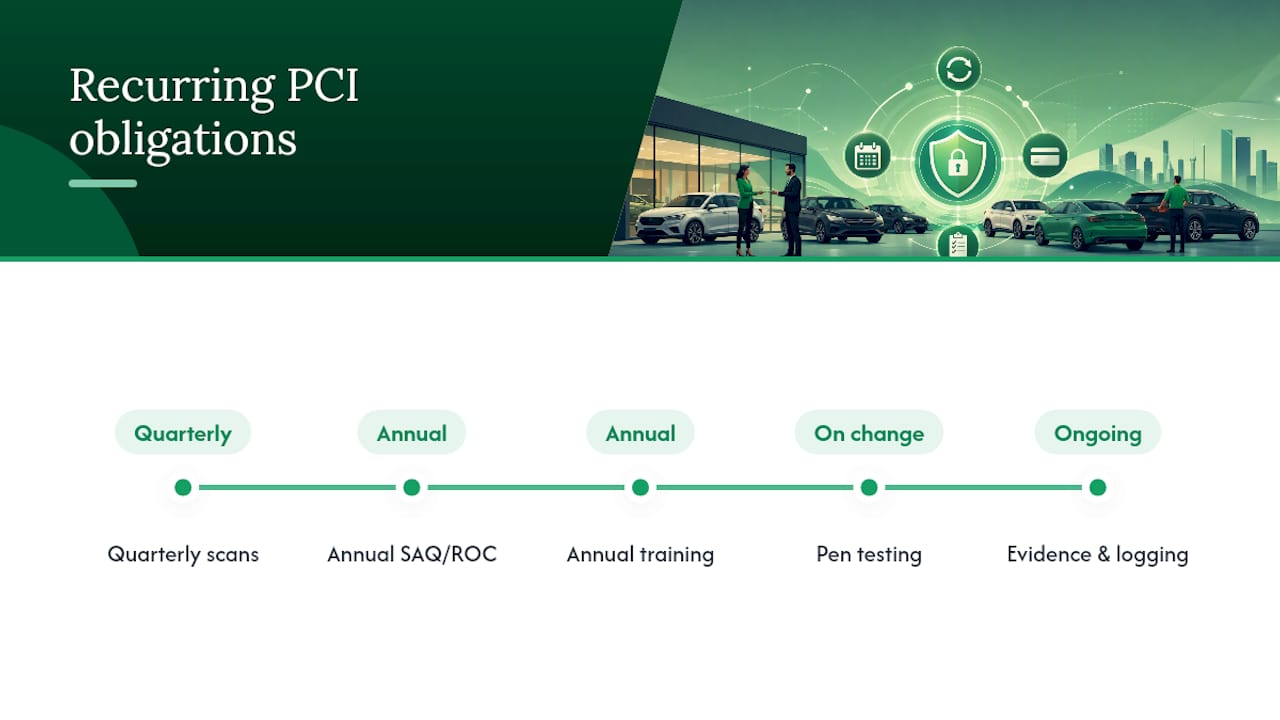
Logging and monitoring matter just as much as the scans. Keep a running “book of evidence,” screenshots, scan reports, vendor attestations, training records, because an assessor or a breach investigator will ask for exactly that during any review. Train staff on card handling and phishing awareness at least annually, and tie those training records to your Safeguards Rule documentation, since both frameworks expect proof, not just policy.
How Centralized Records Cut Down Audit Friction
The dealerships that breeze through a PCI review or a Safeguards Rule check usually share one trait: their financial records aren’t scattered across five systems. Centralized per-vehicle accounting means transaction trails, deposits, holdbacks, financing reserve entries, are traceable to a single deal without hunting through separate spreadsheets or paper folders.
Loturn stores that data with bank-level encryption and pulls dealer-specific compliance forms into one place through its document management tools, which shortens the time it takes to produce evidence when an assessor or auditor comes calling. Reconciling token references against deal records also gets simpler when nothing lives in disconnected files.
What Should Dealerships Actually Prioritize?
Compliance fails when it’s nobody’s job specifically. Name one owner, controller or GM, and put PCI on a quarterly calendar, not an annual scramble. Shrink your scope first through hosted payments and tokenization; only after that should you spend money hardening what remains. Bring in a QSA or managed provider when your environment is genuinely complex, not as a default reflex.
— Eric Dosset
Simplify Your Records Before Your Next PCI Review
Loturn is the alternative to scattered spreadsheets and disconnected paperwork when you’re trying to show an assessor exactly what happened on a deal. Every vehicle gets its own financial record, purchase price, recon, transport, financing entries, stored with bank-level encryption, so when a PCI review or Safeguards Rule check asks for a transaction trail, you’re pulling one clean file instead of reconstructing it from memory.
Setup includes data import, so you’re not stuck manually re-entering months of deal history just to get organized. If your dealership runs multiple lots or a single flip operation, plans scale from the Flipper tier at $99 per month up through Multi-Lot at $699 per month. Check the pricing page and see which tier matches your volume, or browse the Dealer Academy for more compliance-adjacent resources built specifically for independent dealers.
Sources
- Auto Dealership PCI
- Automobile dealers: FTC’s Safeguards Rule FAQs
- PCI Compliance 4.0: Essential Details Dealerships Should Know (PayJunction blog)
FAQ
Do All Merchants Have to Be PCI Compliant?
Yes. Any merchant that accepts, processes, stores, or transmits payment card data must meet PCI DSS requirements, regardless of size or transaction volume. Smaller dealerships typically complete a Self-Assessment Questionnaire, while higher-volume merchants may need a full Report on Compliance from a QSA.
How Much Should PCI Compliance Cost a Dealership?
Costs vary widely based on your current setup, but the biggest drivers are P2PE terminal hardware, QSA or managed security provider fees if you’re above SAQ eligibility, and staff time spent on documentation. Dealerships that already use hosted payment pages or tokenized terminals generally spend far less than those retrofitting legacy systems.
Which Companies Are Considered PCI Compliant?
PCI compliance isn’t a public certification list; it’s a status a merchant attests to annually through an SAQ or validates through a QSA-led ROC. Payment processors and service providers publish their own compliance attestations, and checking a vendor’s Level 1 service provider status directly with the card brands is the reliable way to verify a partner’s standing.
What Happens If a Dealership Isn’t PCI Compliant?
Noncompliance can trigger fines from card brands, per-card penalties, chargeback liability, and expensive forensic investigation costs after a breach. Beyond direct fines, reputational damage and lower customer satisfaction scores often cost dealerships more in the long run than the penalties themselves.
Can Loturn Help With PCI or Safeguards Rule Documentation?
Loturn doesn’t process card payments, but its per-car accounting records and encrypted document storage make it easier to produce transaction trails and evidence during a PCI review or FTC Safeguards Rule audit. Centralizing that paperwork ahead of time saves significant scrambling when an assessor requests records on short notice.