
Open with year, make, model, and trim, then a single standout benefit, then the price, in that order: “2019 Honda Accord Sport, one owner, 38K miles, $18,900.” Follow with VIN and mileage in line two, and close with a one-line call to action like “Text for a test drive.” That structure alone does more for response rate than any adjective you could add.
TL;DR:
- Including the VIN in your listing allows buyers to verify vehicle history independently, building trust and reducing redundant questions.
- A clear price that matches market value and indicates negotiation willingness attracts serious buyers and filters out time-wasters.
- Detailing actual maintenance records and recent service dates proves your vehicle was properly maintained, which buyers prioritize.
- Posting high-quality photos of exterior, interior, and key paperwork supports your description and validates claims made in the ad.
- Tailoring the listing language and features to your target buyer, such as safety for families or cost savings for commuters, increases your chances of a quick sale.
Table of Contents
- Used Car Description Examples: Templates You Can Copy Right Now
- What Facts Belong in a Used Car Ad, and in What Order
- Adjusting Your Listing for Facebook Marketplace, Craigslist, and Autotrader
- Words That Build Trust and Words That Kill It
- The Photos and Paperwork That Prove Your Claims
- Setting a Price and Writing a CTA That Filters Serious Buyers
- Three Sample Used Car Ad Templates You Can Adapt Today
- Being Upfront About Accidents, Liens, and Title Status
- Proving Your Car Was Actually Maintained
- Legal Disclosures You Can’t Skip in a Private-Party Listing
- Writing for the Buyer You Actually Want to Reach
- What Ten Years of Watching Listings Taught Me
- When Selling Turns Into Running a Business
- Sources
- FAQ
Used Car Description Examples: Templates You Can Copy Right Now
The fastest way to write a good listing is to steal a proven skeleton and drop in your car’s facts. Buyers scan for specifics before they read a single adjective, according to Car Spot’s listing guidance, which is why every template below leads with hard facts, not enthusiasm.
Headline templates:
- “[Year] [Make] [Model] [Trim], [mileage] miles, [standout feature] — $[price]”
- “[Year] [Make] [Model] [Trim] — [ownership story, e.g. one owner, garage kept] — $[price]”
- “[Year] [Make] [Model] [Trim], [warranty/service note] — asking $[price], firm”
- “Clean title [Year] [Make] [Model], [big feature like new tires/low miles] — $[price] OBO”
Body templates for common seller situations:
- Private sale, no drama: “Selling my [year/make/model] because [honest, brief reason]. [Mileage] miles, runs and drives great, no warning lights, no accidents on CarFax. Recent [service item] done at [mileage/date]. VIN: [VIN]. $[price], cash or verified funds only.”
- Low-mileage standout: “Only [mileage] miles on this [year/make/model] — that’s about [X] miles a year. Always garage kept, non-smoker, dealer serviced every [interval]. Priced at $[price], slightly below KBB private-party value for a quick sale.”
- Trade-up / upgrading: “Upgrading to a bigger vehicle for the family, so this well-maintained [model] needs a new home. [Feature highlights]. Service records available. $[price], negotiable for serious buyers.”
- As-is fixer: “Mechanic’s special: [year/make/model] runs but needs [specific issue]. Priced accordingly at $[price] to reflect the work needed. Great project car or parts vehicle. Sold as-is, no warranty.”
Shorten these for Facebook Marketplace and expand the service history section for Craigslist or Autotrader, where buyers expect more detail before they’ll call.
What Facts Belong in a Used Car Ad, and in What Order
Buyers read in a predictable sequence: headline, specs, condition, then contact info. Miss a step and you’ll field the same repetitive questions instead of real offers.
- Headline: Year, make, model, trim, one standout feature, and the price, all in the first sentence.
- Quick specs block: Mileage, engine and transmission type, exterior/interior color, drivetrain (FWD/AWD/4WD), and the VIN.
- Honest condition line: Known issues stated plainly, last service date or major maintenance, and title status (clean, salvage, rebuilt, or lien pending payoff).
- Contact and viewing details: Preferred contact method, general location or meeting area, and availability for test drives.
Keysavvy’s used car ad guidance specifically recommends listing the VIN so buyers can pull a vehicle history and recall report themselves, which does more to build trust than any line of sales copy.
Adjusting Your Listing for Facebook Marketplace, Craigslist, and Autotrader
The same car needs a different write-up depending on where it’s posted. Word count, formatting, and what buyers expect to see all shift by platform.
- Facebook Marketplace: Keep it to 150 to 300 words. Most buyers are scrolling on a phone, so your headline and first photo do the heavy lifting. Put the VIN either in the text or as a clear photo of the dash plate or door jamb sticker.
- Craigslist: Go longer, 300 to 500 words, with a complete spec block and a clear, direct line on how to reach you (phone, text, or the relay email). Craigslist shoppers tend to be more research minded and will bail if specs are missing.
- Autotrader or eBay Motors: Fill in every structured spec field the platform offers, not just the free-text description. On eBay specifically, spell out shipping options, pickup logistics, and payment terms, since national buyers need that upfront.
Seller guides consistently note that shorter, punchier copy wins on mobile-first marketplaces, while fuller spec blocks perform better on classifieds where buyers expect to compare listings side by side.
Words That Build Trust and Words That Kill It
Specifics beat adjectives every time. “No accidents, always dealer serviced” tells a buyer something real. “Excellent condition” tells them nothing, and experienced shoppers know it.
- Replace “runs great” with “starts every time, no check engine light, new brakes at 60K miles.”
- Replace “must sell” or “make an offer” with an actual number and a short reason if the price is below market.
- Avoid ALL CAPS headlines. They read as spam, not urgency.
- Skip vague price signals like “OBO” with no baseline. Say “$14,500, some room for a serious buyer” instead.
- Good verbs and descriptors to lean on: documented, verified, inspected, garage kept, one owner, non smoker, dealer maintained.
Kelley Blue Book’s ad guidance points out that the strongest classified ads are the honest ones, ones that name fuel economy, upgrades, remaining warranty, and even battery condition on hybrids and EVs, rather than leaning on generic praise.
Pro Tip: Read your own description out loud before posting. If a sentence sounds like something a car salesman would say instead of a real owner, cut it and replace it with a fact.
The Photos and Paperwork That Prove Your Claims
A description makes a claim. Photos and documents back it up, and that’s what separates a listing that gets real offers from one that gets ignored.
- Exterior shots from all four corners, plus the odometer reading and the VIN plate or door jamb sticker.
- Interior shots of the dash, seats, and any wear points, along with the engine bay and, if the car is clean underneath, the undercarriage.
- A photo or scan of maintenance receipts and, if you have one, a vehicle history report summary page (redact your name and address before posting).
- Reference these directly in your text: “Odometer and VIN photos attached below; full service history available on request.”
Setting a Price and Writing a CTA That Filters Serious Buyers
Always post a real number, never “call for price.” A number filters out time wasters and signals you’re a serious seller. If your price sits below KBB or market averages, say why: “Priced below market for a quick sale” or “Slightly under KBB due to [specific reason].” If you’ll negotiate, say so in measured terms.
- “$16,200, slight negotiation available for serious buyers.”
- “Firm at $9,800, priced to sell fast this week.”
- “Text or call, no lowball offers please, cash or verified funds.”
First-response template for buyer inquiries: “Thanks for reaching out. The car’s still available. Are you looking to see it in person this week, or do you have questions about the history first?”
Three Sample Used Car Ad Templates You Can Adapt Today
A controlled dealer test using a 9-section listing template sold 92% of test vehicles within 14 days, compared to a 41-day average for generic, unstructured listings. Structure isn’t decoration, it changes how fast your phone rings.
- Short (Facebook, 150 to 200 words): “2018 Toyota Camry LE, 62K miles, one owner, non smoker — $14,200. Runs and drives perfectly, no accidents, recently serviced (new brakes, oil change, tires at 80%). Clean title in hand. VIN and odometer photos attached. Located in [area], available evenings and weekends for test drives. Text preferred.”
- Medium (Craigslist, 300 to 400 words): Add a full spec block (engine, transmission, drivetrain, color), a two to three sentence ownership story, a maintenance summary with dates and mileage, and a clear statement on title status before the closing price and contact line.
- Long (Autotrader/eBay, 450 to 600 words): Everything in the medium version, plus a short narrative on why you’re selling, a rundown of any upgrades or rare options, a note on remaining factory warranty if applicable, and shipping or pickup logistics for out-of-area buyers.
Being Upfront About Accidents, Liens, and Title Status
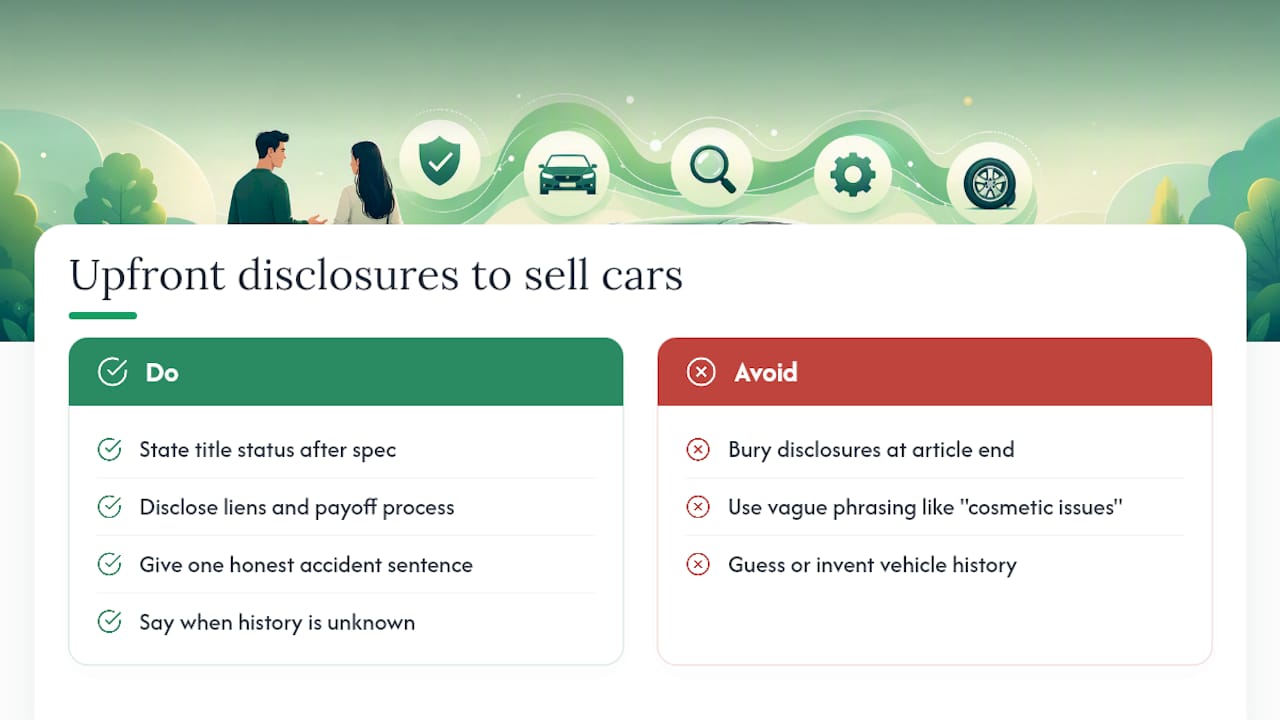
Skipping condition disclosures doesn’t make a car more sellable, it just moves the disappointment to the test drive, and often kills the deal on the spot. State plainly whether the car has a clean, salvage, rebuilt, or flood title, and note it right after your spec block, not buried at the end.
If there’s an outstanding loan, say so: “Vehicle has a lien, payoff will be handled at time of sale through [lender/process].” Keysavvy recommends explaining exactly how a financed vehicle’s title will transfer, since an unclear payoff process is one of the fastest ways to spook a serious buyer.
For accident history, one honest sentence covers it: “Clean CarFax, no accidents reported” or “Minor fender bender in 2023, repaired, no frame damage, photos of repair receipt available.” Vague phrasing like “some cosmetic issues” invites suspicion. Specific phrasing like “small dent on rear bumper, doesn’t affect function” invites trust. If you genuinely don’t know the full history because you bought it used yourself, say that too rather than guessing.
Proving Your Car Was Actually Maintained
“Well maintained” is the single most overused phrase in used car ads, and it means nothing without proof. List actual service events with dates or mileage: “Oil changed every 5,000 miles, timing belt replaced at 90K, new battery in 2025.”
If you have paper receipts, photograph the stack. If service was done at a dealership, mention it by name generically (“dealer serviced” rather than naming the specific dealership if privacy matters to you) and note that records are available on request. Buyers who see a documented maintenance trail move faster to an in-person look, because it answers the question they’re actually asking: will this car cost me money next month?
Legal Disclosures You Can’t Skip in a Private-Party Listing
Every state requires an odometer disclosure statement at the time of sale for most vehicles under a certain age, separate from what you write in the online description. Your listing should state the actual mileage clearly and match what goes on that paperwork exactly. A mismatch between your ad and your title transfer documents can void the sale or expose you to a fraud claim.
Sell “as-is” only if that’s genuinely your intent, and say so directly: “Sold as-is, no warranty expressed or implied.” Some states have specific rules about what as-is language must say to be enforceable, so check your state’s DMV requirements rather than copying wording from another ad. If the vehicle is still financed, disclose the lien status upfront rather than after a buyer has already made an offer. And never use the word “certified” unless the car has gone through an actual manufacturer certified pre-owned inspection. It’s a specific, protected term, not a general compliment.
Writing for the Buyer You Actually Want to Reach
A minivan ad written for a young commuter and a sports coupe ad written for a family both miss their audience. Match your language to who’s actually going to buy the car.
For family vehicles, lead with safety and space: “Fits three car seats across the back row, blind-spot monitoring, and a clean crash-test history.” For commuter cars, lead with cost of ownership: “38 MPG highway, low maintenance costs, and a timing chain instead of a belt, so no expensive replacement looming.” For enthusiast or upgraded vehicles, lead with the specific modifications and their quality: “Cold air intake and cat-back exhaust, both professionally installed, receipts included.”
The trick is restraint. Don’t try to sell one car to every buyer type in a single ad. Pick the two or three features that matter most to your realistic buyer and lead with those, then let the spec block cover everything else.
What Ten Years of Watching Listings Taught Me
The listings that sell fastest aren’t the ones with the most adjectives, they’re the ones a buyer can verify in thirty seconds: VIN visible, mileage matches the odometer photo, price stated plainly. Refresh your main photo or reprice after 10 to 14 days without a serious inquiry. And if a buyer refuses to talk on the phone before showing up, that’s worth noticing before you hand them the keys for a test drive.
— Eric Dosset
When Selling Turns Into Running a Business
If you’re posting one car this year, everything above is enough. But if you’re flipping several vehicles a year, or you’ve noticed you’re now managing multiple listings, multiple buyers, and multiple sets of receipts at once, you’ve crossed into the territory independent dealers live in every day. That’s a different problem: not writing a good ad, but knowing what each car actually cost you once you add in recon, transport, and the days it sat unsold.
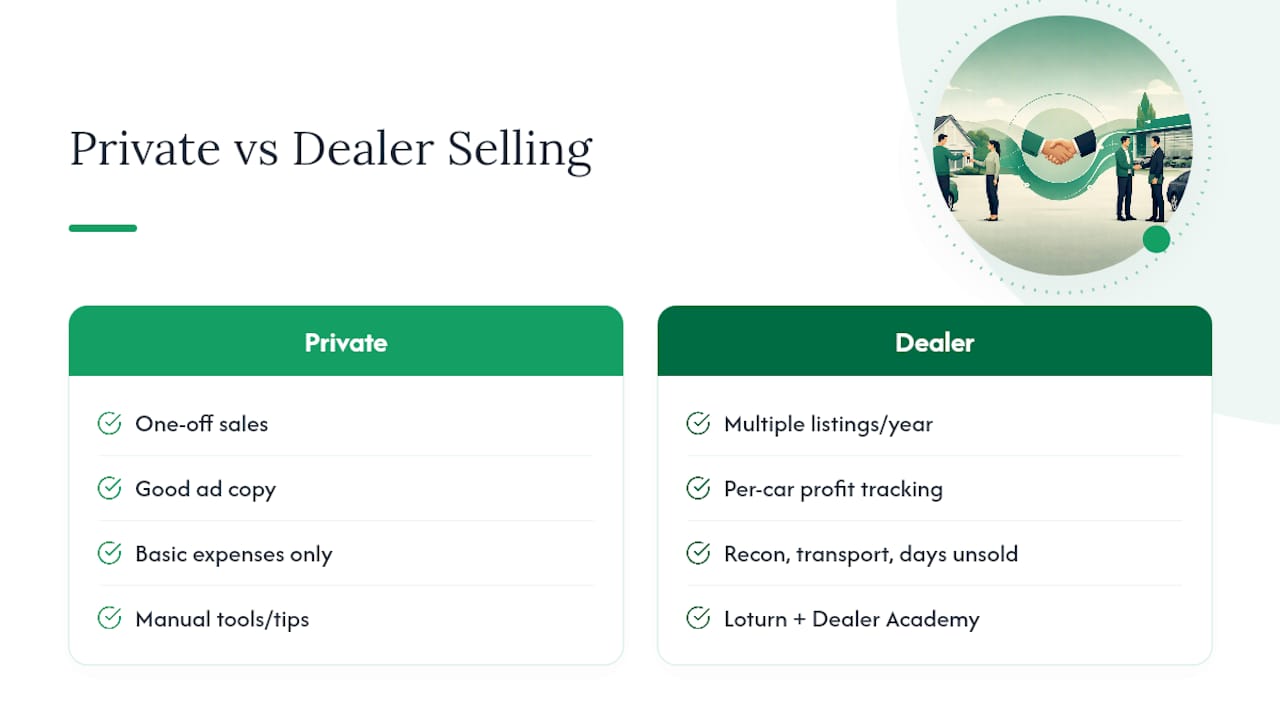
Loturn tracks per-car profit from purchase price through every recon and transport expense, so you know your real margin before you ever write a price line. Dealers and high-volume sellers who want listing and photo standards beyond what a private-party ad needs can find them free in the Loturn Dealer Academy. This type of software is built for dealers and serious volume sellers, not one-off private sales. If that’s where you’re headed, see how Loturn tracks your numbers before your next car goes up for sale.
Sources
- How to Create a Good Classified Car Ad
- How to make your used car ad stand out
- How to Write a Used Car Listing That Sells (CarCheckerVIN)
- How to Write a Used Car Ad Description? (That Sells)
FAQ
What should I put in a used car description?
Lead with year, make, model, trim, and price, then mileage and VIN, then an honest condition summary covering accidents and title status, and close with contact details.
How do I write a good used car ad?
Use a proven template that puts facts first: headline with the standout feature, a quick specs block, an honest condition line, and a clear price and CTA, since a structured 9-section template sold cars in 14 days versus a 41-day average for generic ads.
What are some good words to describe a car?
Use specific, verifiable terms like “documented,” “one owner,” “dealer serviced,” and “no accidents” instead of vague praise words like “excellent” or “must see.”
What should I say when selling a car on Facebook Marketplace?
Keep it to 150 to 300 words, lead with a mobile-friendly headline (year, make, model, price), and make sure the VIN is visible either in the text or in a photo of the door jamb sticker.
Should I include the VIN in my listing?
Yes. Including the VIN lets buyers run their own vehicle history and recall check, which builds trust faster than any description alone.