
Treat every cash payment as both a compliance event and a per-car cost. Segregate who touches the money, who approves it, and who books it; tie every receipt to a VIN; and file Form 8300 within 15 days when the $10,000 threshold is crossed. Loturn’s per-VIN accounting makes that traceability automatic instead of a monthly scramble.
TL;DR:
- Segregation of duties should be maintained, with different staff handling cash custody, approval, and recording to prevent fraud risks.
- Form 8300 must be filed within 15 days whenever a dealership receives over $10,000 in cash or cash equivalents in related transactions.
- Daily cash handling procedures should include recording payments linked to VINs, secure overnight storage, and same-day reconciliation to reduce shrinkage and errors.
- Implementing smart safes and VIN-specific accounting software greatly reduces risks by validating deposits and attaching every dollar to a specific vehicle’s cost file.
- Regular internal audits involving daily, weekly, and quarterly checks help identify discrepancies early and prevent small, repeated thefts over time.
Table of Contents
- What Does Effective Dealership Cash Handling Actually Require?
- How Should You Structure Segregation of Duties for Cash?
- When Do You Have to File Form 8300 for a Car Deal?
- What’s the Day-to-Day Cash Workflow From Intake to the Books?
- What Technology Actually Reduces Cash-Handling Risk?
- How Often Should You Reconcile and Test Cash Controls?
- What Belongs in the Deal Jacket for Cash Transactions?
- How Do You Count and Deposit Cash Correctly Each Day?
- What AML Rules Apply Beyond Form 8300?
- How Should Staff Handle Customers During Cash Payments?
- What Should a Cash Handling Compliance Audit Cover?
- What Risk Management Steps Actually Prevent Cash Theft?
- A Dealer’s Take on Security, Friction, and Real Numbers
- Let Loturn Handle the Bookkeeping Side of Cash Compliance
- Official Forms and Loturn Resources
- Sources
- FAQ
What Does Effective Dealership Cash Handling Actually Require?
Most dealers think of cash handling as a back-office chore: count it, deposit it, move on. That framing misses the two things that actually protect a used car lot: federal reporting law and unit-level accounting truth.
Effective dealership cash handling means three roles never sit with one person, every dollar links to a stock number before it reaches the bank, and the paperwork trail can survive an IRS inquiry without anyone digging through a shoebox. Get those three things right and the rest, deposits, reconciliation, training, becomes maintenance rather than firefighting.
Segregation of duties is the term accountants use for splitting custody, authorization, and recording across different people. Custody means physically handling the cash. Authorization means approving the deal or the deposit. Recording means posting the transaction to the books. When one employee controls two or more of those functions, internal controls specialists flag it as the top fraud risk at dealerships, because that person can both create a discrepancy and hide it.
Layered on top of that is the compliance side: the IRS treats cash transactions over $10,000 as reportable events, and vehicle dealers get specific guidance because cars are exactly the kind of high-ticket item that draws structured cash payments. Ignore that layer and a clean set of books won’t save you from a penalty. Ignore the accounting layer and even perfect compliance paperwork won’t tell you whether last month’s cash deal actually made money once transport, recon, and floorplan interest hit the ledger.
How Should You Structure Segregation of Duties for Cash?
At a five-person used car lot, you can’t hire a separate treasurer, controller, and cashier. But you can still separate the three functions using the staff you already have.
A workable small-dealership split looks like this: the salesperson or F&I manager takes the payment and issues a receipt (custody, momentarily), a manager or owner approves the deal and signs off on any deposit over a set dollar amount (authorization), and someone other than the person who handled the cash posts it to the books (recording). Even a two-person office can pull this off if the owner handles authorization and a bookkeeper, in-house or outsourced, handles recording.
Daily controls that make this stick:
- Cashier logs signed at shift change, with opening and closing cash counts initialed by two people.
- Dual receipts: one copy to the customer, one stapled into the deal jacket, both showing the same amount and payment type.
- A short list of employees authorized to sign checks or approve cash disbursements, reviewed quarterly.
- A voided-receipt report reviewed weekly by a manager who did not create the voids.
Red flags worth training your team to spot: a salesperson pushing to “just handle it” without a manager present, repeated small cash deals from the same buyer name, or a deposit that doesn’t match the deal jacket total. A five-minute manager spot check, pulling three random deal jackets and matching cash amounts to bank deposits, catches most sloppy handling before it becomes theft. Loturn’s Dealer Academy has a detailed walkthrough of segregation of duties built specifically for lots this size, along with an audit trail guide for what to log.
Pro Tip: Rotate who reviews the voided-receipt report every quarter. A reviewer who always checks the same salesperson’s work develops blind spots without realizing it.
When Do You Have to File Form 8300 for a Car Deal?
File Form 8300 when your dealership receives more than $10,000 in cash in a single transaction or in related transactions, and file it within 15 days of receipt. That rule comes straight from the IRS Form 8300 reference guide, and it applies whether the buyer hands you one envelope or spreads the payment across a week.
“Cash” for this purpose includes currency, and in certain vehicle retail transactions, cashier’s checks, money orders, and bank drafts under $10,000 can count as cash equivalents. That trips up dealers constantly. A buyer who pays $6,000 cash and $5,000 via money order for the same VIN has made a related transaction, and the two amounts get aggregated. The IRS’s dealer-specific Q&A walks through exactly this scenario.
Here’s the intake sequence that keeps you compliant:
- Screen the payment type at the desk. Ask directly: cash, cashier’s check, money order, or a mix?
- Check whether any prior payment on the same deal, deposit, trade allowance, or partial, pushes the total cash-equivalent amount over $10,000.
- If it does, collect the payer’s full legal name, address, taxpayer ID (SSN or EIN), and occupation before delivery.
- If the payer refuses ID, note the refusal in the file and still file Form 8300 with the information you have. Refusal is not a way out of the filing.
- Give the payer written notice by January 31 of the following year that you filed, as required by IRS rules.
Roughly $10,000 in cash across related payments on one vehicle deal is the trigger point, and the filing clock starts the moment that threshold is crossed, not at month-end. A dealer who processes multiple deals in a week should escalate flagged deals to a manager before the car leaves the lot, keep proof of the filing (a copy of the 8300 and confirmation) in a dedicated compliance folder, and never let a single salesperson decide alone whether a deal crosses the threshold.
What’s the Day-to-Day Cash Workflow From Intake to the Books?
Every cash deal should follow the same five-stage path, and the goal is simple: nothing moves without leaving a VIN-linked paper trail.
Intake and screening. At the point of sale, staff record payment type, payer name, and whether ID was shown, directly on the deal paperwork. This is also where the Form 8300 threshold gets checked in real time, not after the fact.
Receipt creation. Every cash receipt should include the deal number, VIN, payment type, payer name, amount, and the employee who took it. That receipt gets stapled into the deal jacket immediately, not left loose on a desk.
Overnight custody. Cash sitting in an unlocked drawer overnight is how small shrinkage becomes a pattern. A locked drop box or, better, a smart safe removes the temptation and creates a timestamp record independent of any employee’s memory.
Daily matching. Every morning, someone other than the person who took the cash matches yesterday’s receipts to the actual bank deposit slip. Discrepancies get flagged the same day, not at month-end reconciliation.
VIN-level posting. The cash amount, and any late-arriving supplier bill for transport or recon on that same vehicle, gets posted to that VIN’s file. This is where buy-here-pay-here dealers often stumble: installment payments need to separate the sale itself (recognized at the time of sale) from finance charges (earned over the loan term). Mixing those two inside one VIN entry misstates what the car actually earned. Partial cash payments on a BHPH note should tie back to the same VIN file every single time, not get lumped into a general cash account; dealers can check dealer APRs on retail installment contracts to better understand reporting thresholds and treatment of such payments.
- Screen payment type and payer info at the sales desk, not after the fact.
- Staple a VIN-linked receipt into the deal jacket before the car leaves.
- Use a locked drop box or smart safe for overnight cash, never an open drawer.
- Match receipts to bank deposits every morning, same day as the deposit.
- Post BHPH partial payments to the same VIN file as the original sale.
What Technology Actually Reduces Cash-Handling Risk?
Two categories of technology do the heavy lifting here: physical cash security and per-VIN accounting software. They solve different problems, and most dealers underinvest in one or the other.
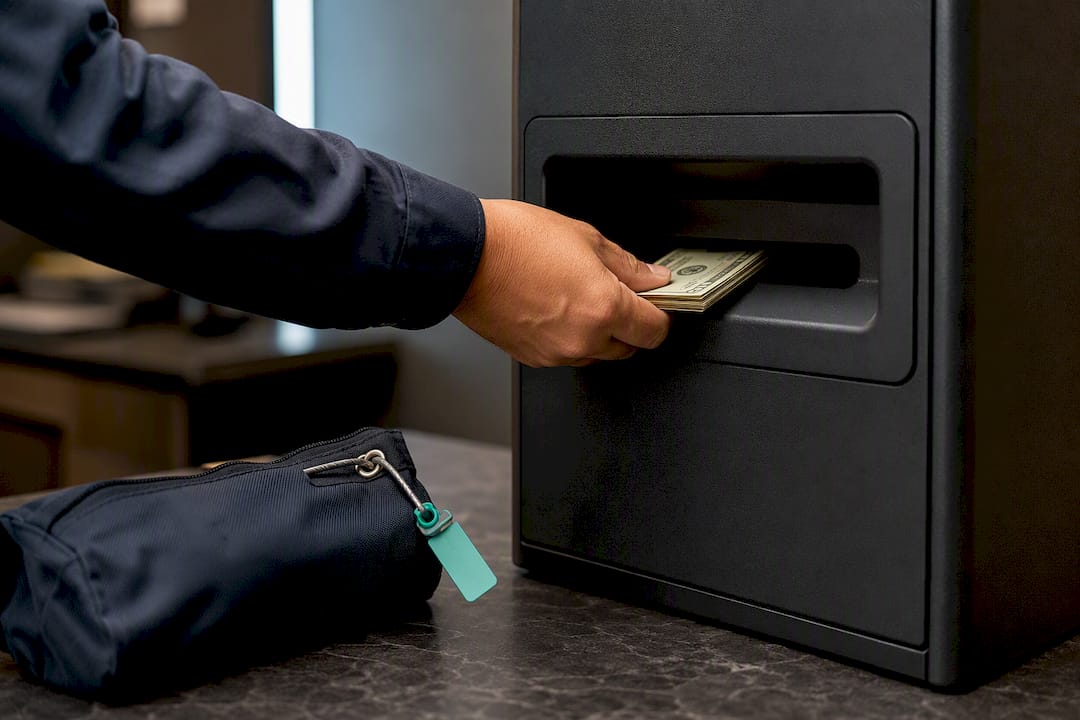
Smart safes count and validate cash on the spot, flag counterfeit bills, and, when tied to a bank relationship, can post provisional credit for deposited funds before an armored courier even picks them up. Case studies from cash-logistics providers show dealers cutting pickup frequency and improving cash flow timing once a smart safe is in place, since money gets credited faster than a manual bank run allows.
On the accounting side, a per-VIN system does something a generic ledger can’t: it attaches every dollar, cash included, to a specific vehicle’s cost file, which is exactly the documentation trail a Form 8300 filing needs behind it.
When evaluating either type of vendor, check for:
- Provisional credit timing and how it reconciles with your bank statement.
- Direct bank integration instead of manual entry of deposit totals.
- Secure remote management so you can review activity without visiting each location.
- Data export formats an outside auditor or accountant can actually use.
Pro Tip: Estimate ROI on a smart safe by counting your current armored pickups per month and pricing out one fewer pickup weekly against the safe’s monthly fee. Most lots break even faster than they expect.
How Often Should You Reconcile and Test Cash Controls?
Reconciliation catches errors. Testing catches fraud. Dealers who only do the first are flying half-blind.
Daily, match bank deposits against your VIN-level cash receipts. Every discrepancy gets a same-day explanation, not a note to “check later.” Weekly, review the voided-receipt report and confirm every void has a manager’s initials and a reason.
Monthly and quarterly, run a pressure test: pull a random sample of deal jackets and verify the cash receipt, the Form 8300 filing (if applicable), and the VIN posting all match. Independent auditors recommend this kind of surprise sampling specifically because scheduled reviews get gamed by staff who know when they’re coming.
User-access reviews belong on this same calendar. Plenty of dealers say they revoke system access when someone quits, but few actually confirm it happened. A quarterly access audit closes that gap.
- Daily: match deposits to VIN receipts, resolve same day.
- Weekly: review voided receipts and dual-signature logs.
- Monthly: sample five deal jackets for full documentation.
- Quarterly: audit user access and retrain on Form 8300 triggers.
Pro Tip: Loop in outside counsel or an external reviewer the moment a pressure test turns up a pattern, not a one-off mistake. Patterns are what regulators and insurers actually ask about.
What Belongs in the Deal Jacket for Cash Transactions?
The deal jacket is your proof that a cash transaction happened the way your books say it did, and it needs to hold up months or years later if a regulator, insurer, or buyer’s attorney comes asking.
At minimum, keep: the signed purchase agreement, the cash receipt with payer name and ID type noted, a copy of any money order or cashier’s check involved in a related transaction, the Form 8300 confirmation (or a note explaining why filing wasn’t triggered), and the written notice sent to the payer confirming the filing. If ID was refused, the refusal itself needs to be documented in writing, not just remembered by whoever was at the desk that day.
Retention matters as much as collection. The IRS can request Form 8300 backup well after the sale, so a folder that gets thrown out during a spring cleaning is a liability, not tidiness. A practical rule: keep deal jacket compliance documents for at least five years, both in paper and in a digital backup, so a lost physical file doesn’t mean lost proof.
The proof-of-filing piece trips up more dealers than the filing itself. A copy of the submitted form isn’t enough on its own, you need something showing it was actually transmitted or mailed, plus the dated notice to the payer. Build that into your checklist as a required field, not an afterthought, and store both digital and paper versions in the same place your accountant already looks for VIN documentation.
How Do You Count and Deposit Cash Correctly Each Day?
Counting cash badly is one of the most common, and most avoidable, sources of dealership shrinkage. The fix is a fixed schedule with named people attached to each step, not a vague “someone counts it before closing” habit.
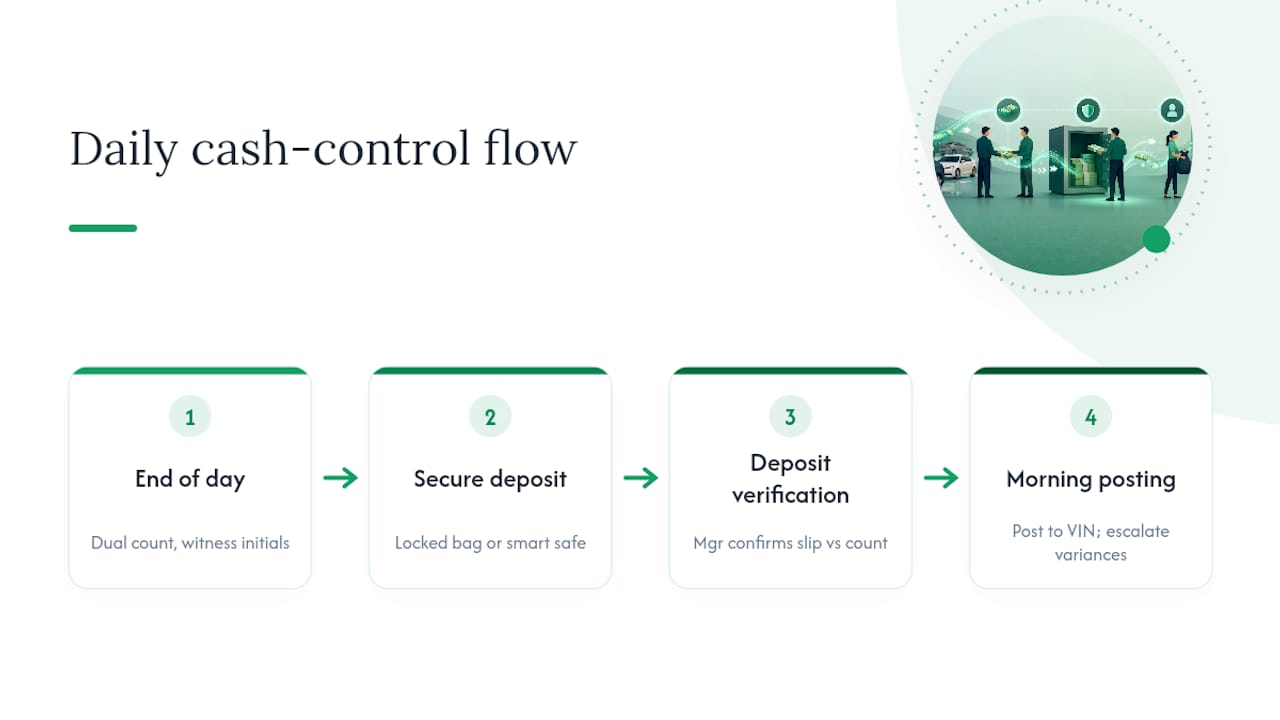
End of business day: the cashier or closing manager counts all cash on hand against the day’s receipts, with a second employee present to witness and initial the count sheet. Any variance over a small preset dollar amount, say $20, gets written up immediately with an explanation, not adjusted quietly.
Before deposit: cash goes into a locked bag or smart safe the same night it’s counted, never held over “until tomorrow’s less busy.” The person sealing the deposit bag should not be the same person who took the original payment from the customer.
Deposit timing: same-day or next-business-day deposit for anything over a set threshold, with a manager confirming the deposit slip total against the count sheet before it leaves the building. If you use a smart safe with provisional credit, the deposit clock effectively starts the moment cash goes in, which is one more reason the technology pays for itself on larger cash volumes.
Following morning: accounting staff, someone who never touched the physical cash, matches the bank confirmation against the count sheet and posts the entry to the correct VIN. Any gap between what was counted and what the bank confirms gets escalated to the owner or general manager that same day, not folded into next month’s reconciliation.
What AML Rules Apply Beyond Form 8300?
Form 8300 gets most of the attention, but it’s not the only anti-money-laundering exposure a dealership carries.
Structuring, breaking a large cash payment into smaller pieces specifically to dodge the $10,000 threshold, is itself a federal offense, separate from any Form 8300 violation. If a buyer proposes paying $9,500 today and the rest “next week in cash,” that’s a structuring red flag your staff needs to recognize and escalate, not accommodate.
Dealers should also watch for third-party cash payments that don’t match the buyer on the title. A stranger paying cash for someone else’s car, with no clear relationship explained, is a pattern worth documenting even below the Form 8300 threshold. Keep informal notes on unusual buyer behavior even when no filing is triggered, because a pattern across multiple small deals can matter more than any single transaction.
Train staff to never tell a customer the exact cash threshold in a way that sounds like coaching. Explaining that you’re required to report cash over $10,000 is fine and often required disclosure. Suggesting a customer pay $9,900 to stay under it edges into facilitating structuring, and that exposure falls on the dealership, not just the buyer. Document any conversation where a customer asks how to avoid reporting, and treat it as an escalation trigger on its own.
How Should Staff Handle Customers During Cash Payments?
The moment a customer hands over cash is also the moment mistakes and friction happen most, so the script matters as much as the paperwork.
Train sales and F&I staff to state the process plainly upfront: “For cash payments, we need to verify identification and, depending on the amount, may be required to file a federal report. This is standard for our industry.” Framing it as routine policy rather than suspicion of the buyer specifically defuses most pushback before it starts.
Staff should never count cash in front of a customer using a single pass. Count once, recount with a second employee present, and log both counts. This protects the dealership from disputes over shortages and protects the employee from accusations of skimming.
Errors cluster around three moments: miscounting large bills quickly under pressure, failing to ask for ID until after the deal is verbally agreed (making refusal awkward), and accepting cash after hours without a manager present. Build training around those three specific failure points rather than generic “handle cash carefully” advice. A short role-play during onboarding, walking a new hire through a customer who gets defensive about showing ID, does more than a written policy ever will.
What Should a Cash Handling Compliance Audit Cover?
A useful internal audit checklist doesn’t need to be complicated, it needs to touch every point where cash could go missing or a filing could get missed.
Cover these areas in any self-audit or third-party review: segregation of duties (does one person control custody, authorization, and recording on any deal?), Form 8300 accuracy (do a sample of large cash deals from the past quarter all have proper filings and payer notices?), deal jacket completeness (pull ten random jackets and confirm receipts, IDs, and filing proof are all present), deposit timing (does the bank confirmation date match policy?), and access controls (does the current employee list match who actually has system and safe access?).
Score each area pass or fail rather than a vague rating, and require a written remediation plan for any fail with a named owner and a deadline. An audit that identifies a problem but assigns no one to fix it isn’t worth running.
Run this internally every quarter and consider an outside review annually, especially once you’re processing enough cash volume that a single missed filing carries real financial exposure. Loturn’s Dealer Academy keeps a running library of audit trail guidance built around exactly these checkpoints, sized for independent lots rather than franchise groups with dedicated compliance staff.
What Risk Management Steps Actually Prevent Cash Theft?
Most dealership cash theft isn’t dramatic. It’s small, repeated skimming that adds up over months because no one was watching the pattern.
The highest-leverage defenses aren’t exotic: segregation of duties catches the person who’d otherwise both take and hide the money, dual counts catch simple miscounts before they’re mistaken for theft, and surprise cash counts catch the employee who’s been quietly shorting the drawer by $20 a week. None of these require new software, just consistent habits enforced by someone other than the person being checked.
Where technology adds real value is in removing the human window for tampering. A smart safe that timestamps and validates every deposit closes the gap between “cash received” and “cash verified” that a manual count leaves open overnight. Tamper-evident deposit bags do the same for cash moving to armored pickup, if a bag arrives opened or resealed, that’s immediate, unambiguous evidence rather than a he-said-she-said dispute.
Insurance matters too, and it’s often overlooked. Confirm your commercial policy actually covers employee theft (fidelity bonding) separately from general liability, because many dealers assume broader coverage than they actually carry until a claim gets denied. Review that coverage annually alongside your other controls, not as a one-time setup task.
A Dealer’s Take on Security, Friction, and Real Numbers
Most independent dealers overbuild security before they’ve ever looked at what a car actually cost them. That’s backwards. Run per-VIN costing first. Once transport, recon, and floorplan interest are attached to each vehicle, a lot of owners discover their “solid” cash deals were thinner than the gross sheet suggested, and that’s usually the moment stronger controls stop feeling optional.
Phase it. Start with segregation of duties and a locked drop box, both cost nothing but discipline. Add a smart safe once cash volume justifies the fee. Customers barely notice good controls done well; they notice controls bolted on badly, mid-transaction, by a nervous employee reciting a script for the first time.
— Eric Dosset
Let Loturn Handle the Bookkeeping Side of Cash Compliance
Loturn is the alternative to spreadsheet bookkeeping for dealers who need every cash receipt tied to a vehicle without hiring a full accounting staff. Every VIN carries its own cost file, purchase price, transport, recon, floorplan interest, and now the cash receipt tied to that same deal, so when a Form 8300 filing needs backup, the documentation is already sitting in one place instead of scattered across drawers and email threads.

Setup includes free data import, so moving your existing deal history in doesn’t cost you a week of downtime. Loturn’s per-car accounting shows true profit before the sale closes, not after month-end guesswork, and the Dealer Academy has step-by-step guides for the segregation-of-duties and audit-trail practices covered above. If your books currently can’t answer “what did this specific VIN actually cost us in cash and fees,” start a free trial and see the difference a per-car ledger makes.
Official Forms and Loturn Resources
- IRS Form 8300 reference guide
- IRS motor vehicle dealer Q&A on cash reporting
- DealerEducator’s Form 8300 checklist
- Loturn’s guide to Form 8300
- Loturn’s segregation of duties guide
This article is general information, not a substitute for advice from a qualified financial advisor. Consult a qualified financial professional about your own circumstances before acting on anything here.
Sources
- IRS Form 8300 reference guide
- Report of cash payments over $10,000 received in a trade or business: Motor vehicle dealership Q&As
- IRS Form 8300 for auto dealers: cash reporting checklist (DealerEducator)
- 13 internal controls dealerships should pressure test (Crowe LLP)
FAQ
What Is the Form 8300 Cash Reporting Threshold?
Dealers must file Form 8300 when they receive more than $10,000 in cash in one transaction or in related transactions, and the form is due within 15 days of receipt.
Do Cashier’s Checks Count as Cash for Form 8300?
In certain vehicle retail transactions, cashier’s checks, money orders, and bank drafts under $10,000 can count as cash equivalents, meaning they get aggregated with currency payments toward the threshold.
What Happens if a Customer Refuses to Provide ID?
Note the refusal in writing in the deal jacket and still file Form 8300 using whatever payer information you have. Refusing ID does not exempt the dealership from filing.
How Does Per-VIN Accounting Help With Compliance?
A per-VIN system like Loturn attaches cash receipts, filings, and cost data to the same vehicle file, so audit and Form 8300 backup are already organized instead of scattered across separate records.
How Often Should a Dealership Test Its Cash Controls?
Daily reconciliation, weekly voided-receipt review, and monthly or quarterly pressure tests, including surprise cash counts and access reviews, are the recommended cadence for catching failures early.