
The fastest fix for a stalled recon approval workflow is combining mobile approvals with pre-set spend thresholds, named stage owners, and automated handoffs so decisions take minutes instead of days. Dealers who make this switch typically shave one to two full days off total recon time and get cars to the frontline faster, cutting holding costs before they eat into gross. The targets to aim for: a ten-minute approval response and a 3 to 5 day recon cycle from intake to frontline.
TL;DR:
- Combining mobile approvals with pre-set spend thresholds can cut recon approval times from hours to minutes and reduce overall cycle time by one to two days.
- Using tiered approval limits based on vehicle value and mileage enables routine repairs to be approved quickly without manager intervention, speeding up the process and maintaining control.
- Assigning clear ownership to each recon stage and monitoring bottlenecks, such as delayed approvals or backordered parts, helps keep the workflow within the targeted three to five days.
- Implementing real-time status dashboards, automated handoffs, and decision capture tools ensures transparency, accountability, and continuous identification of speed-improvement opportunities.
- Tracking approval latency and recon costs together allows dealerships to safely raise thresholds and delegate more decisions, unlocking long-term efficiency gains.
Table of Contents
- What Are the Stages of a Recon Approval Workflow?
- How Do Mobile Approvals and Threshold Rules Speed Up Recon?
- Who Owns Each Recon Stage and How Do You Catch Bottlenecks?
- What Features Make a Recon Approval System Actually Work?
- Your Recon Approval Checklist for This Week
- How a Used-Car Manager Actually Measures Recon Success
- Track Recon Costs and Approvals in One Place With Loturn
- Sources
- FAQ
What Are the Stages of a Recon Approval Workflow?
A recon approval workflow moves a vehicle through seven checkpoints, and each one either adds time or saves it depending on how tightly it’s managed. DealerVLO’s recon turnaround blueprint breaks the process into intake, inspection, approval, mechanical, detail, quality control, and frontline release, with a 3 to 5 day target for the whole cycle.
Here’s how the days typically break down when the workflow runs well:
- Day 0, intake and trade walk. The vehicle gets logged, photographed, and physically walked the same day it arrives. No car should sit uninspected overnight.
- Day 0 to 1, inspection and quoted estimate. A technician documents needed work and pushes a scoped estimate for approval immediately after inspection.
- Day 1, approval. This is the checkpoint most likely to stall. It should take minutes, not a business day.
- Day 1 to 3, mechanical and parts. Parts get ordered the moment approval clears, not after a manager remembers to sign off.
- Day 3 to 4, detail and cosmetic work. Ideally scheduled to start the moment mechanical work finishes, with no idle gap between the two.
- Day 4, quality control. A final checklist catches anything that would bounce the car back a stage.
- Day 4 to 5, frontline release. Photos go up, and the car is ready to sell.
Cartuul’s step-by-step mapping of the recon process finds that approval latency and parts backorders are usually the two biggest contributors when a car blows past that five-day window. The fix for both is the same: stop treating approval as a manual task that waits for someone to check email.
How Do Mobile Approvals and Threshold Rules Speed Up Recon?
Approval latency is the single easiest bottleneck to eliminate, because it rarely requires new labor. It requires a different channel and a set of rules that let most decisions skip the manager entirely.
DealerVLO’s data shows a practical model: a technician texts a scoped estimate straight to the used-car manager’s phone, including the VIN, the issue, the cost, and a one-tap approve or deny. Dealerships running this model report approvals returning in roughly 5 to 10 minutes, compared with the half-day-to-day delay common when estimates sit in an inbox or on a clipboard. Rapid Recon’s research on workflow delays backs this up, noting that pushing diagnostic data directly to a manager’s phone in real time is what actually collapses the approval window.
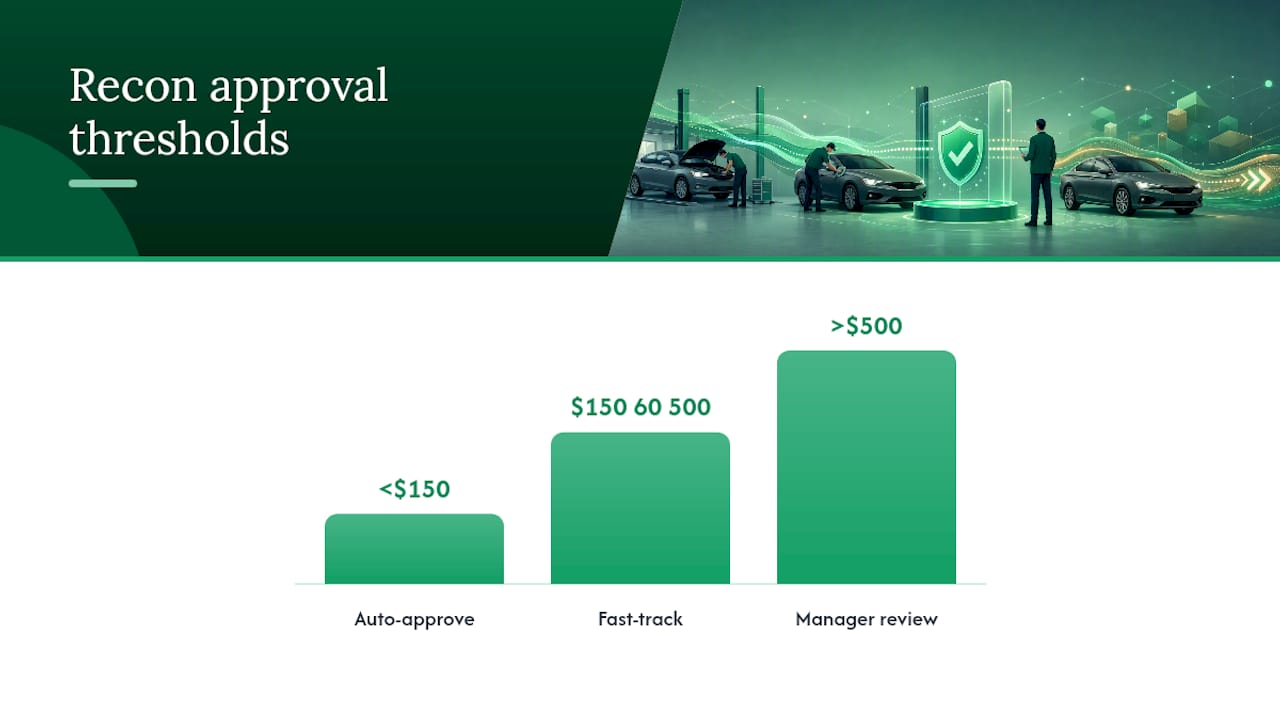
Pre-approval thresholds cut out even that ten-minute wait for routine work. A workable tiered structure looks like this:
- Auto-approve under $150. Oil changes, wiper blades, minor detail fixes. No approval needed at all.
- Fast-track $150 to $500. Requires a text approval, but any manager or assistant manager on shift can clear it.
- Manager review over $500. Routed to the used-car manager or GM, with a required reason code if the job pushes the vehicle’s total recon cost past its target ceiling.
Recon approval example: a car with 60,000 miles and a $9,000 acquisition cost might carry a $600 threshold before it needs GM sign-off, while a $4,000 unit might cap at $250. Buckets set by mileage and acquisition price keep low-value units from absorbing high-dollar repairs nobody notices until the car is underwater.
Every approval, whatever the tier, should log who approved it, what was approved, and why. DealerInt’s analysis of recon bottlenecks found that decision capture, rather than the approval speed alone, is what let one dealer identify safe delegation opportunities and drop average recon time from 10 days to 6 within 30 days.
Who Owns Each Recon Stage and How Do You Catch Bottlenecks?
Every stage needs one named owner and a due date, or delays become invisible until the car has already sat for a week. Assign a person, not a department, to intake, inspection, mechanical, detail, and QC, and hold a short daily huddle to review anything past its clock.
The daily trade walk is the backbone of this. DealerVLO recommends walking every trade-in the day it lands and ordering parts immediately after inspection, rather than waiting for a batch cycle. That single habit removes a full day from most recon timelines.
Watch for these specific bottleneck signals:
- Any approval sitting unanswered past 24 hours.
- Parts on backorder without a confirmed return date from the vendor.
- A car sitting between mechanical and detail with no reserved slot, waiting for whoever’s free.
- The same reason code showing up repeatedly on approval denials, which usually points to a scoping problem at intake, not a spending problem.
Vendor coordination deserves its own rule. Whether or not your vendors use a formal portal, every outside job needs a committed return date in writing, even if that’s just a confirmed text or email. Without it, “the shop’s working on it” becomes an unmeasurable excuse.
Pro Tip: Pipeline mechanical and detail work so detail has a reserved bay slot the moment mechanical finishes. This one scheduling change eliminates the day-level wait that happens when detail crews only get notified after the fact.
What Features Make a Recon Approval System Actually Work?
The right tooling turns these rules into habits instead of good intentions that slip during a busy week. Look for a system that supports the real-time behavior this workflow depends on, not just a digital version of the same paper process.
- A mobile approval feature that pushes scoped estimates to a manager’s phone with one-tap approve or deny.
- A live status dashboard showing every unit’s current stage and how long it’s been there.
- Automated handoffs that notify the next stage owner the instant a car clears the prior one.
- A vendor portal or shared log for tracking outside work and return dates.
- A digital QC checklist that auto-reopens a unit if it fails inspection, rather than letting it slip to the frontline.
- Time-in-stage and approval-latency reports that show exactly where cars are losing days.
| Template | What it standardizes |
|---|---|
| Intake checklist | Photos, mileage, condition notes, trade walk sign-off |
| Scoped estimate form | Issue, cost, technician notes, threshold tier |
| QC checklist | Safety items, fluids, cosmetics, photo requirements |
| Reason-code list | Standard denial and approval reasons for audit review |
Approval-latency and days-in-stage reports matter beyond daily management. Once you have 30 days of data showing which approval tiers rarely get denied, you have the evidence to raise thresholds and delegate more decisions, which is exactly the pattern DealerInt’s bottleneck research points to as the source of long-term speed gains.
Your Recon Approval Checklist for This Week
Turning this into practice doesn’t require a system overhaul. It requires committing to a few habits starting Monday.
- Run a daily trade walk using a standard intake checklist so every unit gets inspected the day it arrives.
- Set two-tier pre-approval thresholds by mileage or acquisition cost, and move routine work to mobile, one-tap approvals.
- Turn on decision capture so every approval logs who signed off, what was approved, and the reason code.
- Pull a 30-day approval-latency report to find which thresholds you can safely raise and which approvals you can delegate.
Pro Tip: Start the audit trail even before you touch thresholds. You can’t safely delegate what you can’t measure, and a month of approval data tells you exactly where the safe delegation line sits.
How a Used-Car Manager Actually Measures Recon Success
The number I watch first isn’t total recon time. It’s approval latency alone, because that single metric usually reveals whether the rest of the workflow is broken or just slow by design. A tightened approval process frees up cashflow faster and protects gross before a car ever hits the lot. Run the checklist above for 30 days and track the difference in turn time. Most dealers see a real 1 to 3 day improvement.
— Eric Dosset
Track Recon Costs and Approvals in One Place With Loturn
Every rule in this guide, mobile approvals, threshold tiers, decision capture, only pays off if the costs behind them land on the right car. Loturn tracks recon and transport expenses per VIN alongside acquisition price, so a manager approving a $600 repair sees exactly what that decision does to true profit on that specific unit, not a lump recon line buried at month end.
The platform pairs that per-car costing with an audit trail built for exactly the kind of decision capture this workflow depends on: who approved what, when, and why, all tied back to the vehicle’s full cost history. That record is what lets you safely raise thresholds and delegate approvals down the line, instead of guessing. Loturn’s plans start with Flipper at $99 per month, scaling up through Dealer and Multi-Lot as your volume grows. Check the pricing page and get your recon costs tied to real per-car profit this week.
Sources
- Recon turnaround time: workflow to hit 3-5 days | DealerVLO
- The used-car recon process: intake to frontline, step by step | Cartuul
- Recon bottlenecks and hidden profit loss | DealerInt
- Reconditioning workflow delays dealerships | Rapid Recon
FAQ
What Are the Main Steps in a Recon Approval Workflow?
The core steps are intake and trade walk, inspection with a scoped estimate, approval, mechanical and parts work, detail and cosmetic work, quality control, and frontline release, ideally completed within 3 to 5 days.
What Is a Process Approval Workflow?
A process approval workflow is the sequence of decision points where someone with authority signs off on a task, cost, or step before work continues, and in recon that means a manager approving a repair estimate before a technician proceeds.
What Are the Four Types of Workflows?
Workflow theory generally groups processes into sequential, parallel, state machine, and rules-driven workflows; recon approvals typically function as a rules-driven workflow, where pre-set spend thresholds automatically route decisions to the right approver.
How Do You Speed Up a Slow Recon Approval Process?
Push scoped estimates to a manager’s phone for one-tap approval, set pre-approval spend thresholds so routine work skips manual review, and track approval latency so you know which thresholds are safe to raise.
Can Software Like Loturn Help With Recon Approval Tracking?
Yes. Loturn tracks recon and transport costs per vehicle and logs the decision history behind them, giving managers the same audit trail and per-car profit visibility this workflow depends on.