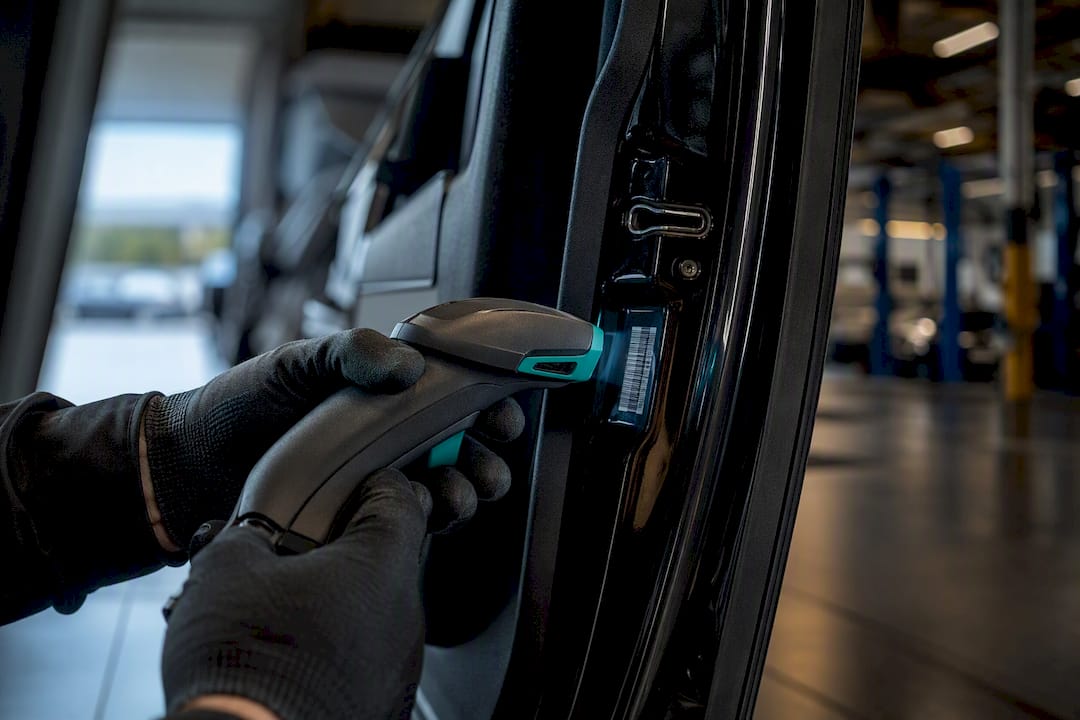
Track every vendor invoice and transport charge to the vehicle’s VIN, require a committed return date from every sublet vendor, and capitalize recon costs onto that vehicle’s books instead of burying them in overhead. That’s the whole system: per-VIN cost capture, vendor commitments with deadlines, and accounting that treats recon as inventory, not expense. A platform like Loturn handles all three without forcing you to build spreadsheets from scratch.
TL;DR:
- Tracking every vendor invoice and transport charge by VIN ensures accurate, per-vehicle cost attribution and prevents guessing on actual profit margins.
- Requiring a confirmed return date for all vendors and establishing standardized pickup schedules helps prevent vehicles from being lost or delayed without accountability.
- Capitalizing direct recon costs such as third-party work, internal labor, and inbound transport to the vehicle’s inventory value avoids overstating profit and complies with federal inventory rules.
- Using simple fields like VIN, vendor name, PO number, scope, and invoice images on every record lays the foundation for reliable data capture as volume increases.
- Regular reports on recon stages, costs, and operational KPIs identify leaks and inefficiencies before they impact monthly financial results.
Table of Contents
- What Does Recon Vendor Tracking Actually Require?
- How Do You Stop Vendors From Losing Track of Your Cars?
- Which Recon Costs Get Capitalized, and Which Don’t?
- What’s the Fastest Way to Start Capturing This Data?
- Which Reports Actually Show You Where the Money Leaks?
- How Do You Roll This Out Without Disrupting Sales?
- Why Most Dealers Get This Wrong Anyway
- Get Per-Vehicle Recon Costs Working Automatically
- Sources
- FAQ
What Does Recon Vendor Tracking Actually Require?
Recon vendor tracking means attaching every dollar and every hour of reconditioning and transport work to a specific vehicle, not to a monthly bucket labeled “recon expense.” Without that link, you’re guessing at true profit per car until the deal closes and the bookkeeper reconciles everything weeks later.
The minimum record set looks like this:
- VIN or stock number on every work order and invoice. No exceptions, no “we’ll match it up later.”
- A purchase order or work-order ID tied to a scope code: mechanical, body, detail, or reconditioning-adjacent (tires, glass, keys).
- Labor hours and attached invoice images, whether the work came from your own shop or a sublet vendor.
- Transport fields: carrier name, invoice number, pickup date, drop date, and the cost itself.
In-house labor needs the same discipline as outside vendors. If your technician spends three hours on a brake job, that time gets allocated to the VIN at a reasonable internal rate, the same way a sublet invoice would post. Treat sublet costs as pass-through dollars and in-house labor as an allocated cost, but record both against the same vehicle record so nothing falls through a gap between departments.
How Do You Stop Vendors From Losing Track of Your Cars?
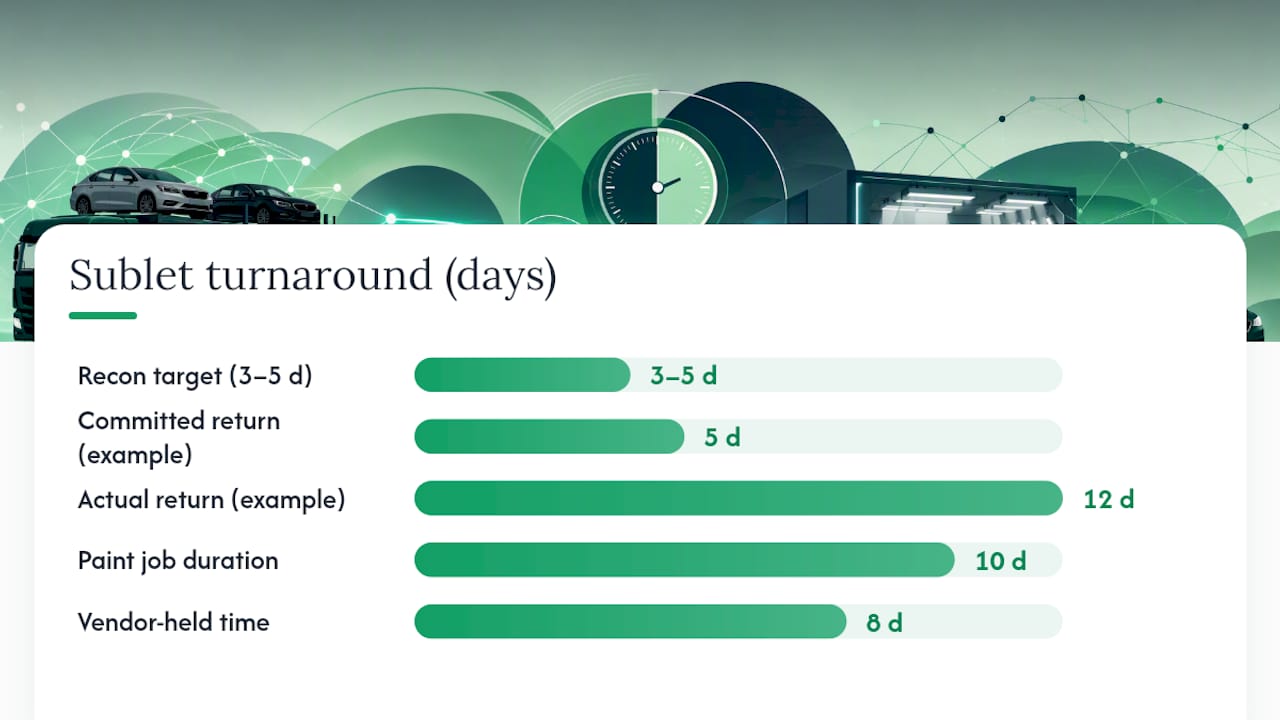
Cars vanish at sublet shops more often than dealers admit. A vehicle goes out for paint work and reappears twelve days later instead of five, and nobody flagged it because nobody was tracking it against a deadline. Vendor portals or even a shared tracking sheet that requires vendor confirmation and a committed return date close that gap fast, and they support the widely cited 3 to 5 day recon turnaround target most process guides aim for.
Four moves fix most of this:
- Require a written work order with a confirmed return date before the vehicle leaves your lot. A verbal agreement is not a commitment.
- Set standing pickup and drop schedules with your highest-volume sublets so transport isn’t improvised every time.
- Assign one person as recon owner who checks status daily and escalates anything past its committed date.
- Keep a vendor performance log tracking average turnaround, missed dates, and comeback rates, then use it to cut vendors who consistently blow deadlines.
Pro Tip: Track sublet time separately from your own shop’s internal wait time. If a paint job takes ten days, you need to know whether the vendor held the car for eight of them or your own detail bay was the bottleneck.
Which Recon Costs Get Capitalized, and Which Don’t?
Under 26 CFR § 1.263A-1, dealers must capitalize direct inventory costs, which includes third-party reconditioning, allocated internal mechanic labor, inbound transportation, auction fees, and title or registration costs, until the unit sells. These aren’t optional line items you can expense in the month you pay them. They attach to the vehicle and ride on the books as inventory value until the car leaves your lot.
That means the following typically get capitalized to the VIN:
- Third-party invoiced mechanical, body, and detail work
- Allocated internal labor for reconditioning performed in-house
- Inbound transport and carrier fees
- Auction buy fees and title/registration costs tied to acquisition
What “Fuzzy Math Syndrome” costs you: many dealers hide recon and indirect costs in general operating expenses instead of tagging them to a VIN, which can mask several hundred to over a thousand dollars per unit in indirect costs and materially overstate what a car actually earned.
Lot storage and holding costs sit in a grayer zone. Some retail facility rules treat extended storage differently from direct recon labor, so check with your accountant if a vehicle sits on an outside lot for an extended stretch before assuming the same capitalization treatment applies. When in doubt, Loturn’s guide to tracking recon costs walks through how to tag these correctly at the point of entry rather than reconstructing them at month-end.
What’s the Fastest Way to Start Capturing This Data?
You don’t need enterprise software on day one, but you do need consistent fields. Every vendor record and invoice should carry: VIN, vendor name, PO number, scope code, cost, date completed, and a photo or scanned copy of the invoice itself.
Three realistic capture paths exist depending on where you are:
- Manual forms or a shared spreadsheet. Works for low volume, but breaks down past 15 to 20 units a month unless someone is disciplined about entry.
- DMS add-ons that bolt recon tracking onto your existing dealer management system, useful if your DMS already handles most other workflows well.
- Dealer-focused platforms built specifically for per-vehicle costing, which typically save the most time once volume climbs.
Whatever method you pick, build in validation: require an invoice reference number on every entry, attach a photo of the physical invoice, and get written vendor confirmation before marking a job complete. Those three checks catch most of the reconciliation errors that create fuzzy math down the line, since a VIN requirement on every vendor invoice eliminates the majority of these mismatches before they ever reach your books.
Which Reports Actually Show You Where the Money Leaks?
A weekly dashboard with the right four categories catches problems before they compound into a bad month. Run these consistently, not just when something feels off.
| Report Type | What It Shows |
|---|---|
| Recon stage dashboard | Units by stage (intake, mechanical, body, detail, ready) and units currently at outside vendors |
| Cost reports | Recon cost per vehicle, transport cost per vehicle, average cost by category |
| Profit verification | Sale price minus purchase, recon, transport, and holding costs |
| Operational KPIs | Average days to front-line, vendor turnaround time, percent of units within SLA |
Holding costs deserve their own line, since floorplan interest, depreciation, and insurance can add tens of dollars per vehicle per day in holding costs in benchmark ranges. A car that sits an extra two weeks past your target can quietly erase the margin you thought you had. Loturn’s per-car profit tracking guide breaks down how to build this calculation so it updates automatically instead of requiring a spreadsheet rebuild every month.
How Do You Roll This Out Without Disrupting Sales?
You don’t need to overhaul everything at once. A phased rollout gets your team using the system without a week of chaos, and it matches how most dealers successfully train staff on new recon workflows without losing productivity.
- Days 1 to 30: Standardize work-order forms, require VIN on every invoice without exception, start manual tracking or trial a dealer-focused platform, and train staff on the new fields.
- Days 31 to 60: Add vendor commitments with return dates, launch a weekly dashboard review, and start a vendor performance log.
- Days 61 to 90: Reconcile per-VIN costs directly into your accounting system, automate invoice imports where possible, and close out any remaining gaps between operations and the books.
Define roles early: who owns escalation, what counts as a red flag, what your SLA is for each vendor type, and how often the team reviews the dashboard.
Why Most Dealers Get This Wrong Anyway
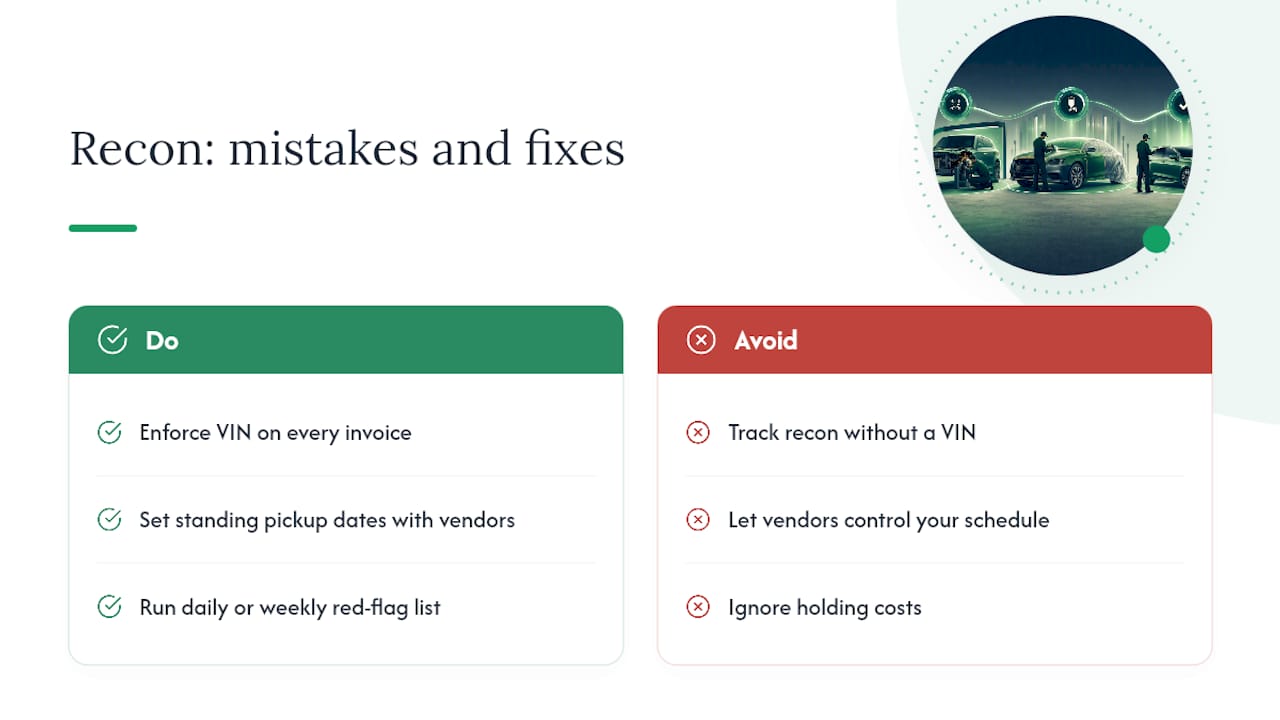
The biggest mistake I see isn’t a lack of effort. It’s dealers who track recon diligently on paper but never connect it to a VIN, so the data dies the moment the car sells. Missing VINs, vendors who control your own schedule because you never demanded a return date, and holding costs nobody bothers calculating: these three gaps account for most of the “we thought we made money on that car” conversations.
The fix is boring and that’s exactly why it works: enforce VIN on every single invoice, set standing pickups so vendors can’t improvise your timeline, and run a daily or weekly red-flag list of anything past its committed date. For deeper operational detail, Loturn’s dealer academy has more on building this out step by step.
— Eric Dosset
Get Per-Vehicle Recon Costs Working Automatically
A specialized platform can close the gap between what you spend reconditioning a car and what you actually know about it before the sale. Every vendor invoice, transport charge, and in-house labor entry can attach directly to the vehicle’s record, so your recon dashboard and your accounting stay in sync instead of living in two different systems.
The platform tags costs per vehicle as they happen, keeps transport charges in their own field, and lets you attach work orders and invoice images directly to each VIN, providing an effective revenue recovery software solution to automate lost revenue recovery. Setup may include data import assistance to help preserve existing vendor records and inventory during migration, with data security measures applied throughout. If you’re still reconciling recon costs by hand at month-end, Loturn’s accounting features are built to eliminate that step entirely. Start a trial at Loturn and see your true per-car profit the moment a vehicle goes into recon, not after it sells.
Sources
- 26 CFR § 1.263A-1 — Capitalization of certain expenses
- Recon Turnaround Time: Workflow to Hit 3-5 Days | Process Guide — DealerVLO
- Dealers suffer from Fuzzy Math Syndrome - Vis-Flow
- 5 keys to having a successful inventory reconditioning process — Credit Acceptance (The Lot)
FAQ
What Counts as a Recon Cost That Must Be Capitalized?
Third-party reconditioning invoices, allocated in-house mechanic labor, inbound transport, auction fees, and title or registration costs all get capitalized to the vehicle under federal inventory rules until the unit sells.
How Long Should Recon Take From Intake to Front Line?
Most dealers target 3 to 5 days from intake to front-line ready, measuring vendor turnaround separately from internal shop delays.
What’s the Simplest Way to Start Tracking Vendor Costs Per Vehicle?
Require a VIN on every vendor invoice and work order immediately. That single habit eliminates most reconciliation errors before you even add software or a formal vendor portal.
Does Loturn Handle Recon and Transport Cost Tracking?
Yes. Loturn tags recon and transport costs to each vehicle’s record automatically, feeding directly into per-car profit reporting instead of requiring a separate spreadsheet.
What Happens if I Don’t Track Recon Costs by Vehicle?
You end up with what’s known as Fuzzy Math Syndrome, where indirect costs of several hundred to over a thousand dollars per unit in indirect costs get buried in general expenses, overstating what individual cars actually earned.