
Only the amounts a title company or closing agent actually earns, retained premium splits, settlement fees, document prep charges, count as revenue. Everything else moving through a closing, buyer and seller escrow deposits, lender-required reserves, the underwriter’s share of the insurance premium, sits on the balance sheet as a fiduciary liability until it’s disbursed. The immediate move for any bookkeeper touching a closing file: open a per-file subledger the day funds land, and run a three-way reconciliation before you ever touch the income statement.
TL;DR:
- Title service fees include title search, insurance premiums, settlement charges, and recording fees, with total costs varying widely by state and transaction size.
- Proper recording of title fees requires classifying earned fees into revenue and holding escrow funds in fiduciary liability accounts, not as income.
- Regulatory and audit standards mandate file-level reconciliation of escrow accounts weekly to prevent errors and ensure segregation of client funds.
- Escrow balances that do not zero out after disbursement or revenue postings that exceed settlement statement amounts indicate potential bookkeeping issues.
- Capitalization of title plant costs is only appropriate during initial construction or acquisition, with ongoing expenses expensed once the plant is operational.
Table of Contents
- What Do Title Fees Actually Include?
- How Do You Record Title Fees in Journal Entries?
- Why Does Escrow Accounting Deserve Separate Treatment?
- What Tax and 1099 Rules Apply to Title Fees?
- When Can You Capitalize Title Plant Costs?
- Where Do Title Fees Show Up on Closing Documents?
- A Practical Closing-Day Checklist
- Why Accountants Get This Wrong More Often Than They Should
- How Loturn Handles the Same File-Level Discipline for Dealers
- Sources
- FAQ
What Do Title Fees Actually Include?
“Title fees” is shorthand for a cluster of distinct charges, and lumping them together is exactly how misclassification happens. The CFPB defines title service fees as the costs tied to issuing a title insurance policy, which typically breaks down into these components:
- Title search and examination: the cost of pulling the chain of title and checking for liens, judgments, or ownership gaps.
- Owner’s and lender’s title insurance premiums: separate policies protecting the buyer and the lender, usually the largest single line item.
- Settlement or closing fee: what the title or escrow company charges to run the closing itself.
- Escrow service fee: compensation for holding and disbursing funds.
- Recording fees: paid to the county to record the deed and mortgage.
- Courier, wire, and notary charges: smaller pass-through costs tied to document handling.
- Attorney or abstract fees: common in attorney-closing states.
- Endorsements and curative work: fees to clear title defects found during search.
Cost ranges vary widely by state and transaction size. Rocket Mortgage puts combined lender’s and owner’s title insurance at roughly 0.5% to 1% of the purchase price, and other benchmark data pegs total title and settlement charges anywhere from a few hundred dollars to several thousand, depending on the deal. Some states set promulgated title insurance rates, meaning the premium itself isn’t negotiable, only the ancillary fees are. County recording fees add another layer of variance since they’re set locally, not federally.
How Do You Record Title Fees in Journal Entries?
The classification logic is simple even when the paperwork isn’t: funds you’ve earned go to revenue, the underwriter’s cut goes to a liability account until remitted, and anything sitting in escrow for a buyer, seller, or lender stays a fiduciary liability, never income. Here’s how that plays out in practice.
- Receipt of funds into escrow. Debit Escrow Cash (asset), credit Escrow Liability, buyer or seller (liability), for the full amount received at intake, including earnest money, loan proceeds, and prorated items.
- Recognize earned fees at closing. Debit Escrow Liability, credit Settlement Fee Revenue, Escrow Fee Revenue, and Title Premium Revenue, agency share, for the exact amounts the agency is entitled to keep.
- Record the underwriter’s premium split. Debit Escrow Liability, credit Due to Underwriter (liability), for the portion of the title insurance premium that must be remitted upstream.
- Remit to the underwriter. Debit Due to Underwriter, credit Cash, when the check or wire actually goes out. This should never hit revenue or expense.
- Pay third-party and recording costs. Debit Escrow Liability, credit Cash, for recording fees, courier costs, or attorney charges paid on the client’s behalf.
Post refunds and post-closing corrections against the original escrow liability account, not against revenue, unless the correction relates to a fee your firm actually earned and later returned.
Why Does Escrow Accounting Deserve Separate Treatment?
Escrow and trust balances have to stay segregated from operating cash, and that’s not just good hygiene. It’s a custodial duty that regulators and auditors treat as a bright-line test of whether a firm is handling client money responsibly. Mixing the two, even temporarily, is one of the fastest ways to trigger a licensing or audit problem.
The fix is organizational as much as procedural: build a subledger keyed to each file or closing number, and link every line item back to its source document, the settlement statement, the wire confirmation, the recording receipt. Industry bookkeeping practitioners consistently point to the failure to separate operating cash from fiduciary escrow cash as the single most common error in this space, and a file-level subledger is the standard fix.
Run a three-way reconciliation on a set schedule:
- Match the bank statement balance for the escrow account.
- Match the general ledger escrow liability balance.
- Match the sum of all open subledger files.
All three numbers should tie out exactly. If they don’t, the gap is almost always a single file with a posting error or a stale entry that never cleared.
Pro Tip: Reconcile escrow accounts weekly, not monthly, during high closing volume. A one-file error compounds fast when you’re running twenty files a week, and catching it on day three is far cheaper than catching it on day thirty.
What Tax and 1099 Rules Apply to Title Fees?
The reportable-income line is the same one that separates revenue from escrow: agency-retained premium, settlement fees, and document prep charges are taxable income and belong on your books as such. Escrow funds passing through to a buyer, seller, or underwriter are not revenue and generally aren’t reportable the same way, a distinction IOFM’s guidance on title company reporting lays out clearly.
Sales and use tax treatment of settlement service fees varies by state, so don’t assume a fee is tax-exempt just because it’s tied to a real estate closing. Some jurisdictions tax certain service fees while exempting others entirely.
The bigger operational risk is losing track of the underwriter versus agency split. SnapClose’s guidance for title agents warns that failing to track which payments are reportable versus pass-through triggers compliance headaches during audits. Tight vendor and remittance tracking isn’t optional paperwork, it’s what keeps your 1099 filings defensible when a regulator asks for backup.
When Can You Capitalize Title Plant Costs?
If your firm builds or acquires a title plant, a searchable database of property records, FAS 61 guidance allows you to capitalize the direct construction or acquisition costs until the plant becomes operational. Once it’s up and running, ongoing maintenance and the routine cost of running individual title searches get expensed as incurred, not added to the capitalized balance.
The distinction matters for audit defense: capitalize the initial build, expense everything after go-live, and apply standard impairment testing if the plant’s value drops. Document the go-live date clearly, since that’s the line auditors will ask about first.
Where Do Title Fees Show Up on Closing Documents?
Title search, examination, and settlement fees appear in the “Title Charges” section of the Loan Estimate and again on the Closing Disclosure, typically in the same grouping alongside owner’s and lender’s title insurance. Reconcile every posted entry against the title company’s settlement statement and your own subledger, not just the Closing Disclosure alone. Comparing those Closing Disclosure lines against the settlement statement is the fastest way to catch a posting error before the books close, and federal rules require that document reach the buyer at least three business days before closing, so there’s no excuse for skipping the check.

A Practical Closing-Day Checklist
Run this sequence on every file before you release it from your working queue:
- Confirm the settlement statement total matches the escrow cash receipt.
- Post earned fees to revenue and the underwriter split to a liability account.
- Verify recording and third-party disbursements against paid receipts.
- Reconcile the subledger balance to zero once all funds are disbursed.
- Flag any file with an unresolved balance older than five business days.
A few modular templates worth keeping on hand: one for initial escrow receipt, one for fee recognition at closing, one for underwriter remittance, and one for post-closing refund corrections. Build them generically enough that any bookkeeper on the team can adapt them without rewriting the account structure each time.
Pro Tip: A file sitting open more than a week after disbursement is your single best early-warning sign of a misposted fee or an unremitted underwriter payment. Chase it down before month-end, not after.
Watch for these red flags: escrow balances that don’t zero out after disbursement, revenue postings that exceed the settlement statement’s stated agency share, and underwriter remittances that lag more than a few business days behind collection.
Why Accountants Get This Wrong More Often Than They Should
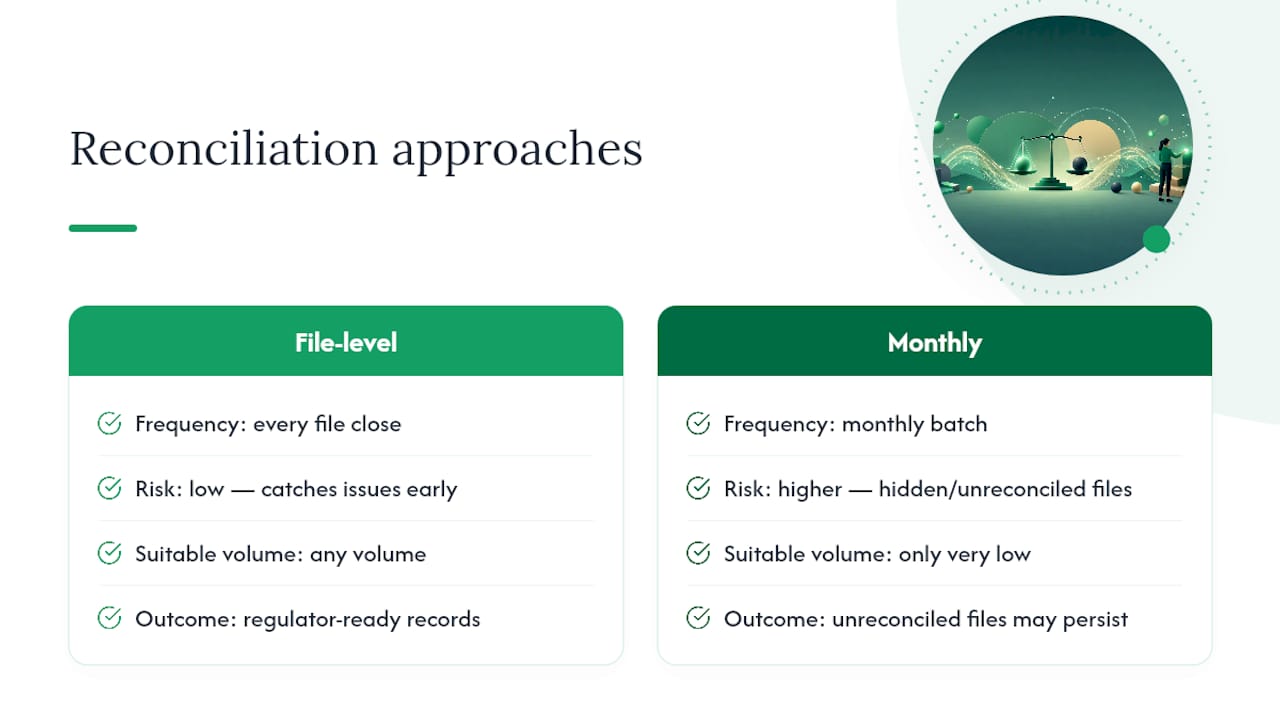
Most guidance on closing costs treats title fees as a single line on a spreadsheet, and that’s the root of nearly every misclassification I’ve seen discussed in this space. The real work isn’t understanding that escrow money isn’t yours, most bookkeepers know that instinctively. It’s building the discipline to reconcile at the file level every single time, even when volume is low and the temptation to batch-process is high.
Where I’d push back on conventional advice: monthly reconciliation is treated as sufficient in a lot of firm procedures, and it isn’t, not for anyone closing more than a handful of files a month. A single unreconciled escrow file can sit for weeks looking harmless until it’s the one item an underwriter or regulator flags. The firms that handle this well aren’t necessarily the most sophisticated ones. They’re the ones that made file-level tracking non-negotiable from day one, the same principle that per-vehicle cost tracking tools like Loturn’s accounting features apply to dealership files instead of closing files.
— Eric Dosset
How Loturn Handles the Same File-Level Discipline for Dealers
Loturn is the alternative to spreadsheet chaos for dealers who need the same file-level accuracy title accountants rely on, applied to every vehicle instead of every closing. Every cost tied to a unit, purchase price, transport, recon, gets tracked against that specific vehicle from intake to sale, so you see true profit before the deal closes instead of guessing after.

That per-file tracking mirrors exactly what this article recommends for title fees: a dedicated subledger for every transaction, reconciled against real documents rather than a lump-sum estimate. Loturn pairs that with native double-entry accounting built for dealership charts of accounts, bank-level encryption, and free data import so you’re not rebuilding your books from scratch. Plans run from Flipper at $99 per month up to Multi-Lot at $699 per month, depending on lot size and volume. If you’re tracking recon costs by hand right now, the recon vendor tracking guide shows what a per-VIN subledger actually looks like in practice, and it’s worth a look before your next closing month starts.
Sources
The guidance in this article draws on primary regulatory and industry sources worth bookmarking for audit prep: the CFPB’s title service fee explainer, IOFM’s 1099 reporting guidance, Rocket Mortgage’s title fee benchmarks, and FAS 61’s title plant capitalization rules. Keep all four handy the next time a reviewer questions a closing entry.
- IOFM - 1099 reporting to a title company
- What are title service fees? – CFPB
- What are title fees? – Rocket Mortgage
- 1099 reporting for title agents – SnapClose
FAQ
What Is the Journal Entry for Professional Fees?
Professional fees earned at closing, settlement, escrow, and document prep charges, are recorded with a debit to Escrow Liability and a credit to the corresponding revenue account once the fee is actually earned. The underwriter’s share of any insurance premium is never booked as revenue; it goes to a liability account until remitted.
How Much Does a Title Fee Usually Cost?
Combined lender’s and owner’s title insurance typically runs 0.5% to 1% of the purchase price, with settlement and ancillary charges adding several hundred to a few thousand dollars depending on location and transaction complexity. State-set promulgated rates mean the insurance premium itself may not be negotiable in some markets.
Are Legal Fees Capitalized or Expensed?
Attorney and abstract fees tied to a specific closing are expensed as part of that transaction’s cost, not capitalized. The only capitalization exception under FAS 61 applies to costs directly tied to constructing or acquiring a title plant, not to routine legal work on individual files.
Are Title Fees Part of Closing Costs?
Yes, title fees are one category within the broader bucket of closing costs, alongside prepaid items like property taxes and homeowners insurance. Accountants should keep them in a separate line since title charges are service fees tied to clearing ownership, not prepaid future obligations, a distinction Urban Institute’s breakdown of closing cost components draws explicitly.
Which Title-Related Amounts Count as Revenue Versus Escrow?
Revenue includes only what the agency actually earns and keeps: retained premium share, settlement fees, and document prep charges. Buyer and seller deposits, lender reserves, and the underwriter’s premium split are fiduciary liabilities that must stay off the income statement entirely until disbursed or remitted.