
A down payment you receive is cash plus a liability, not revenue. A down payment you pay is a prepaid asset, not an expense. You only recognize revenue or expense once the underlying performance obligation is satisfied, and under ASC 606 that liability is called a contract liability, though refundable deposits get classified differently. The journal entries below show exactly how that plays out on both sides of the transaction.
TL;DR:
- Deposit liabilities are to be classified as contract liabilities if non-refundable, but refundable deposits are financial liabilities, affecting balance sheet presentation.
- Recording a down payment as revenue before delivering goods or services is a common mistake that overstates profit and should be avoided.
- Buyers should record deposits as prepaid assets, not expenses, and apply vendor prepayments when settling bills, which prevents internal management distortions.
- Automation tools and monthly reconciliations are essential to prevent stale liabilities and ensure deposits are correctly released to revenue or expenses.
- Dealerships benefit from per-VIN deposit tracking and inventory-linked accounting, reducing manual matching and improving reconciliation accuracy.
Table of Contents
- How Do You Record a Down Payment as the Seller?
- How Do You Record a Down Payment as the Buyer?
- What Does ASC 606 Say About Deposit Classification?
- Worked Examples: Copy-Ready Journal Entries
- What Mistakes Cause the Most Bookkeeping Headaches?
- Getting the Classification Right the First Time
- How Loturn Keeps Deposit Tracking Clean for Dealers
- Sources
- FAQ
How Do You Record a Down Payment as the Seller?
When you receive a down payment, you have cash in hand and an obligation you haven’t fulfilled yet. That obligation sits on your balance sheet as a liability until you deliver the goods or service. Booking it straight to revenue is the single most common mistake in down payment accounting, and it overstates profit in the period you least deserve it.
Here’s the flow:
- On receipt: Debit Cash, Credit Customer Deposits (or Unearned Revenue). No revenue line moves yet.
- On delivery or milestone completion: Debit Customer Deposits, Credit Revenue, recognizing only the portion tied to work actually performed.
- **If the deposit is refundable, it stays classified as a financial liability until the refund window closes or the customer forfeits it, which changes how you disclose it separately from a straightforward contract liability.
The distinction between refundable and non-refundable deposits matters more than most bookkeepers treat it. A non-refundable deposit on a custom order is a contract liability from day one. A refundable deposit on, say, a reserved vehicle, is closer to a financial liability, and canceling the deal means reversing cash out rather than reversing revenue you never booked.
How Do You Record a Down Payment as the Buyer?
Paying a deposit to a vendor doesn’t create an expense. It creates an asset, specifically a prepaid asset or vendor prepayment, sitting on your books until the vendor delivers. QuickBooks and most mid-market ERPs handle this cleanly if you set the account up correctly from the start.
- Create a dedicated current-asset account named something like Vendor Prepayments or Prepaid Expenses, separate from your general expense accounts.
- Record the payment: Credit Cash, Debit Vendor Prepayments. If the goods arrive immediately, debit the actual asset account instead.
- When the final bill arrives, enter the full vendor bill as normal.
- Apply the prepayment by posting a vendor credit against that bill, which reduces both the payable and the prepaid asset simultaneously, per the standard vendor down payment workflow in QuickBooks.
Cash-basis filers sometimes skip the prepaid asset step and expense the payment immediately. That’s technically permissible for tax reporting in some cases, but it distorts your internal management numbers, which is exactly the kind of gap that makes month-end reviews harder than they need to be.
What Does ASC 606 Say About Deposit Classification?
Under ASC 606, any prepayment received before you satisfy a performance obligation is a contract liability. That’s the default bucket. Refundable deposits work differently: they’re financial liabilities, governed more by the terms of the refund agreement than by revenue recognition rules, and that split has real consequences for how your balance sheet reads to a lender or investor.
- Contract liability: the customer paid in advance for a good or service you haven’t yet delivered; you’ll recognize revenue as you perform.
- Financial liability: the deposit is refundable on demand or under specific conditions; recognition depends on contract terms, not delivery.
- Material financing component: if a deposit sits on your books for an extended period, especially over a year, you may need to recognize the time value of money and disclose it, effectively treating part of the balance as implicit interest.
Roll-forward disclosures aren’t optional for companies with sizable contract liability balances. Guidance on classification and measurement makes clear that misclassifying a large deposit balance distorts liquidity ratios and current-vs-long-term liability splits, which matters to anyone reading your financials for a loan decision. A related walkthrough on service contract accounting under ASC 606 breaks down how this applies specifically to multi-period service agreements.
Worked Examples: Copy-Ready Journal Entries
Example 1, seller side. A contractor collects a $5,000 deposit on a $25,000 remodeling job.
- On receipt: Debit Cash $5,000; Credit Customer Deposits $5,000.
- On job completion, invoicing the remaining $20,000: Debit Customer Deposits $5,000, Debit Accounts Receivable $20,000; Credit Revenue $25,000.
The full contract value hits revenue only once, at completion, not in pieces as cash arrives.
Example 2, buyer side. A dealer pays a $2,500 down payment to a vendor for a vehicle being reconditioned before delivery.
- On payment: Credit Cash $2,500; Debit Vendor Prepayments $2,500.
- On final bill of $12,000: Debit Recon Expense (or Vehicle Inventory) $12,000; Credit Accounts Payable $12,000. Then apply the vendor credit: Debit Accounts Payable $2,500; Credit Vendor Prepayments $2,500, leaving $9,500 in net cash owed.
In most ERPs and QuickBooks, this means setting up the prepaid account once, then repeating the same two-step process (record payment, apply credit) for every purchase. A guide on dealership double-entry structure covers how this maps onto a full chart of accounts if you’re building this out for the first time.
What Mistakes Cause the Most Bookkeeping Headaches?
The most damaging error is coding a deposit straight to income when it lands in the bank feed. Automated bank matching tools do this constantly if nobody flags the transaction, and it inflates profit in a period where you haven’t earned it, only to create a confusing reversal later. A close second: forgetting to release the liability once a job wraps, leaving a stale customer deposit balance sitting on the books for months.
- Reconcile deferred revenue or vendor prepayment balances every month, not just at year-end.
- Require documented proof of delivery or milestone completion before releasing any deposit to revenue.
- Never let a retainer and a prepaid expense share the same account. They behave differently and confuse anyone reading the trial balance.
Automation helps here. Workflow tools built for accounting automation can flag deposits sitting untouched past a set threshold, which catches the stale-liability problem before your accountant does at year-end close.
Pro Tip: Set a recurring calendar reminder to run a deferred revenue and prepaid asset aging report every month. Anything older than 60 days with no activity is a flag worth investigating before it becomes a year-end surprise.
Getting the Classification Right the First Time
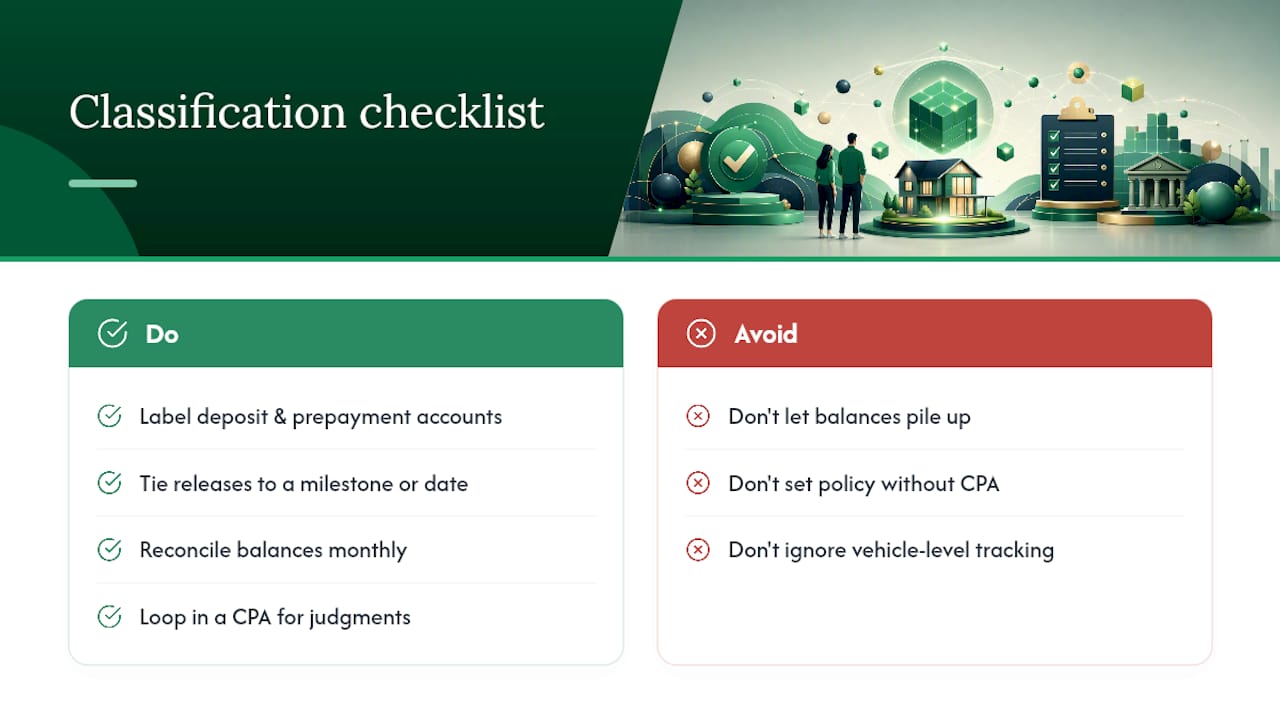
Getting down payment accounting right comes down to discipline, not complexity. Label your deposit and prepayment accounts clearly, tie every release to a specific milestone or delivery date, and reconcile those balances monthly rather than letting them pile up until your accountant asks uncomfortable questions in March. Judgment calls on non-refundable deposits and financing components are exactly where a CPA earns their fee, so loop one in before you set policy on anything unusual.
For dealers specifically, the same discipline applies to every vehicle sitting in inventory, and Loturn’s transaction-level tracking is built around that exact problem, which the next section covers.
— Eric Dosset
How Loturn Keeps Deposit Tracking Clean for Dealers
The software gives you per-VIN tracking on every down payment, so a deposit on a trade-in doesn’t get lost in a general “customer deposits” bucket with other cars in it. Every deposit ties to a specific vehicle, with a native chart of accounts built for dealership accounting rather than a generic small-business template.

That specificity matters at reconciliation time. Instead of digging through bank feeds to figure out which deposit belongs to which deal, The accounting features map deposits and releases directly to inventory records, cutting the manual matching that causes stale liabilities in the first place. Dealers managing paperwork on top of deposits also lean on document management built for auto dealerships to keep the paper trail attached to the right deal. If you’re running deposits through spreadsheets or a generic bookkeeping tool right now, consider trialing software with per-car deposit tracking to see how it looks on your own inventory.
This article is general information, not a substitute for advice from a qualified financial advisor. Consult a qualified financial professional about your own circumstances before acting on anything here.
FAQ
How Do You Record a Down Payment in Accounting?
Record cash received as a debit and the offsetting amount as a credit to a liability account like Customer Deposits if you’re the seller, or as a debit to a prepaid asset account if you’re the buyer paying the deposit.
How Do You Journal a Down Payment?
The seller’s entry is Debit Cash, Credit Customer Deposits; the buyer’s entry is Credit Cash, Debit Vendor Prepayments or Prepaid Expense, with both reversed to revenue or expense only once performance is complete.
What Does Down Payment Mean in Accounting?
A down payment is a partial payment made before a good or service is delivered, recorded as a liability for the party receiving it and a prepaid asset for the party paying it, per standard definitions.
How Do You Record a Deposit Payment in Accounting?
Debit the bank account and credit a liability account such as Customer Deposits or Unearned Revenue, then reclassify that liability to revenue only when you deliver the goods or complete the service.
Does Loturn Track Down Payments for Dealership Inventory?
Yes, Loturn ties deposits and prepayments to individual vehicle records rather than a lump-sum account, which keeps reconciliation tied to specific deals through its per-car profit tracking.