
A mobile inventory audit is a mobile-app inspection that ties VIN-validated physical checks and photos to per-VIN cost assignments so dealers can see true profit on every unit. Done right, it does two things at once: it confirms each vehicle actually exists, where you think it is, in the condition you logged, and it flags exceptions like unapproved spend or missing Buyers Guide forms before they cost you money.
TL;DR:
- Mobile audits should record VINs via scanning, ensure Buyer’s Guide presence, and capture detailed vehicle condition and location data for compliance and profitability.
- Audit frequency must align with lot turnover, with slower lots doing monthly reconciliations and busier sites requiring weekly checks and daily exception scans.
- Assigning costs and tracking changes automatically per VIN streamline profit calculations and reduce manual reconciliation at month-end.
- A true profit-focused audit app includes role-based approval workflows, offline capability, and integration with accounting systems, unlike basic counting tools.
- Conducting regular checks of Buyer’s Guides and immediate routing of exceptions prevent compliance lapses and inventory discrepancies.
Table of Contents
- What belongs in the mobile audit checklist
- Setting the right audit cadence and ownership
- Turning audit entries into per-vehicle profit
- Choosing a mobile audit app that produces finance-grade data
- A runbook you can start this week
- Why audits should work like investment accounting
- Getting mobile audits and per-VIN profit working together
- Where this guidance comes from
- Sources
- FAQ
What belongs in the mobile audit checklist
A lot walk that only counts cars is not an audit; it is a headcount. A defensible mobile audit captures enough detail to support both your books and a compliance review for auto dealer cleaning. At minimum, each entry needs:
- VIN, scanned rather than typed, to avoid transposition errors
- Year, make, model, and trim to confirm identity against title documents
- Odometer reading and a condition note covering visible defects
- Photos of the exterior, interior, and any damage
- Current lot location and inventory status (acquired, in recon, frontline ready, displayed, sold, wholesale)
- Buyers Guide presence and a note on whether it reflects the final price and terms
- Title and document status
- Per-VIN cost entries for purchase, transport, and reconditioning
- Audit date and the name of the person who performed the check
Scanning the VIN instead of keying it in matters beyond data entry speed. The FTC explains that an accurate VIN is how dealers and buyers pull vehicle history and check for open safety recalls, so a wrong digit anywhere in that chain breaks the record it was meant to protect.
Dealers who sell more than five used vehicles in a 12-month period generally must comply with the FTC Used Car Rule, which requires the Buyers Guide to be displayed before a vehicle is offered for sale or opened up for inspection. Build that check into the audit itself, not into a separate paperwork pass, so a missing Guide gets caught the same day a car hits the lot.
Setting the right audit cadence and ownership
Audit frequency should match how fast your lot turns, not a calendar default. A 20-car lot with slow movement can run a full physical reconciliation monthly, while a multi-location dealer with heavy daily traffic needs weekly full counts backed by daily exception scans. Industry guidance on used-vehicle management points the same way: tie audit frequency to lot size, locations, and how actively inventory is financed, rather than applying one frequency everywhere, as the NADA education guide coverage lays out.
A workable structure assigns four roles:
- Field auditor walks the lot with the mobile app and logs VIN, condition, location, and status
- Recon approver reviews flagged cost entries before they post against a vehicle
- Finance reviewer reconciles audit data against the accounting ledger weekly
- Management reviewer reads the audit report alongside turn and gross metrics monthly
Approval gates need a time limit or they become a bottleneck. A same-day SLA on recon approvals keeps cars moving through the process instead of sitting half-reconditioned, and our recon approval workflow guide walks through how to set one up.
Pro Tip: Route every flagged exception to a named owner the moment it is logged, not at the next full reconciliation, so small problems do not compound into aged inventory.

Turning audit entries into per-vehicle profit
The entire point of a mobile audit is feeding the math that tells you what a car is actually worth to you right now. The formula is simple: purchase price plus transport plus reconditioning plus fees equals total investment. Sale price minus total investment equals projected gross. Our real-time gross tracking playbook covers how to keep that number current as costs land.
Audit reports should sit next to a short set of KPIs, not float on their own:
- Inventory turns, since slow-turning stock quietly erodes margin
- Days supply, which flags units approaching your reprice or wholesale threshold
- Net return on inventory investment per vehicle
- Percentage of aged units past your internal cutoff
NADA’s used-vehicle management guidance ties inventory aging and reconditioning cost control directly to profitability, with a turn time often cited as a reasonable benchmark that varies by dealer, according to Driven. A report that only lists what happened is less useful than one that tells you what to do next:
| Report field | What it shows | Action it triggers |
|---|---|---|
| Expected gross | Sale price minus total investment | Hold, reprice, or wholesale |
| Unreconciled spend | Cost entries without an approval | Route to recon approver |
| Buyers Guide status | Present or missing at display | Block display until corrected |
| Days on lot vs. target | Current age against turn goal | Escalate to management review |
Choosing a mobile audit app that produces finance-grade data
Plenty of apps can count cars. Fewer can turn that count into profit visibility. Prioritize these capabilities when you evaluate or configure one:
- VIN scanning rather than manual entry
- Photo capture tied to each VIN record
- Per-VIN cost assignment for purchase, transport, and recon
- A built-in Buyers Guide presence check
- Offline mode for lots with weak signal
- An audit trail showing who changed what and when
- Role-based approvals so cost entries require sign-off
- Integration or export to your accounting or DMS system
Configuration matters as much as feature selection. Make VIN, odometer, and cost fields mandatory before a record saves, set a dollar threshold above which recon spend needs approval, and schedule full reconciliations automatically rather than relying on someone to remember. The most common product gap is an app that produces a tidy count with no audit trail and no cost assignment, which leaves you with inventory numbers but no profit picture. Our dealership audit trail guide covers what to log and why it matters when numbers get questioned later.
A runbook you can start this week
You do not need a new system to start running better audits, just a sequence:
- Run a nightly or weekly exception scan for missing VINs, duplicate records, and unapproved spend, and fix what you find immediately.
- Do a weekly frontline readiness check on displayed units, confirming the Buyers Guide is present and current.
- Run a full physical reconciliation monthly, matching every VIN on the lot against your records and reconciling cost entries per vehicle. The recon cost tracking guide breaks down how to assign those costs correctly.
- Hold a monthly management review using the audit report to decide which units to reprice, wholesale, or push through recon faster based on expected gross and days on lot.
Each step feeds the next. Skip the weekly exception scan and the monthly reconciliation turns into a much bigger cleanup job.
Why audits should work like investment accounting

Most dealers treat a lot walk as a counting exercise. It should work more like a quarterly portfolio review, because every vehicle on your lot is capital you have tied up and are waiting to recover with a margin. A car sitting past its turn target is not just old inventory, it is a return that is shrinking by the day, and an audit that does not say so in plain numbers is not doing its job.
The dealers who get the most out of mobile audits are the ones who treat per-VIN costing and audit trails as part of the same system, not two separate chores. That is the thinking behind how Loturn structures its mobile app and onboarding, assigning recon and transport costs to a VIN the moment they occur rather than reconstructing them at month-end.
— Eric Dosset
Getting mobile audits and per-VIN profit working together
Loturn builds the mobile side of inventory audits directly into the same system that tracks cost and profit per vehicle, so a VIN scan on the lot and a recon invoice in the office land in the same record instead of two spreadsheets you have to reconcile by hand.
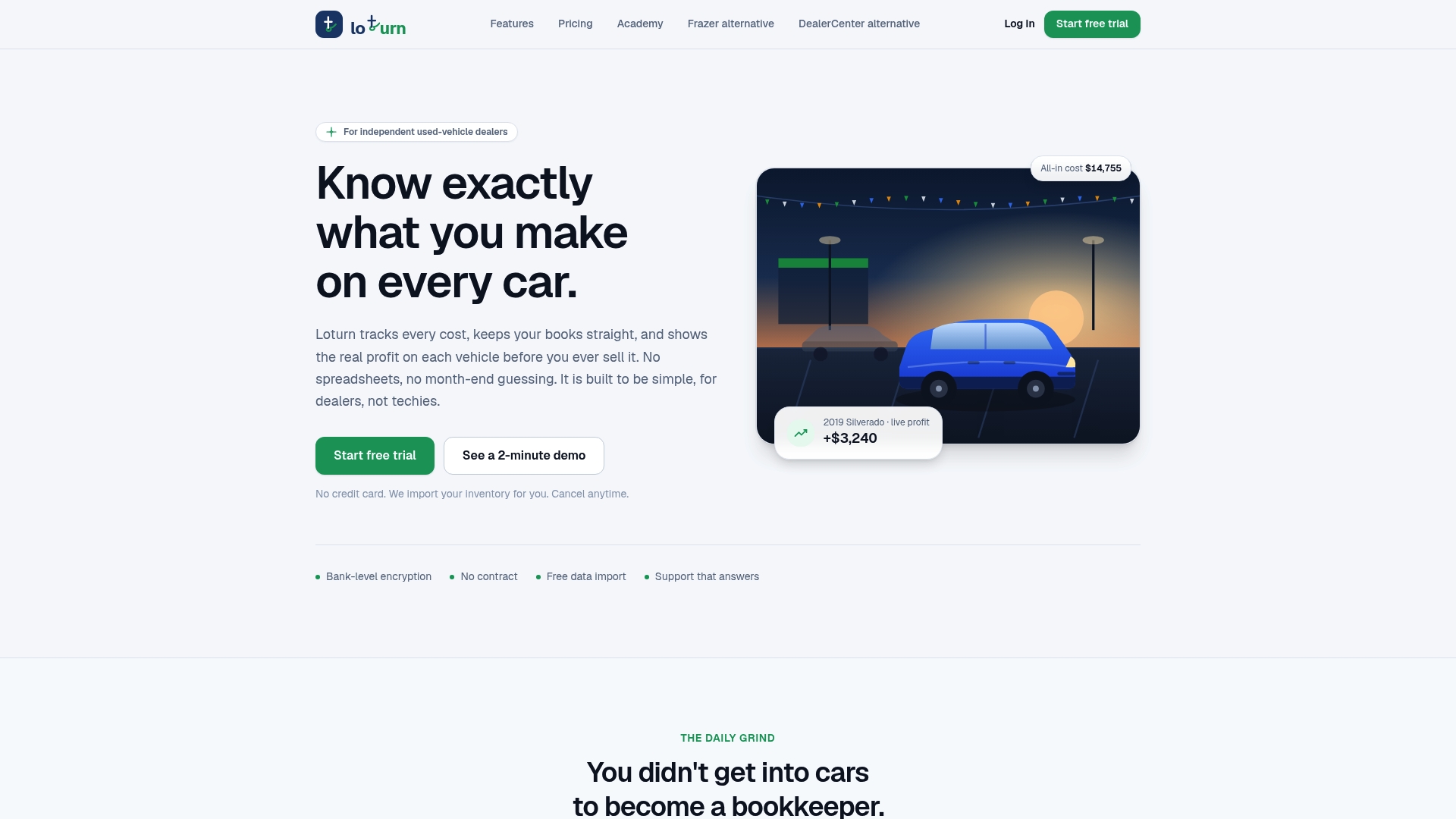
What that looks like day to day:
- Scan a VIN and log condition, location, and status from a phone, with photos attached to the record
- Assign purchase, transport, and recon costs to that same VIN as they happen
- See an audit trail of who logged or changed an entry and when
- Get a Buyers Guide status flag before a car goes on display
- Export or sync audit and cost data to your accounting setup
- Get data import and setup assistance, with data encryption for security
The result is a faster monthly reconciliation and a profit number per car you can trust without a side calculation. If your current process produces a count but not a profit picture, our accounting features page shows how the pieces connect, and the pricing page lists the Flipper, Dealer, and Multi-Lot plans so you can see which fits your lot size before you start a trial.
Where this guidance comes from
These sources back the compliance and operational points above and are worth bookmarking if you are building or auditing your own checklist.
- The FTC’s dealer guide to the Used Car Rule explains who must comply and when the Buyers Guide must be displayed.
- The fillable Buyers Guide form and the plain-language PDF version show the required wording and formatting.
- The FTC’s consumer guidance on used cars covers VIN accuracy and recall checks.
- NADA’s Driven guidance ties inventory turn and reconditioning control to profitability.
Sources
- Dealer’s Guide to the Used Car Rule | Federal Trade Commission
- Buyers Guide (Fillable form) | Federal Trade Commission
- Buyers Guide (fillable PDF) | Federal Trade Commission
- Driven (NADA) — Used-vehicle management and inventory analysis
- Used cars (consumer feature) | Federal Trade Commission
FAQ
What is a mobile inventory audit at a car dealership?
It is a phone or tablet-based check where staff scan each vehicle’s VIN, log condition, location, and status, and attach cost entries for purchase, transport, and reconditioning. The goal is a record accurate enough to support both your per-vehicle profit calculation and a compliance review.
How often should a dealer run a full inventory audit?
Cadence depends on lot size and how fast inventory moves, with smaller, slower lots managing on a monthly full reconciliation and busier multi-location dealers needing weekly counts backed by daily exception checks, per NADA-aligned guidance. Short exception scans between full audits catch problems like missing VINs or unapproved spend before they compound.
Does the Buyers Guide need to be checked during every audit?
Yes. Under the FTC Used Car Rule, the Buyers Guide must be displayed before a vehicle is shown or offered for sale, so it should be verified as part of the same mobile check that confirms condition and location rather than handled separately.
How does audit data turn into per-vehicle profit numbers?
Total investment is purchase price plus transport plus reconditioning plus fees, and projected gross is sale price minus that total investment. Platforms like Loturn assign those costs to the VIN as they occur, so the profit figure updates automatically instead of requiring a manual reconstruction at month-end.
What features separate a real audit app from a basic counting app?
A finance-grade audit app assigns costs per VIN, keeps an audit trail of who changed what and when, and requires role-based approval before cost entries post. An app that only produces a vehicle count without those features leaves you with inventory numbers but no reliable profit picture.